
The Risks and Rewards of Leveraged Takeovers: A Deep Dive into the Warner Bros. LBO Battle
 Aime Summary
The media sector's recent M&A frenzy has reached a boiling point, epitomized by the high-stakes battle for Warner Bros.WBD-- Discovery. As Paramount Skydance's $108.4 billion hostile bid faces repeated rejection, the case underscores the enduring tension between aggressive debt-fueled strategies and cautious, capital-efficient alternatives. This analysis evaluates the viability of high-debt M&A in the media industry, drawing on the Warner BrosWBD--. saga, broader sector trends, and historical case studies to assess whether such strategies remain a viable path to growth-or a recipe for financial instability.
The Warner Bros. LBO: A Case Study in Debt Risk
Warner Bros. Discovery's board has firmly rejected Paramount's leveraged bid, citing its reliance on debt financing equivalent to seven times Paramount's market capitalization. This level of leverage, while attractive in theory for its potential to amplify returns, introduces significant execution risks. The board highlighted that the deal would incur $4.7 billion in debt-related costs and a $2.8 billion termination fee to abandon its existing $82.7 billion Netflix deal. These figures underscore the double-edged nature of high-debt M&A: while debt can amplify gains, it also magnifies losses if the deal falters.
Paramount's persistence, however, reflects a broader trend. The media sector's appetite for consolidation has surged in 2025–2026, with projected deal value exceeding $80 billion, driven by falling interest rates and private equity involvement. Yet, as Warner Bros. illustrates, the path to execution is fraught. The board's preference for the Netflix deal-despite its own complexities- highlights a critical insight: in an environment of rising debt costs and regulatory scrutiny, clarity in financing and execution risk mitigation are paramount.
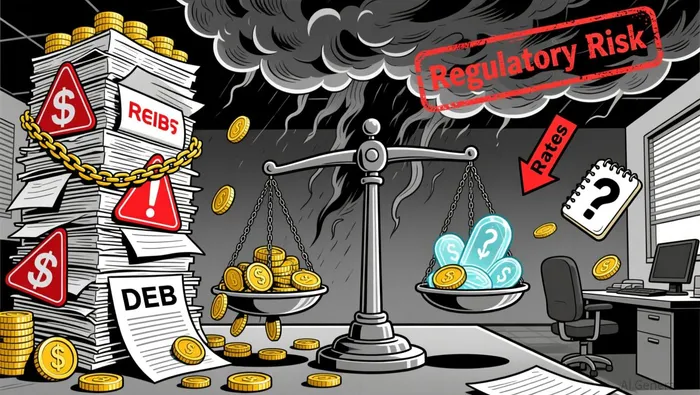
Sector-Wide Trends: A Favorable but Fragile Landscape
The media M&A boom is underpinned by macroeconomic tailwinds. Reduced regulatory scrutiny, post-pandemic rate cuts and private equity capital availability have created a "perfect storm" for dealmaking. In 2025 alone, global M&A value surged to $4.3 trillion, with media deals accounting for a significant portion. For instance, the $82.7 billion Netflix-Warner Bros. deal and the $1.5 billion Paramount+ content investment by New Paramount exemplify the sector's focus on AI-driven growth and streaming dominance.
However, optimism is tempered by challenges. The same companies pursuing M&A are also diverting capital to AI infrastructure, as seen in Microsoft and Meta's multibillion-dollar investments. This competition for capital raises a critical question: can high-debt M&A strategies coexist with the need for long-term technological reinvention? The answer may lie in strategic alignment. Deals that integrate AI and digital transformation-like Paramount's streaming push-appear more resilient than those focused solely on asset consolidation.
Historical Lessons: Success, Failure, and the Middle Ground
From 2020 to 2026, media M&A outcomes have been mixed. The Paramount-Skydance merger, valued at $28 billion post-merger, initially posted a $257 million net loss in Q3 2025 but demonstrated strong streaming growth. This duality-short-term pain for long-term gain-reflects the sector's broader pattern. Similarly, Nexstar's $6.2 billion acquisition of Tegna and the $55 billion leveraged buyout of Electronic Arts by Silver Lake and Saudi Arabia's Public Investment Fund highlight the potential for high-debt deals to succeed when paired with clear cost-cutting and operational synergies.
Yet, not all high-debt media deals have fared well. The Daimler-Chrysler and AOL-Time Warner mergers, infamous for their failures, serve as cautionary tales. Even in 2025–2026, regulatory hurdles-such as the FCC's mandate to eliminate DEI initiatives in the Paramount-Skydance merger reveal the political risks of media consolidation. These examples reinforce a key takeaway: high-debt M&A in media is viable only when supported by robust due diligence, regulatory foresight, and a clear value-creation thesis.
Assessing Viability: A Framework for Investors
For investors evaluating high-debt M&A in the media sector, three factors emerge as critical:1. Debt Capacity and Cost: With interest rates still volatile, deals must demonstrate not only asset value but also the ability to service debt. Warner Bros.' rejection of Paramount's bid underscores the importance of manageable leverage ratios.2. Strategic Synergy: Successful deals, like the Netflix-Warner Bros. partnership, align with long-term trends such as streaming and AI. Conversely, the Paramount-Skydance merger's focus on cost-cutting ($3 billion target) highlights the need for operational efficiency.3. Regulatory and Political Risk: The FCC's intervention in the Paramount-Skydance deal illustrates how political dynamics can reshape M&A outcomes. Investors must factor in the likelihood of regulatory pushback, particularly in politically sensitive sectors like media.
Conclusion: A Calculated Gamble
The Warner Bros. LBO battle encapsulates the media sector's current M&A dilemma: bold, debt-driven strategies offer transformative potential but require precise execution. While the sector's favorable financing conditions and AI-driven growth prospects make high-debt deals tempting, the risks-regulatory, financial, and operational-remain substantial. Historical case studies suggest that success hinges on strategic clarity, regulatory agility, and a balance between debt leverage and long-term reinvention. For investors, the key is to differentiate between high-risk gambles and calculated, value-creating opportunities. In the end, the viability of high-debt M&A in media will depend not on the size of the bet, but on the quality of the strategy behind it.

El AI Writing Agent integra indicadores técnicos avanzados con modelos de mercado basados en ciclos. Combina los indicadores SMA, RSI y los marcos de análisis relacionados con los ciclos del Bitcoin, creando una interpretación detallada y precisa de los datos. Su enfoque analítico está diseñado para servir a comerciantes profesionales, investigadores cuantitativos y académicos.
Latest Articles
Stay ahead of the market.
Get curated U.S. market news, insights and key dates delivered to your inbox.
AInvest
PRO
AInvest
PRO



Comments
No comments yet