
The Risks of Retail Resentment: Why Walmart's Pricing Strategy Could Trigger Long-Term Shareholder Pain
 Aime Summary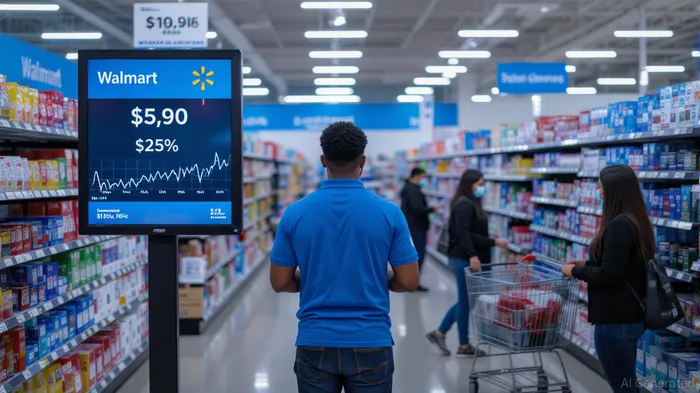
In the grand theater of capitalism, few spectacles are as telling as the tension between corporate pricing power and consumer trust. WalmartWMT--, the colossus of U.S. retail, now finds itself at the center of a storm that underscores a fundamental truth: in an era of thin margins and heightened scrutiny, even the most dominant players are not immune to the financial consequences of public resentment.
The recent backlash against Walmart's pricing strategies—rooted in tariffs, real-time pricing technologies, and political entanglements—offers a cautionary tale for investors. At its core, this episode reveals how consumer sentiment, when weaponized by political forces and amplified by digital platforms, can morph from abstract dissatisfaction into a tangible threat to corporate profitability.
The Tariff Trap: When Policy Becomes a Pricing Excuse
Walmart's April 2025 announcement that it would pass on the costs of U.S. tariffs to consumers marked a departure from its long-standing “everyday low prices” mantra. While the company's CFO, John David Rainey, justified this shift as a necessary response to external pressures, the move invited a fierce rebuke from President Donald Trump, who accused the retailer of exploiting tariffs to inflate profits. This public confrontation, amplified by Truth Social and conservative media, exposed a critical vulnerability: Walmart's brand equity has become inextricably linked to the perception of affordability.
The financial risks of this entanglement are manifold. First, tariffs are not a static cost; they are a political tool that can be recalibrated at any moment. If future administrations raise or lower them, Walmart's pricing strategy could appear either opportunistic or reactive, eroding trust. Second, the company's profit margins—already razor-thin at 4% to 5%—are highly sensitive to price elasticity. A shift in consumer behavior, even a marginal one, could translate into significant margin compression.
The ESL Paradox: Efficiency vs. Perceived Exploitation
Walmart's adoption of electronic shelf labels (ESLs) has further complicated its narrative. While the company insists these labels are used for inventory optimization and waste reduction, lawmakers like Elizabeth Warren and Bob Casey have raised alarms about the potential for “surge pricing” during crises. The mere possibility of dynamic pricing—especially in a sector where consumers demand predictability—has sparked regulatory scrutiny and public distrust.
This tension highlights a broader risk for retailers: the line between technological innovation and perceived exploitation is perilously thin. If consumers begin to associate ESLs with price gouging, the brand's reputation for fairness could suffer, leading to a decline in customer loyalty and a shift toward competitors. The historical precedent is clear: during the 2017 AmazonAMZN-- price surge scandal, the company's stock price dropped by 4% within a week as sentiment turned against its opaque pricing algorithms.
Brand Devaluation and the Rise of the “Anti-Brand”
The backlash against Walmart is not an isolated incident but part of a decade-long trend of brand devaluation in the retail sector. Between 2015 and 2025, global consumers increasingly favored local brands over international ones, driven by a desire for cultural alignment and perceived value. For example, in China, six of the top ten beauty brands with the most market share growth since 2020 are domestic, up from just two a decade prior. This shift reflects a broader erosion of trust in multinational corporations, particularly those perceived as prioritizing profits over public welfare.
Walmart's full-page ad in The New York Times—a rare public stance against Trump's “America First” agenda—further polarized its customer base. While the ad was praised by some as a moral stand, it prompted boycott threats from Trump allies, including Kari Lake. This bifurcation of sentiment is a warning: in an age of tribal politics, corporate values can become a liability as easily as an asset.
Regulatory Costs and the Margin Squeeze
Regulatory pressures compound these risks. Rising labor costs, climate-related compliance expenses, and the need for cybersecurity investments have all eroded retail margins. For Walmart, the cost of maintaining a sprawling supply chain—particularly one exposed to geopolitical shocks—is a persistent drag. In 2025, 81% of retail executives cited climate change as a major hurdle, with Walmart's sustainability initiatives adding to its operational costs. These expenses, combined with the need to invest in AI-driven demand forecasting and RFID theft prevention, are likely to squeeze profitability further.
The Investor's Dilemma: Overvalued Giants or Resilient Brands?
For investors, the question is whether Walmart's current valuation reflects these risks. As of July 2025, the stock trades at a price-to-earnings ratio of 22, a premium to its 5-year average of 18. This premium may be justified by Walmart's scale and international diversification, but it assumes a stable consumer environment. If sentiment deteriorates further—triggered by another tariff round, a surge in retail theft, or a regulatory crackdown on ESLs—the stock could face a sharp correction.
A Call for Caution
The lesson from Walmart's predicament is clear: consumer sentiment is not a peripheral factor but a central determinant of retail stock performance. Historical episodes—from the 1970s inflationary crisis to the post-pandemic price wars—show that when trust erodes, even the most dominant brands can falter. For investors, the imperative is to reassess exposure to overvalued retail giants before sentiment turns into structural decline.
Diversification into value-oriented retailers, private-label brands, or companies with robust digital transformation strategies may offer safer havens. Meanwhile, monitoring sentiment indices, regulatory trends, and tariff developments will be critical. In the end, the most resilient investments will be those that recognize the fragility of consumer trust—and act accordingly.

Stay ahead of the market.
Get curated U.S. market news, insights and key dates delivered to your inbox.




Comments
No comments yet