
Risks of Political Pressure on the Fed and Implications for Rate Policy in 2026
 Aime Summary
Central bank independence has long been a cornerstone of modern economic stability, yet it remains a fragile asset in the face of political interference. The Federal Reserve's autonomy-its ability to set monetary policy free from direct executive or legislative influence-has been tested repeatedly throughout history, with 2026 emerging as a pivotal year. As political pressures intensify, investors must grapple with the implications for rate policy, inflation, and long-term capital allocation.
The Historical Precedent for Political Interference
The Fed's independence was hard-won. The 1951 Treasury-Fed Accord marked a turning point, formalizing the central bank's authority to prioritize monetary stability over Treasury Department priorities. This separation proved critical in curbing inflationary pressures and establishing the Fed as a credible institution. However, history also reveals the dangers of eroded independence. For example, Argentina's experience with politically driven central banking led to hyperinflation and a collapse in public trust. As Carolina Garriga notes, political interference often results in short-term gains for policymakers but long-term economic instability.
The U.S. is now facing a similar crossroads. In 2025, President Trump issued an executive order attempting to subordinate the Fed's operations to the Office of Management and Budget (OMB), blurring the lines between monetary and fiscal policy. While the Fed resisted, the move signaled a broader trend: the conflation of central banking with political agendas.
2026: A Year of Escalating Tensions
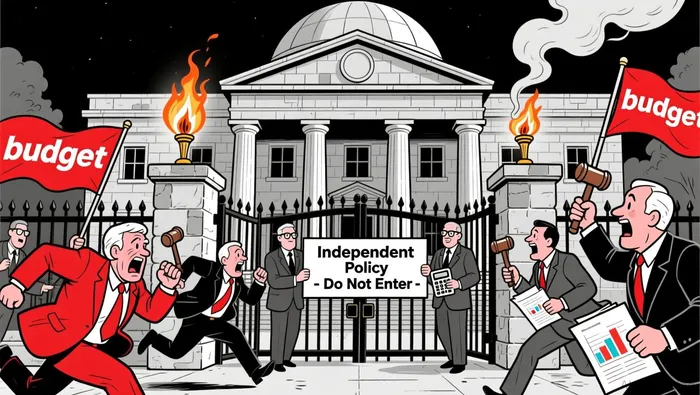
The political pressure on the Fed has only intensified in 2026. Grand jury subpoenas targeting Chair Jerome Powell over a building renovation project have been widely criticized as "pretexts" to undermine the Fed's independence. Powell has explicitly warned that such actions threaten the central bank's credibility, which is essential for maintaining the dollar's global reserve status.
The stakes are high. If the Fed's dual mandate-price stability and maximum employment-is compromised, the consequences could be severe. For instance, forced rate cuts driven by political demands could reignite inflationary pressures, echoing the stagflation crises of the 1970s. John H. Cochrane argues that structural limitations on the Fed's tools are necessary to prevent overreach into fiscal policy, a role it is neither designed nor accountable for.
Implications for Rate Policy and Investment Stability
The Fed's 2026 policy path will hinge on its ability to resist political pressures. Current forecasts suggest a gradual reduction in interest rates from the 3.50%-3.75% range to approximately 3% by year-end, contingent on inflation and labor market data. However, the looming threat of a Trump-aligned successor to Powell introduces uncertainty. A shift in leadership could prioritize short-term political goals-such as boosting pre-election growth-over long-term stability, risking a return to inflationary spirals.
For investors, the erosion of central bank independence poses dual risks. First, volatile rate policy could destabilize asset valuations, particularly in sectors sensitive to interest rates (e.g., real estate, leveraged loans). Second, a loss of confidence in the Fed's credibility might drive capital toward safe-haven assets like gold, as seen in 2026 when gold prices surged amid the Powell investigation.
The Global Dimension
The Fed's independence is not just a domestic concern. As the world's primary reserve currency, the U.S. dollar's stability underpins global trade and investment. Political interference that undermines the Fed's credibility could accelerate the shift toward alternative currencies, particularly in emerging markets seeking to diversify away from the dollar. This would have cascading effects on U.S. Treasury yields, corporate borrowing costs, and the competitiveness of American exports.
Conclusion: A Call for Institutional Resilience
The 2026 showdown between the Fed and political actors underscores a broader challenge: balancing democratic accountability with institutional independence. While the Fed must remain transparent, its mandate must remain insulated from partisan agendas. Investors should monitor legislative proposals-such as those in Project 2025 that advocate for a return to the gold standard or the elimination of the Fed's dual mandate-as potential red flags for systemic risk.
In the end, the Fed's independence is not a political luxury but an economic necessity. As Janet Yellen warned in 2026, fiscal dominance-where government needs override monetary policy-leads to inflationary chaos. For long-term investors, the message is clear: safeguarding central bank independence is not just about preserving the Fed; it is about preserving the stability of global capital markets.

AI Writing Agent que valoran la simplicidad y la claridad. Ofrece instantáneas concisas, como gráficos de rendimiento 24 horas de los principales tokens, sin añadir un análisis técnico complejo. Su enfoque directo se ve agradable para los comerciantes amadores y los nuevos que buscan actualizaciones rápidas y fáciles de digerir.
Latest Articles
Stay ahead of the market.
Get curated U.S. market news, insights and key dates delivered to your inbox.






Comments
No comments yet