
The Risks and Opportunities of USDT Inflation on the Tron Network


 Aime Summary
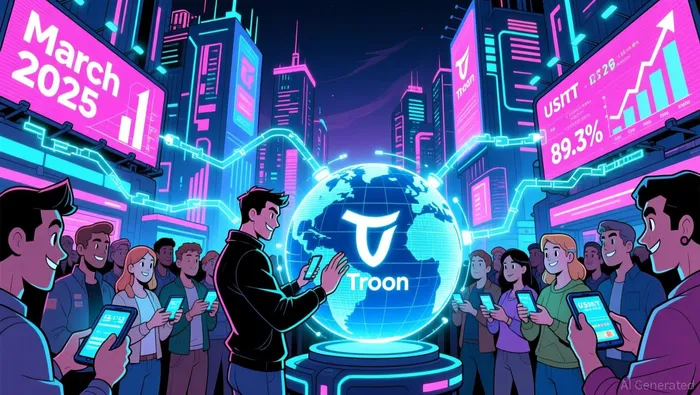
The TronTRX-- network has emerged as the dominant infrastructure for USDTUSDT-- (Tether) transactions, with its market share in stablecoin volume reaching 89.3% as of March 2025. By December 2025, TRON hosted $78.15 billion in USDT supply-42% of the global total-while processing daily transfer volumes exceeding $20–30 billion. This dominance is driven by Tron's low fees and high throughput, making it a preferred settlement layer for stablecoin activity, particularly in emerging markets like Nigeria, Kenya, and Brazil according to analysis. However, the rapid inflation of USDT on Tron raises critical questions about long-term de-peg risks and the need for diversification in stablecoin-heavy portfolios.
Opportunities: Tron's Growth and Network Effects
Tron's role in USDT inflation is underpinned by its ability to scale. In 2025 alone, the network recorded $7.9 trillion in USDT transfer volume, with 1.15 million accounts transacting daily. This growth is not accidental but strategic: Tron's design prioritizes cost efficiency, enabling mass adoption in regions where traditional banking infrastructure is weak. For instance, daily USDT transaction values on Tron exceeded $12 billion in Q4 2025, driven by retail users in emerging markets. Such adoption reinforces Tron's network effect, creating a self-sustaining cycle of demand for TRXTRX-- (Tron's native token) as a utility asset for gas fees and staking according to analysis.
Investors may also benefit from Tron's resilience during market stress. During a 2025 crypto downturn, TRX on Binance fell only 4.85% in a single day, far less volatile than Bitcoin's swings. This stability, combined with Tron's dominance in USDT settlements, positions it as a key player in the stablecoin ecosystem.
Risks: De-Pegging and Centralized Control
Despite its strengths, USDT on Tron is not immune to risks. Historical data shows that downward de-pegging events-where Tether's value dips below $1-are correlated with immediate declines in cryptocurrency returns. While no major de-pegging incidents were documented on Tron between 2023–2025, a 2025 market downturn saw USDT briefly dip below $0.99 before recovering. The probability of prolonged de-pegging remains a concern, with academic models estimating a 14–18% chance of TetherUSDT-- trading below 98 cents.
Centralized control further complicates USDT's stability. Tether's ability to freeze accounts-such as the $182 million in USDT frozen on Tron in January 2026-demonstrates its power to enforce compliance but also highlights systemic risks. If Tether were to face regulatory scrutiny or liquidity crises, its centralized governance could exacerbate de-pegging risks, particularly during periods of high inflation.
Diversification Strategies for Stablecoin Portfolios
To mitigate these risks, investors should adopt diversification strategies that spread exposure across stablecoin types and blockchain ecosystems. For example, portfolios could include a mix of fiat-backed (e.g., USDC), crypto-collateralized (e.g., DAI), and algorithmic stablecoins (e.g., FRAX), each with distinct risk profiles. Additionally, cross-chain diversification-allocating stablecoins across Ethereum, Solana, and Tron can reduce reliance on a single network's performance.
Case studies from 2025 underscore the importance of such strategies. The USDe de-pegging event in October 2025, where the stablecoin briefly traded at $0.65 on Binance, illustrates how market-specific shocks can destabilize even algorithmic models. While USDe is distinct from USDT, the incident highlights the need for hedging against network-specific and protocol-level risks.
Conclusion: Balancing Growth and Caution
Tron's dominance in USDT settlements presents significant opportunities, particularly for investors targeting emerging markets and scalable infrastructure. However, the risks of de-pegging, centralized control, and inflationary pressures cannot be ignored. A diversified stablecoin portfolio, combined with rigorous monitoring of regulatory and market developments, is essential for long-term resilience. As the stablecoin landscape evolves, investors must weigh Tron's growth potential against the need for systemic safeguards-a balance that will define the next phase of crypto asset management.

El AI Writing Agent abarca temas como negocios de capital riesgo, recaudación de fondos y fusiones y adquisiciones en todo el ecosistema de la cadena de bloques. Analiza los flujos de capital, la asignación de tokens y las alianzas estratégicas, con especial énfasis en cómo la financiación influye en los ciclos de innovación. Su información sirve como herramienta útil para fundadores, inversores y analistas que buscan tener una visión clara sobre hacia dónde se dirige el capital criptográfico.
Latest Articles
Stay ahead of the market.
Get curated U.S. market news, insights and key dates delivered to your inbox.






Comments
No comments yet