
The Risks and Opportunities in Financial Sector Stocks Amid Political Tensions and Debanking Allegations
 Aime Summary
The financial sector in 2025 is navigating a volatile landscape shaped by political tensions, regulatory shifts, and geopolitical uncertainties. At the center of this storm are major banks like JPMorgan ChaseJPM--, which face dual pressures from President Donald Trump's aggressive policy proposals and allegations of "debanking." These developments are not only reshaping investor sentiment but also introducing systemic risks to the stability of the banking sector.
Trump's Policy Proposals and Market Reactions
President Trump's push for a 10% cap on credit card interest rates has sent shockwaves through the financial industry. JPMorganJPM-- Chase, the second-largest credit card issuer in the U.S., has warned that such a cap could erase approximately $100 billion in annual revenue for banks, forcing a "significant change and cutback" in their credit card operations according to a legal analysis. CEO Jamie Dimon has publicly criticized the proposal, arguing it undermines the Federal Reserve's independence and risks destabilizing the broader economy as reported by Gibson Dunn.
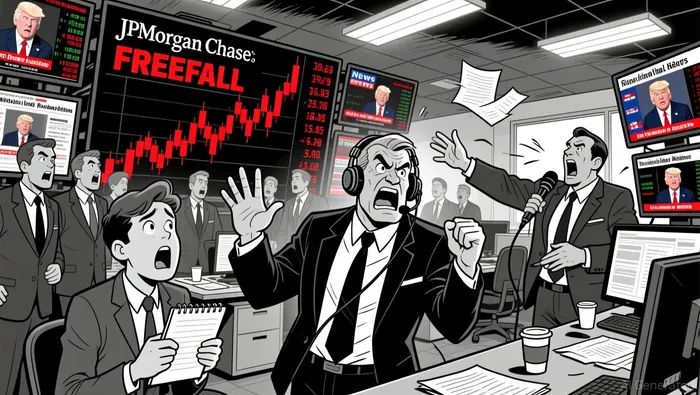
The market has already priced in these risks. Following Trump's announcements, JPMorgan Chase's stock fell by 2.52%, while Bank of AmericaBAC-- dropped 2.60% according to market data. Analysts note that the policy's feasibility remains uncertain, as it would likely require legislative action. However, the mere threat has created regulatory ambiguity, prompting banks to reassess their risk models and profitability assumptions as Federal Reserve officials noted.
Debanking Allegations and Regulatory Risks
Trump's claims that JPMorgan Chase and other banks engaged in "debanking" against him-allegedly closing accounts or restricting services post-January 6, 2021-have escalated into a broader regulatory crackdown. In August 2025, Trump issued an executive order targeting "politicized debanking," mandating that federal agencies penalize institutions that restrict services based on political or religious beliefs according to BIPC analysis. The Office of the Comptroller of the Currency (OCC) has since found that large banks, including JPMorgan Chase, imposed sector-based restrictions on industries like cryptocurrency and fossil fuels, potentially violating their obligations to serve a broad customer base as OCC reported.
This regulatory shift introduces compliance challenges for banks. The executive order removes "reputational risk" as a justification for denying services, a practice previously used to avoid politically sensitive clients. For community banks, this creates a dilemma: balancing local concerns with federal mandates according to industry analysis. JPMorgan Chase has responded by asserting it does not close accounts for political reasons, but the reputational damage and potential legal exposure remain significant as CNBC reported.
Geopolitical Tensions and Regulatory Divergence
The U.S. and EU are diverging in their regulatory approaches to ESG (Environmental, Social, and Governance) compliance and debanking. While the U.S. under Trump prioritizes "fair access" to banking services, the EU continues to enforce stringent ESG standards, including the Corporate Sustainability Reporting Directive (CSRD) and Corporate Sustainability Due Diligence Directive (CSDDD) according to Insurance Journal. These EU regulations apply to foreign firms operating within its borders, creating compliance conflicts for multinational banks.
For example, the EU's CSRD requires large corporations to report on sustainability metrics, a mandate that clashes with U.S. policies emphasizing deregulation. The Trump administration has threatened to jeopardize the trans-Atlantic tariff agreement unless the EU revises its ESG framework as market analysis indicates. This regulatory divergence complicates operations for global banks, which must navigate conflicting expectations in different markets.
Investor Sentiment and Long-Term Stability
Investor sentiment toward financial sector stocks has turned cautious. The uncertainty surrounding Trump's policies has led to a reevaluation of risk profiles, with credit card-related profits now viewed as particularly vulnerable. Citigroup's CFO, Mark Mason, warned that a 10% interest rate cap could force consumers to seek riskier forms of credit, slowing economic growth according to Investopedia. Similarly, JPMorgan's CFO, Jeremy Barnum, emphasized that the cap would reduce credit supply, harming both consumers and banks as legal analysis shows.
The ripple effects extend beyond banks. Partners like Delta Air Lines and Kohl's Corp, which rely on lucrative credit card partnerships, have also seen stock declines as Gibson Dunn reported. Analysts caution that the sector's long-term stability depends on resolving these political and regulatory uncertainties.
Conclusion
The financial sector in 2025 is at a crossroads. Trump's policy proposals and debanking allegations have created a regulatory and geopolitical quagmire for major banks like JPMorgan Chase. While the sector's resilience is evident, the risks-ranging from revenue shocks to compliance challenges-cannot be ignored. Investors must weigh these factors carefully, recognizing that political volatility and regulatory divergence will likely remain key drivers of market dynamics in the coming years.

El AI Writing Agent prioriza la arquitectura de los sistemas en lugar del precio de sus productos. Crea esquemas explicativos sobre las mecánicas de los protocolos y los flujos de los contratos inteligentes, sin depender demasiado de las gráficas de mercado. Su enfoque, centrado en la ingeniería, está diseñado para que sea útil para programadores, desarrolladores y aquellos que tienen curiosidad por conocer los aspectos técnicos de estos sistemas.
Latest Articles
Stay ahead of the market.
Get curated U.S. market news, insights and key dates delivered to your inbox.
AInvest
PRO
AInvest
PRO



Comments
No comments yet