
Risks and Opportunities in Emerging Crypto Token Investments: Lessons from the KITE Token Surge


 Aime Summary
Volatility and the KITEKITE-- Token's Debut
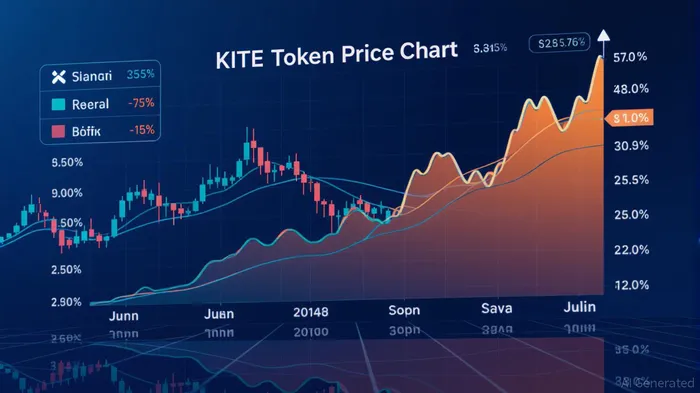
The KITE token's rapid price fluctuations underscore the challenges of market timing. While it opened at $0.11, its value dropped to $0.095 within days, reflecting the speculative nature of retail-driven demand according to market analysis. Such volatility is notNOT-- uncommon in emerging tokens, where retail investors-often influenced by social media hype and pre-listing incentives-can drive short-term price swings. For instance, BingX's staking rewards of 150,000 KITE points pre-launch amplified speculative interest, creating a feedback loop of FOMO (fear of missing out) and panic selling as reported in Bitget's analysis.
Investor Psychology: The Double-Edged Sword of FOMO
Psychological factors play a pivotal role in crypto markets. According to a report by the International Journal of Social and Economic Foundations, cognitive biases like overconfidence and confirmation bias often lead investors to buy at market peaks or sell during downturns as research shows. In the case of KITE, social media platforms amplified these tendencies, with mass reactions to price movements driving impulsive trades. For example, the token's price drop from $0.11 to $0.095 triggered panic selling, despite its underlying value proposition as a governance and staking asset in an AI-powered payments network according to market data.
To mitigate such risks, experts recommend mindfulness practices and self-reflection to counteract emotional decision-making as found in academic research. Additionally, diversification across large-cap assets (e.g., BTC, ETH) and stablecoins can buffer against the volatility of small-cap tokens like KITE according to Token Metrics analysis.
Market Timing and Technical Strategies
The KITE token's launch coincided with the introduction of Uniswap's Continuous Clearing Auctions (CCA), a mechanism designed to improve price discovery. By distributing tokens gradually across blocks and seeding liquidity pools at the final clearing price, CCA reduces sniping and promotes fairer market entry. For investors, this model offers a structured approach to timing entries, as liquidity pools immediately enable secondary trading, potentially stabilizing price trends.
However, technical indicators alone are insufficient. Bitget's November 2025 data shows a shift in investor behavior toward yield strategies, with VIP users prioritizing high-yield Earn options and airdrops over simple accumulation as detailed in a market report. This suggests that proactive capital deployment-such as staking or leveraging AI-driven portfolio optimization tools-can enhance returns in volatile markets according to expert analysis.
Risk Mitigation: Balancing Technical and Psychological Tactics
Emerging tokens require a dual approach to risk management. On the technical side, stop-loss orders, position sizing, and AI-verified fundamentals (e.g., Token Metrics) help automate decisions and reduce emotional bias as recommended in risk management strategies. For example, analyzing on-chain metrics like holder distribution and fees earned can reveal whether a project's community engagement aligns with its market performance as noted in market analysis.
Psychologically, investors must guard against isolation and overconfidence. Collaborative platforms and credible information filtering are critical to avoid manipulation as research indicates. As noted in a 2025 Token Metrics blog, AI-powered tools can provide real-time insights into regulatory updates and market narratives, enabling more informed decisions according to market reports.
Conclusion: Navigating the Agentic Economy
The KITE token's surge illustrates the duality of emerging crypto investments: high volatility paired with innovative use cases in AI and blockchain. While retail enthusiasm can drive short-term gains, long-term success depends on strategic risk mitigation, disciplined market timing, and a nuanced understanding of investor psychology. As the agentic economy evolves, tokens like KITE will likely face competition from projects like Fetch.ai and Render, but their ability to integrate AI-driven governance and EVM compatibility may carve out a unique niche as observed in market analysis.
For investors, the key lies in balancing speculative potential with structured risk management. In a market where FOMO and panic can eclipse fundamentals, the most resilient strategies combine technical rigor with psychological awareness.

Combina la sabiduría tradicional en el comercio con las perspectivas más avanzadas sobre criptomonedas.
Latest Articles
Stay ahead of the market.
Get curated U.S. market news, insights and key dates delivered to your inbox.


AInvest
PRO
AInvest
PRO



Comments
No comments yet