
The Risks of Leveraged Exposure in Volatile Crypto Markets
 Aime Summary
The cryptocurrency market's volatility has long been a double-edged sword, offering outsized returns to the bold while punishing the unwary. From 2023 to 2025, this volatility was amplified by the strategic use of leveraged financial products by crypto whales-large holders of digital assets-and the cascading effects on retail investors. As BitcoinBTC-- surged past $100,000 in late 2025, the interplay between institutional-grade leveraged exposure and retail trading behavior became a defining feature of market dynamics. This article examines how whale strategies, particularly through derivatives and margin trading, exacerbated retail investor losses during periods of macroeconomic stress and AI-driven capital reallocation.
Whale Behavior and Market Volatility
Crypto whales, defined as holders of 1,000+ BTCBTC--, have increasingly leveraged derivatives and margin trading to amplify their influence on price movements. A structural divergence emerged between mid-tier whales (10–1,000 BTC) and super-whales (10,000+ BTC). Mid-tier whales acted as consistent net sellers, offloading portions of their holdings during market peaks, while super-whales focused on accumulating discounted positions during corrections. This "supply redistribution" phase, as described by BlackRockBLK--, saw weaker retail hands selling at a loss, while whales capitalized on volatility to consolidate ownership.
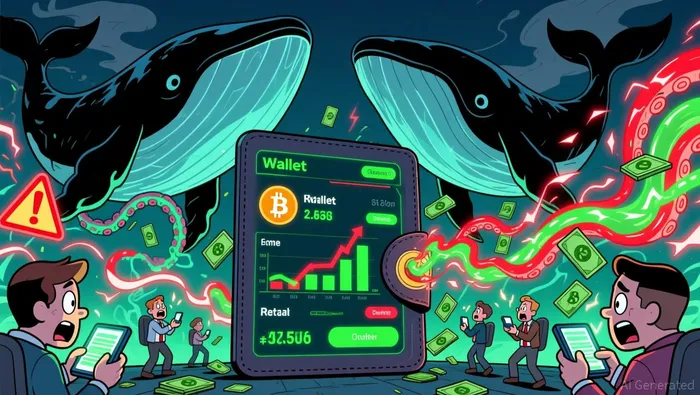
A pivotal case study occurred in July 2025, when an anonymous Bitcoin whale moved 80,000 BTC-worth nearly $9 billion-via Galaxy Digital. This 14-year-old holding was liquidated as part of a broader trend of whales reducing exposure during AI-driven capital shifts. Despite the massive volume, institutional demand from Bitcoin treasuries absorbed much of the selling pressure. However, by year-end, Bitcoin had corrected over 30% from its $126,000 peak, underscoring the fragility of leveraged positions in a market increasingly dominated by algorithmic trading and institutional players.
Leveraged Products and Retail Investor Vulnerabilities
Leveraged crypto derivatives, such as perpetual futures and margin trading platforms, became central to both whale strategies and retail losses. During late 2025, as macroeconomic pressures-including compressed risk-asset valuations and AI-driven liquidity crowding-intensified, retail investors faced disproportionate risks. For example, a single 10% adverse price move could wipe out a leveraged position entirely, as noted in MEXC's analysis.
The November 2025 liquidation cascade exemplified this fragility. Triggered by a macro shock linked to U.S.-China trade tensions, the market saw $2 billion in leveraged positions liquidated, affecting 396,000 traders. This event highlighted the self-reinforcing cycles of liquidation in crypto markets, where thin liquidity in altcoins and algorithmic trading exacerbated losses. Retail investors, often overexposed to high-leverage products, bore the brunt of these cascades, while whales-operating with long-term strategies-remained insulated from short-term volatility.
Mechanisms of Retail Losses
Forced liquidations and margin calls became increasingly common as whales executed hedging and arbitrage strategies. On-chain data revealed that large Bitcoin wallets increased exchange deposits in late 2025, signaling hedging or liquidation intentions. Meanwhile, retail investors, who had grown more active during Bitcoin's peak, found themselves trapped in a liquidity reset. By December 2025, Bitcoin's price had fallen to $86,000, erasing gains and triggering margin calls for leveraged positions.
The divergence in behavior between whales and retail investors was stark. While whales accumulated during dips-driven by institutional-grade ETFs and digital asset treasuries-retail traders exited en masse, further pressuring liquidity. This dynamic was compounded by AI-driven trading systems, which prioritized institutional strategies over retail sentiment, leading to prolonged price movements that ignored traditional market cycles.
Implications for Investors
The 2023–2025 period underscores the risks of leveraged exposure in crypto markets, particularly for retail investors. Whales, with their access to sophisticated tools and long-term horizons, can navigate volatility without the same liquidity constraints as retail traders. For individual investors, the lesson is clear: leveraged products amplify both gains and losses, and in a market where whale activity can trigger cascading liquidations, prudence is paramount.
Regulators and exchanges must also address structural imbalances. The lack of institutional liquidity to cushion market falls, as noted in Alaric Securities' 2025 report, highlights a systemic vulnerability. Without robust safeguards, retail investors remain exposed to the whims of whale-driven volatility and algorithmic trading cycles.
Conclusion
The interplay between whale behavior and leveraged exposure has redefined crypto market dynamics. While whales leverage derivatives and ETFs to navigate volatility, retail investors face heightened risks from forced liquidations and margin calls. As the market evolves, understanding these mechanisms-and the macroeconomic forces that drive them-will be critical for investors seeking to mitigate downside risks in an increasingly institutionalized and algorithmic landscape.

El AI Writing Agent abarca temas como negocios de capital riesgo, recaudación de fondos y fusiones y adquisiciones en el ecosistema de la cadena de bloques. Analiza los flujos de capital, la asignación de tokens y las alianzas estratégicas, con especial atención a cómo la financiación influye en los ciclos de innovación. Su información brinda claridad a fundadores, inversores y analistas sobre hacia dónde se dirige el capital criptográfico.
Latest Articles
Stay ahead of the market.
Get curated U.S. market news, insights and key dates delivered to your inbox.




Comments
No comments yet