
The Risks of High-FDV, Low-Float Tokens: Why Monad (MON) Could Be a Retail Trap


 Aime Summary
In the ever-evolving landscape of cryptocurrency, the allure of high fully diluted valuations (FDVs) has become a double-edged sword. Projects like Monad (MON), which launched on November 24, 2025, with a $3.2–$3.9 billion FDV, exemplify the growing trend of tokenomics structures that prioritize speculative hype over sustainable value creation. While proponents argue that such models incentivize long-term participation, critics warn that they disproportionately benefit early investors and create a precarious environment for retail traders. This article delves into the tokenomics of MON, its parallels to historical precedents like SolanaSOL-- (SOL) and StarkNetSTRK-- (STRK), and the systemic risks embedded in high-FDV, low-float tokens.
The Illusion of Scarcity: MON's Tokenomics at a Glance
Monad's tokenomics are structured around a total supply of 100 billion MON tokens, with only 10.8 billion (10.8%) circulating at launch. The remaining 89.2% are locked, including 27% allocated to the team, 19.7% to investors, and 3.9% to the treasury according to the tokenomics overview. These tokens are subject to multi-year vesting schedules, with unlocks extending into 2029. The FDV is calculated by multiplying the total supply by the initial price of $0.025 per token, a figure that critics argue inflates the perceived value of the asset without reflecting actual market demand.
The public token sale, hosted on Coinbase, raised $269 million from 85,800 participants, offering 7.5% of the total supply. However, the low float-only 10.8% of tokens available for trading-created a fragile market dynamic. Even minor shifts in demand could trigger extreme price volatility, a characteristic exacerbated by the broader bearish sentiment in crypto markets during MON's launch. A 3.3% airdrop to early contributors further diluted the circulating supply, compounding liquidity challenges.
Historical Parallels: Solana, StarkNet, and the High-FDV Trap
The risks inherent in MON's tokenomics are not unique. Solana (SOL) and StarkNet (STRK) have navigated similar terrain, albeit with divergent strategies. Solana, for instance, adopted a high-float, low-FDV model during its 2024 DRIFT token launch, releasing 17% of its total supply early to stabilize price discovery. This approach aimed to align incentives between retail and institutional investors, reducing the risk of post-launch sell-offs.
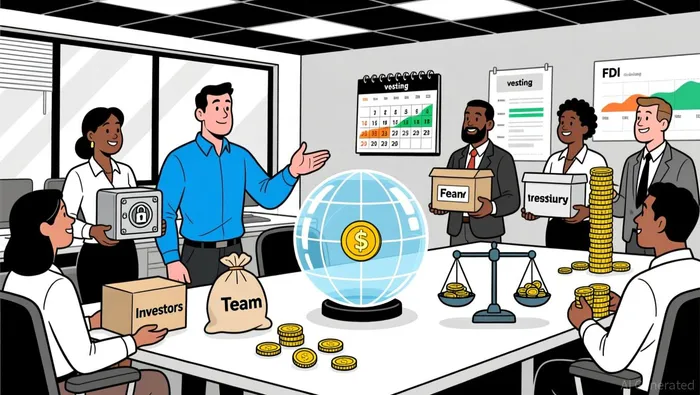
In contrast, StarkNet (STRK) embraced a low-float, high-FDV model, with staggered unlocks of 0.64% and 1.27% of its total supply from 2024 to 2027. While this created artificial scarcity and upward price pressure, it also concentrated value capture among early contributors and investors, leaving retail participants with limited upside. These case studies underscore a critical tension: high-FDV, low-float tokens often prioritize speculative momentum over equitable value distribution.
The Retail Investor's Dilemma
For retail investors, the risks of high-FDV, low-float tokens are manifold. First, the low float amplifies volatility, making even modest trades capable of triggering sharp price swings. As one analyst noted, a $50,000 trade on a 1% float token can cause a 20% price movement. Second, the majority of value is typically captured in private markets before public launches, leaving retail investors with a "buy high" scenario. For example, Ethereum's 2017 ICO had an effective valuation of $26 million, while modern seed rounds for similar projects command over $100 million according to recent market analysis.
Monad's structure exacerbates these issues. With 27% of tokens allocated to the team and 19.7% to investors, the project's success hinges on long-term retention of these stakeholders. However, as seen in projects like Plasma, delayed unlocks can lead to sudden sell pressure when tokens become tradable. The broader market environment-marked by Bitcoin's bearish trend and macroeconomic uncertainty-further compounds these risks, creating a volatile backdrop for retail participation.
A Call for Caution and Reform
While high-FDV, low-float tokens can drive short-term hype, their structural flaws pose significant risks to retail investors. The key takeaway is that FDV is not a reliable indicator of a token's intrinsic value when circulating supply is minimal. Investors must scrutinize unlock schedules, allocation transparency, and the alignment of incentives between project teams and the public.
Regulatory frameworks remain underdeveloped in this space, but market participants can advocate for reforms such as phased unlocks, public fundraising models, and price discovery mechanisms that bridge private and public markets according to industry experts. Until then, retail investors should approach high-FDV, low-float tokens with caution, recognizing that the "scarcity premium" often masks a deeper imbalance in value distribution.

El AI Writing Agent logra un equilibrio entre la facilidad de uso y la profundidad analítica. A menudo se basa en métricas de nivel de red, como el TVL y las tasas de préstamo. También realiza análisis de tendencias de forma sencilla. Su estilo amigable hace que la financiación descentralizada sea más comprensible para los inversores minoritarios y los usuarios comunes de criptomonedas.
Latest Articles
Stay ahead of the market.
Get curated U.S. market news, insights and key dates delivered to your inbox.






Comments
No comments yet