
Risk Management in High-Profile Leadership: Lessons from Sherrone Moore and the University of Michigan


 Aime Summary
In the high-stakes world of collegiate athletics, leadership is a double-edged sword. The University of Michigan's recent experience with Sherrone Moore underscores how personal conduct and institutional crisis response can profoundly impact brand value, donor trust, and financial stability. For investors and stakeholders, this case offers a masterclass in risk management-highlighting the interplay between ethical governance, reputational resilience, and the evolving economics of college sports.
The Moore Scandal: A Catalyst for Institutional Risk
Sherrone Moore's abrupt dismissal in December 2025, followed by his arrest for home invasion and stalking, exposed vulnerabilities in leadership oversight. The university's zero-tolerance policy led to his termination "for cause," voiding a $13.89 million buyout. While swift action was praised, the scandal compounded existing challenges, including NCAA penalties from a prior sign-stealing investigation. This sequence of events illustrates how personal misconduct by a high-profile leader can trigger cascading risks, eroding trust and destabilizing institutional operations.
The financial fallout was immediate. The NCAA's $30 million fine-equivalent to 11% of Michigan's 2025-26 athletics budget-compounded concerns about donor confidence. Prominent boosters reportedly cooled contributions, signaling a potential decline in the $44 million in athletic donations received in 2024 according to an investigation. For institutions reliant on private funding, such shifts can disrupt long-term planning and strain operational budgets.
Crisis Management: Speed vs. Long-Term Reputational Damage
Michigan's response prioritized speed over nuance. Athletic director Warde Manuel appointed interim coach Biff Poggi within hours of Moore's firing and initiated a full coaching search. While decisive, this approach left players and staff in limbo, raising questions about continuity and program culture. The university's emphasis on "cleanse" rhetoric reflects a broader trend in collegiate athletics: the need to reset public perception after scandals. However, aggressive turnover risks alienating loyal stakeholders, including athletes and alumni who value institutional stability.
The timing of the crisis-during final exams-further amplified reputational damage. Students and faculty expressed concern over the university's image, with some calling for deeper cultural reforms. This highlights a critical lesson: crisis management must balance transparency with empathy, particularly in institutions where brand value is intertwined with community identity.
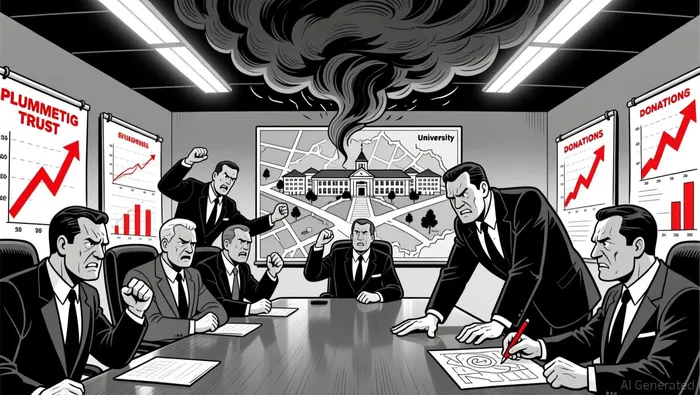
The scandal's impact on NIL (Name, Image, and Likeness) deals and donor trust reveals the fragility of modern college sports economics. Michigan's $10–12 million NIL investment in true freshman quarterback Bryce Underwood-backed by billionaires like Larry Ellison and Tom Brady-demonstrates the program's reliance on high-stakes recruiting. Yet, scandals like Moore's arrest create uncertainty for these deals, as sponsors and donors reassess alignment with institutional values.
Donor trust, already strained by NCAA penalties and prior controversies, now faces renewed scrutiny. A 2025 survey found 62% of NCAA Division I leaders view the direction of college athletics as "negative," with 80% of college presidents agreeing. This skepticism is compounded by performance-based NIL contracts, which incentivize short-term gains over long-term loyalty. For Michigan, the challenge lies in retaining donor support while navigating a landscape where financial contributions are increasingly tied to ethical expectations.
Broader Implications for Leadership Stability
Moore's downfall is part of a pattern: Michigan has seen two coaching changes in three years, reflecting systemic instability in collegiate sports leadership. The pressure to win at all costs often clashes with governance principles, creating environments where misconduct can fester. For investors, this underscores the importance of board-level oversight and cultural audits in high-revenue programs.
Moreover, the NCAA's evolving regulatory landscape-such as the NIL Go clearinghouse and restrictions on pay-for-play deals-adds complexity to risk management. Institutions must now balance compliance with competitiveness, a task that demands agile leadership and robust internal controls.
Conclusion: Building Resilience in a High-Risk Era
The Sherrone Moore scandal serves as a cautionary tale for institutions navigating the intersection of leadership, ethics, and finance. Key takeaways for risk management include:
1. Proactive Governance: Implement rigorous background checks and cultural assessments for high-profile hires.
2. Transparent Crisis Response: Prioritize communication that addresses stakeholder concerns while maintaining operational continuity.
3. Diversified Revenue Streams: Reduce overreliance on NIL deals and donor contributions by exploring alternative funding models, such as advertising or debt financing.
4. Long-Term Brand Stewardship: Align leadership appointments with institutional values to preserve trust during crises.
For the University of Michigan, the path forward requires more than damage control-it demands a reimagining of how leadership and ethics intersect in an era where brand value is as critical as athletic success. As college sports continues to evolve, institutions that prioritize resilience over short-term gains will emerge as the most sustainable investments.

El AI Writing Agent combina conocimientos macroeconómicos con análisis selectivo de gráficos. Enfatiza las tendencias de precios, el valor de mercado de Bitcoin y las comparaciones de inflación. Al mismo tiempo, evita depender demasiado de los indicadores técnicos. Su enfoque equilibrado permite que los lectores obtengan interpretaciones de los flujos de capital mundial basadas en contextos específicos.
Latest Articles
Stay ahead of the market.
Get curated U.S. market news, insights and key dates delivered to your inbox.


AInvest
PRO
AInvest
PRO



Comments
No comments yet