
Rising Yields vs. Growth Stocks: The Tech-Fixed Income Tug-of-War
The bond market's relentless climb in 2025 has thrown equity investors into a dilemma. With the U.S. 10-year Treasury yield now hovering near 4.4%, up 5.5% year-over-year, the cost of capital has surged, forcing a reckoning for growth stocks like NVIDIANVDA-- (NVDA), whose sky-high valuations depend on distant future profits. 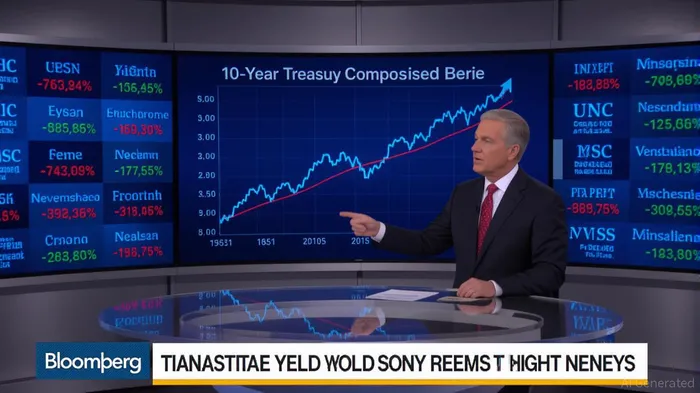 . The math is stark: higher bond yields compress the present value of equity earnings, and with tech stocks trading at premiums based on 10-year growth assumptions, the pain is acute. This isn't just a temporary blip—it's a structural shift in how markets price risk. Let's dissect why the bond market's rise is reshaping equity portfolios and where investors should turn next.
The Current Landscape: Yield Pressure on Growth Stocks
Growth stocks, particularly in the tech sector, have long been the darlings of low-rate environments. When the 10-year Treasury yield languished below 2%, investors were willing to pay a premium for companies like NVIDIA, whose revenue streams are tied to AI adoption decades into the future. But with yields now above 4%, the calculus changes. A simple example: a company valued at 20x its earnings has a 5% required return (1/20). If bond yields rise to 4.4%, the market's “risk-free” rate approaches that hurdle, squeezing the premium investors demand for equity risk. For NVIDIA, which trades at 35x forward earnings, this is a recipe for volatility.
Consider . The correlation is undeniable—every spike in bond yields since early 2024 has coincided with dips in NVDA's share price. The recent $500+ rally in NVIDIA's stock may look impressive, but it's occurring against a backdrop of deteriorating fundamentals: the company's enterprise value-to-research and development spending ratio has hit historic highs, a sign of overvaluation relative to its innovation pipeline.
Historical Precedents: When Yields Rise, Growth Pays the Price
This isn't the first time bond markets have upended equity darlings. In the early 1980s, when the 10-year yield topped 15%, growth stocks were crushed. Even in 2007, as the Fed raised rates to cool the housing bubble, tech stocks like MicrosoftMSFT-- and CiscoCSCO-- saw corrections of 30-40%. More recently, in 2022, the Nasdaq fell 30% as the 10-year yield surged to 4.3%, proving that even in a tech-led economy, rising rates are a threat.
The current environment mirrors these periods. The 10-year yield's 4.4% is still below 1980s peaks, but it's now 30% above its 4.25% long-term average. The Fed's delayed pivot to rate cuts—despite market expectations of three cuts by December—has kept yields elevated. Even if the Fed relents, the damage to growth stocks may already be done. As the saying goes, “Don't fight the Fed,” but in this case, investors should also heed the bond market's warning.
The Fed's Tightrope Walk
The Federal Reserve's dilemma is central to this conflict. While policymakers have paused rate hikes since May 2024, they've kept short-term rates near 5.5% to combat stubborn inflation. This has kept the yield curve stubbornly flat: the 10-year-3-month spread is just 0.02%, signaling caution about future growth. For tech companies, which rely on cheap debt to fund R&D and acquisitions, this is problematic. NVIDIA's $70 billion acquisition of Arm in 2023 was feasible in a low-rate world, but today's borrowing costs make such deals riskier.
Meanwhile, the Fed's communication has been inconsistent. Chair Powell's “higher for longer” rhetoric clashes with market bets on rate cuts, creating uncertainty. This ambiguity has fueled volatility in both bond and equity markets. For investors, the key takeaway is clear: don't bet on a Fed rescue for growth stocks. The era of free money is over.
Strategic Shifts: Dividends and Duration Matter
So where should investors turn? The answer lies in sectors and instruments that thrive in high-yield environments. Dividend-paying stocks in utilities, consumer staples, and healthcare offer steady income that's less sensitive to rate fluctuations. Consider Procter & GamblePG-- (PG), which yields 3% and has a 10-year dividend growth rate of 6%—a stable contrast to NVIDIA's speculative AI bets. Similarly, short-duration bonds (e.g., 2-5 year Treasuries) act as a hedge against equity volatility while offering yields above 4.5%, a compelling “risk-free” return.
For tech investors, the path is narrower. Rotate into companies with tangible earnings and low leverage, like Texas InstrumentsTXN-- (TXN), which derives 60% of revenue from industrial clients insulated from AI hype cycles. Avoid pure-play AI stocks with razor-thin margins, such as C3.ai (AI), whose 2024 revenue growth of 15% pales against its 200x price-to-sales ratio.
Conclusion: Embrace the New Math
The bond market's ascent is rewriting equity valuations, and growth stocks are on notice. While NVIDIA and peers may still innovate, their valuations now demand perfection—a tall order in a world of rising rates and slowing growth. Investors would be wise to pivot to dividend stocks and short-duration bonds, which offer safety without sacrificing returns. The tug-of-war between tech and fixed income isn't just a market story—it's a lesson in risk management. As yields stay stubbornly high, the best offense remains a robust defense.
The data tells the story: defensive plays are outperforming. It's time to adjust portfolios accordingly.

Stay ahead of the market.
Get curated U.S. market news, insights and key dates delivered to your inbox.




Comments
No comments yet