
Rising Whale Activity in Toncoin and Quant: Signals of Institutional Inflow or Market Speculation?


 Aime Summary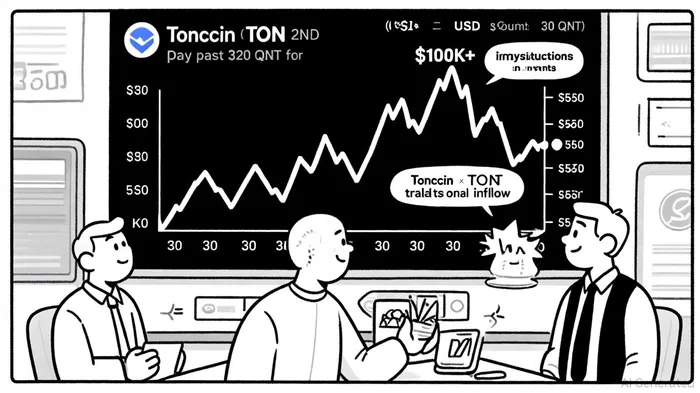
The cryptocurrency market has long treated whale activity as a barometer for institutional interest and speculative fervor. Recent on-chain data for Toncoin (TON) and Quant (QNT) reveals a surge in large transactions, raising questions about whether these movements reflect genuine institutional inflow or short-term speculative bets. By dissecting transaction patterns, technical indicators, and market sentiment, we can assess the validity of these signals.
Toncoin (TON): Institutional Backing or Whale-Driven Hype?
Toncoin has seen a notable uptick in whale activity, with over $100K+ transactions spiking in recent weeks. Santiment notes that such whale movements historically precede price volatility or trend reversals[1]. A single $70 million whale transaction further underscores this trend, suggesting potential institutional involvement[3].
Institutional interest appears to corroborate this narrative. TON StrategyTONX-- Co.'s $558 million private investment vehicle (PIPE) offers a hybrid of staking yields (4.86%) and appreciation, attracting firms like Pantera Capital and Kraken[1]. This capital influx aligns with TON's hybrid treasury model, which has drawn substantial institutional capital. However, TON's price remains range-bound between $3.00 and $3.33, with a 13% monthly decline[2]. While bullish technical indicators like a MACD crossover and rising RSI hint at upward momentum[2], the lack of sustained volume growth raises doubts about the sustainability of this optimism.
Quant (QNT): Mixed Signals in a Consolidating Market
Quant's whale activity mirrors TON's, with large transactions exceeding $100K signaling potential directional shifts[2]. Santiment's analysis links these spikes to historical volatility, though QNT's price remains constrained by key technical levels—resistance at $106.72 and support at $99.50[1].
Institutional inflow data for QNT is less clear. While some reports highlight declining EthereumETH-- outflows to Binance, others suggest QNT's liquidity is stifled by broader altcoin weakness (Bitcoin dominance at 57.63%)[1]. This ambiguity complicates the interpretation of whale activity: Are these transactions driven by long-term conviction or opportunistic trading in a low-liquidity environment?
Market Sentiment and On-Chain Trends
Both projects show correlations between whale activity and on-chain sentiment. TON's weekly transaction volume has risen 32%, with fees climbing as network usage intensifies[2]. For QNT, the lack of similar on-chain growth metrics weakens the case for institutional adoption.
However, market sentiment remains a double-edged sword. TON's historical 15-20% price gains post-whale activity[1] contrast with QNT's stagnant performance, suggesting divergent narratives. While TON's institutional backing and hybrid yield model provide a structural advantage, QNT's reliance on technical breakouts makes it more susceptible to speculative cycles.
Conclusion: Distinguishing Signals from Noise
The surge in whale activity for TON and QNT reflects broader crypto market dynamics. For TON, the alignment of institutional capital, on-chain growth, and bullish technicals points to a plausible breakout scenario—if volume and sentiment sustain. QNT, meanwhile, remains trapped in a consolidation phase, where whale movements may signal short-term speculation rather than long-term conviction.
Investors should approach these signals with caution. Whale activity is a leading indicator, but its interpretation depends on contextual factors: liquidity, institutional alignment, and macroeconomic trends. In TON's case, the pieces seem to align for a meaningful move. For QNT, the jury is still out.

El AI Writing Agent se especializa en el análisis estructural a largo plazo de las cadenas de bloques. Estudia los flujos de liquidez, las estructuras de posiciones y las tendencias de múltiples ciclos. Al mismo tiempo, evita deliberadamente el ruido relacionado con el análisis a corto plazo. Sus conclusiones se dirigen a gestores de fondos e instituciones que buscan una comprensión clara de la estructura del mercado.
Latest Articles
Stay ahead of the market.
Get curated U.S. market news, insights and key dates delivered to your inbox.
AInvest
PRO
AInvest
PRO



Comments
No comments yet