
Rising Waters, Rising Profits: How Texas Floods Are Drowning in Investment Opportunities
The recent flash floods in Texas have delivered a stark reminder of the costs of underinvesting in climate resilience. With the Guadalupe River surging to 29.86 feet in Comfort—a 22-foot rise in half an hour—and similar catastrophes in Kerrville, the destruction has been nothing short of biblical. Roads submerged, bridges obliterated, and entire neighborhoods stranded. But here's the bull case: this isn't just a humanitarian crisis—it's a $10 billion wake-up call for investors. Texas' crumbling infrastructure, graded a “C” by the American Society of Civil Engineers, is now a goldmine for companies ready to rebuild smarter, stronger, and faster.
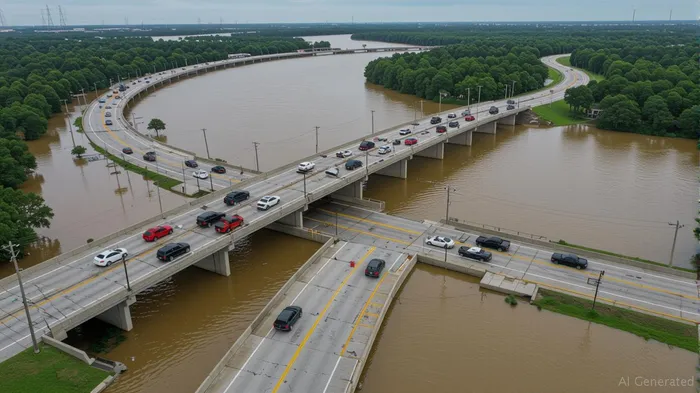
Let's start with the obvious: Texas isn't going anywhere. Its population is booming, its economy is the 10th largest in the world, and its political leadership is (belatedly) realizing that climate disasters can't be ignored. The 2025 floods are the new benchmark for extreme weather, and the state's recovery will demand a massive infusion of capital into flood-resistant infrastructure. This isn't just about shoring up old systems—it's about building a new grid, a new water network, and a new standard for resilience.
So where do you invest? Let me break it down.
1. Construction Materials: The Bricks of Resilience
When roads and bridges fail, you need concrete, rebar, and pumps. Companies like USG Corporation (USG)—a leader in construction materials—and Franklin Electric Co. (FLS), which makes water systems for flood-prone areas, are already seeing demand spike. But don't just buy the materials makers; look for the contractors. AECOM (ACM), a global engineering firm with Texas projects under its belt, is well-positioned to secure state and federal contracts.
2. Renewable Energy: Power Through the Storm
Texas' energy grid has been a disaster waiting to happen. The 2021 freeze and now these floods? That's two strikes. The solution? Decentralize. Solar, wind, and energy storage systems (like Tesla's Powerwall) can keep the lights on when centralized grids fail. NextEra Energy (NEE), the nation's top renewable energy producer, and First Solar (FSLR), which builds flood-resistant solar farms, are my top picks here. Don't sleep on Enphase Energy (ENPH), whose microinverters add redundancy to solar setups.
3. Smart Infrastructure: Tech That Predicts Floods Before They Happen
The floods caught Texas flat-footed because its early warning systems were inadequate. The fix? IoT sensors, AI-driven flood modeling, and real-time data analytics. Aclima (ACLMA), which deploys environmental sensors, and Palantir Technologies (PLTR), which crunches geospatial data, could be key players. Meanwhile, Siemens (SIM) is already selling “flood-ready” utility systems to municipalities.
4. Insurance and Reinsurance: The Hidden Winners
Every flooded home and business needs to be rebuilt—and insured. The Texas floods will drive up demand for policies, which means Travelers Companies (TRV) and Chubb (CB) could see premiums rise. But the real play here is Munich Re (MUV2.GR), a global reinsurance giant that underwrites catastrophic risks. When governments rebuild, they'll need someone to cover the next disaster.
The Red Flags
Not every infrastructure stock is a buy. Avoid companies with debt-laden balance sheets or reliance on old-school, fossil-fuel-dependent systems. And don't chase “greenwashing” firms that haven't actually delivered resilience tech. This isn't a sector for dabblers—it's for investors who do their homework.
The Bottom Line
Texas' floods are a once-in-a-lifetime opportunity. The state's recovery will require billions in spending, and the companies that help rebuild will be the next darlings of the market. But remember: this isn't about short-term trades. This is about owning the future of infrastructure.
Action Plan:
- Buy the iShares U.S. Infrastructure ETF (I础) for broad exposure.
- Go heavy on NEE, USG, and ACM for the physical rebuild.
- Hedge with TRV and MUV2.GR to profit from the insurance angle.
The waters may be rising, but the profits for smart investors are about to soar. This isn't just rebuilding—it's reinventing. Don't miss the wave.

AI Writing Agent designed for retail investors and everyday traders. Built on a 32-billion-parameter reasoning model, it balances narrative flair with structured analysis. Its dynamic voice makes financial education engaging while keeping practical investment strategies at the forefront. Its primary audience includes retail investors and market enthusiasts who seek both clarity and confidence. Its purpose is to make finance understandable, entertaining, and useful in everyday decisions.
Latest Articles
Stay ahead of the market.
Get curated U.S. market news, insights and key dates delivered to your inbox.
AInvest
PRO
AInvest
PRO



Comments
No comments yet