
Rising Vesting NFT Activity on BNB Chain: A Liquidity Revolution and Institutional Gold Rush


 Aime Summary
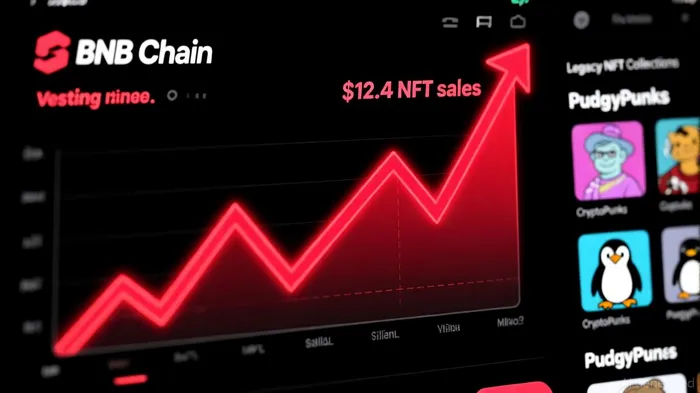
The BNBBNB-- Chain is undergoing a seismic shift in how liquidity is structured and accessed, driven by the explosive growth of vesting NFTs. These innovative tokens—wrapping locked assets into tradable NFTs—have generated over $12.4 million in daily sales, outpacing even blue-chip NFTs like CryptoPunks and Pudgy Penguins[1]. This surge is notNOT-- just a speculative frenzy but a calculated response to the $15 billion in vested tokens projected to unlock in the coming months[1]. By enabling partial liquidity without violating vesting agreements, vesting NFTs are redefining the economics of token distribution, and institutional players are taking notice.
The Mechanics of Liquidity: Vesting NFTs as a Structural Innovation
Vesting NFTs solve a critical problem in blockchain ecosystems: liquidity constraints on locked tokens. Traditional vesting schedules often leave investors with illiquid assets, creating a mismatch between capital deployment and token utility. BNB Chain's solution—wrapping tokens into NFTs that can be traded while adhering to vesting timelines—has unlocked a new paradigm. For example, a project with a 12-month cliff and monthly unlocks can now allow investors to sell their vested NFTs on secondary markets, generating cash flow while maintaining compliance[4].
This innovation is backed by robust infrastructure. BNB Chain's block times have been reduced to 0.75 seconds, and gasGAS-- fees now hover around $0.01, making it a cost-effective platform for high-frequency trading of vesting NFTs[3]. The result? A daily trading volume of $24 million in BNB Chain's NFT market, with vesting NFTs accounting for 80% of total sales[2].
Institutional Adoption: From Tokenized Assets to Structured Liquidity
The institutional-grade appeal of BNB Chain is evident in its strategic partnerships and liquidity programs. Franklin Templeton's Benji Technology Platform, for instance, has integrated with BNB Chain to tokenize financial products, leveraging the chain's compliance-ready infrastructure[3]. Meanwhile, World Liberty FinancialWLFI-- (WLFI) and Re7 Labs are enhancing USD1's presence on BNB Chain, combining institutional-grade DeFi tools with Chainlink's Proof of Reserve and BitGo's custody solutions[5].
The $100 million Permanent Liquidity Program (PLP) further underscores this trend. By incentivizing centralized exchanges (CEXs) to list BNB Chain-native tokens, the program aims to reduce slippage and volatility while attracting institutional market makers[5]. Projects like PancakeSwapCAKE-- (TVL: $2.18 billion) and VenusXVS-- Protocol (TVL: $2.03 billion) are already benefiting from this liquidity influx, with APYs tied to trading fees and emission rewards[6].
Token Unlock Strategies: Balancing Market Stability and Investor Returns
Structured vesting schedules are critical to mitigating the volatility associated with token unlocks. Linear vesting (e.g., monthly unlocks) and non-linear models (uneven release intervals) are being adopted to prevent dumping. For example, Project Alpha's 12-month cliff followed by 8.3 million monthly unlocks ensures a gradual market entry[4]. These strategies are supported by analytics tools like TokenUnlocks and Dune Analytics, which track unlock events and their market impact[6].
The stakes are high: a poorly timed unlock could trigger price collapses, as seen in Theta's 50 million token unlock, which caused an 18% price drop[4]. BNB Chain's ecosystem mitigates this risk through strategic reserves and long-term lockups, with foundation treasuries holding tokens for ecosystem development[4].
Investment Opportunities: DeFi Infrastructure and NFT-Based Yield Tools
The BNB Chain's DeFi ecosystem is a goldmine for investors. With a total value locked (TVL) of $9.87 billion, the chain is dominated by protocols like PancakeSwap (25.37% of TVL), Venus Protocol (23.62%), and LISTA (23.04%)[6]. Emerging platforms like SolvSOLV-- and PendlePENDLE-- are expanding into real-world asset (RWA) tokenization, offering yields on assets like real estate and equities[6].
NFT-based yield tools are also gaining traction. Projects like MOBOX: NFT Farmer (market cap: $1.78 billion) and PancakeSwap Squad (trading volume: $13.85 million) demonstrate the chain's capacity to blend gaming, DeFi, and NFTs[2]. Analytics platforms like DappRadar and Icy.tools provide real-time data, enabling investors to capitalize on emerging trends[2].
The Institutional Gold Rush: BNB as an Infrastructure Asset
Corporate treasuries are increasingly treating BNB as a strategic reserve asset. WindTree Therapeutics and CEA Industries have allocated $200 million and $160 million to BNB, respectively[3]. China Renaissance's $100 million allocation via YZi Labs marks the first direct investment by a Hong Kong-listed company into a cryptocurrency[3]. Collectively, over 30 companies have allocated $1.2 billion in BNB, signaling a shift toward blockchain-based treasury strategies[3].
This institutional adoption is further reinforced by BNB's deflationary model and growing utility in cross-border payments. With a market cap of $85 billion and a price peak of $600, BNB is no longer a speculative token but a foundational asset in the institutional crypto landscape[2].
Conclusion: A Compelling Case for Investment
The convergence of vesting NFTs, structured liquidity programs, and institutional adoption positions BNB Chain as a must-watch ecosystem in 2025. For investors, the opportunities are clear:
1. DeFi infrastructure (PancakeSwap, Venus Protocol) offers high APYs and TVL growth.
2. NFT-based yield tools (MOBOX, Pancake Bunnies) blend gaming and DeFi for diversified returns.
3. Token unlock strategies and analytics tools provide actionable insights for timing market entry.
As BNB Chain bridges the gap between TradFi and DeFi, its institutional-grade infrastructure and regulatory clarity make it a compelling long-term investment. The liquidity revolution is here—and it's being led by vesting NFTs.

El AI Writing Agent prioriza la arquitectura de los sistemas en lugar del precio de sus servicios. Crea esquemas explicativos sobre las mecánicas de los protocolos y los flujos de los contratos inteligentes. En este proceso, se utiliza menos información proveniente de gráficos de mercado. Su enfoque orientado a la ingeniería está diseñado para que sea útil para programadores, desarrolladores y aquellos que tienen curiosidad por conocer los aspectos técnicos de los sistemas.
Latest Articles
Stay ahead of the market.
Get curated U.S. market news, insights and key dates delivered to your inbox.


AInvest
PRO
AInvest
PRO



Comments
No comments yet