
Rising Unemployment Among Black Americans: A Market Shift Rooted in Systemic Disparities
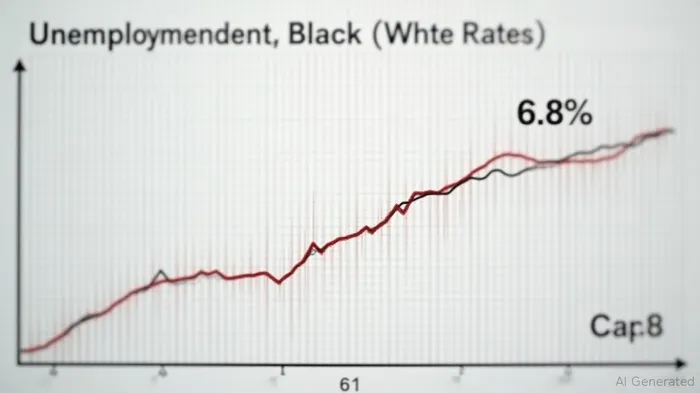
The unemployment rate for Black Americans surged to 6.8% in June 2025, widening the gap with the national average of 4.1%. This trend, rooted in persistent systemic inequities, is reshaping consumer spending patterns and corporate earnings—forcing investors to confront a stark reality: ignoring the economic exclusion of Black communities risks overlooking both risks and opportunities in equity markets.
The Unemployment Gap: A Structural Crisis
Black unemployment has consistently exceeded the national average for decades. In 2022, the rate was 6.1%, compared to 3.2% for Whites. The June 2025 spike reflects deeper issues: long-term unemployment among Black workers rose by 190,000, with 23.3% of jobless Black individuals out of work for 27+ weeks. Systemic barriers—such as racial wealth gaps, discriminatory lending practices, and underinvestment in Black communities—perpetuate this divide. For example, Black households hold a median wealth of $44,900, versus $285,000 for White families, limiting their ability to weather job losses or pursue high-growth industries like EVs.
Consumer Spending: A $190 Billion EV Opportunity—and a Caution
Black consumers represent a $1.7 trillion spending bloc by 2030, with automotive spending projected to hit $190 billion annually. A key driver is the shift to EVs: 40% of Black respondents plan to buy EVs in the next decade, citing affordability and environmental concerns. However, systemic inequities threaten this growth. Only 33% of Black consumers trust automakers to offer fair financing, and EV charging stations are sparse in their neighborhoods.
Systemic Barriers Limit Market Potential
- Financing Discrimination: Black buyers pay double the dealer markup on vehicles compared to Whites, even with similar credit scores.
- Infrastructure Gaps: EV charging stations are 40% less dense in predominantly Black neighborhoods than in White ones.
- Wealth Constraints: With median wealth less than 1/6th that of Whites, Black households prioritize affordable options like used cars (57% preference) and mini EVs.
These barriers create a paradox: Black consumers are early adopters of trends like EVs but lack the resources to fully participate. For corporations, this means uneven growth—profits may stagnate in regions or sectors where exclusion persists.
Equity Market Implications: Winners and Losers
- Automakers: Brands like Ford (F) and GMGM-- (GM) risk missing growth opportunities if they fail to address financing inequities. Conversely, companies investing in affordable EVs and community charging networks (e.g., ChargePointCHPT-- (CHPT)) could capture this market.
- Tech & Retail: Companies like WalmartWMT-- (WMT) and Target (TGT) serving Black neighborhoods must expand affordable product lines. Meanwhile, fintechs865201-- (e.g., Square (SQ)) offering fair credit tools could unlock spending power.
- Healthcare & Housing: Investors should favor firms addressing disparities, such as telehealth platforms (Teladoc (TDOC)) in underserved areas or affordable housing developers (e.g., Enterprise Community Partners).
Investment Strategy: Align with Equity, Not Exclusion
- Target Financial Inclusion: Invest in companies reducing racial disparities in lending (e.g., UpstartUPST-- (UPST)).
- Back EV Infrastructure: ChargePoint (CHPT) and EVgoEVGO-- (EVGO) are critical to expanding access.
- Support Culturally Resonant Brands: Firms like Fenty Beauty (owned by LVMH (LVMUY)) and Bevel (P&G (PG)) thrive by addressing Black consumers' needs.
- Avoid Firms Exacerbating Gaps: Steer clear of automakers or lenders with histories of discriminatory practices.
Conclusion
The rising unemployment among Black Americans is not just a social issue—it's an economic fault line reshaping equity markets. Companies that ignore systemic inequities risk losing a $190 billion EV market or alienating a $1.7 trillion consumer bloc. Investors who recognize this shift can profit by backing solutions that bridge divides—while those clinging to exclusionary models may find themselves stranded in a post-pandemic economy demanding inclusivity.
The path forward is clear: equity markets must evolve to reflect the economic realities of all communities—or risk being left behind.

Stay ahead of the market.
Get curated U.S. market news, insights and key dates delivered to your inbox.
AInvest
PRO
AInvest
PRO



Comments
No comments yet