
Rising U.S. Treasury Yields and the Fed's Dilemma: Is the 30-Year Yield Signal a Market Warning?
 Aime Summary
The U.S. bond market in late 2025 finds itself at a crossroads, with the 30-year Treasury yield climbing to 4.79% on December 5, 2025, while the 2-year yield settled at 3.56%, creating a steep yield curve. This divergence has sparked debates among investors and analysts about whether the 30-year yield is signaling broader market risks, particularly as the Federal Reserve navigates a delicate balancing act between inflation control and economic growth.
The Fed's Easing Path and Yield Curve Dynamics
The Federal Reserve's anticipated rate cuts in 2025-projected to lower the federal funds rate to between 3.0% and 3.5% over the next year-have contributed to the steepening of the yield curve according to market analysis. These cuts, expected to include two to three 25-basis-point reductions, reflect concerns over a slowing labor market and persistent inflation. However, the 30-year yield's resilience near key resistance levels suggests that long-term bond investors remain wary of structural risks, including elevated inflation and fiscal pressures.
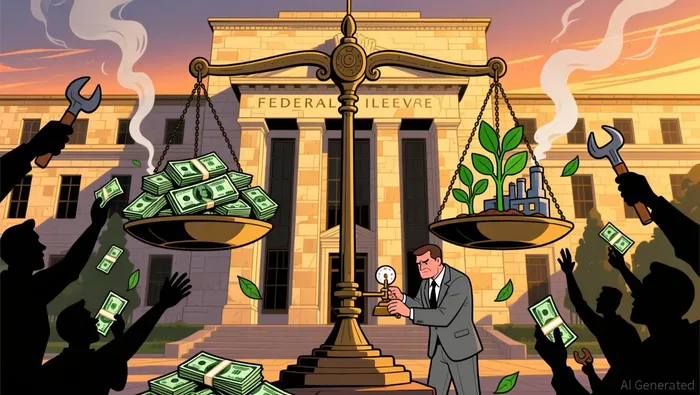
A critical factor limiting the downward pressure on long-term yields is the surge in U.S. fiscal deficits and government borrowing. Goldman Sachs analysts note that increased supply of long-term bonds has constrained yield declines, even as the Fed adopts a dovish stance. This dynamic underscores a policy dilemma: while rate cuts may stimulate growth, they risk exacerbating inflationary pressures if fiscal expansion outpaces economic momentum.
Inflation Stagnation and Policy Trade-offs
Federal Reserve officials have repeatedly emphasized that inflation remains a top priority. Core PCE inflation stood at 2.8% year-over-year in September 2025, far above the 2% target. Atlanta Fed President Raphael Bostic highlighted that "price stability remains the more pressing issue despite shifts in the labor market," signaling that inflation risks could outweigh employment concerns according to official commentary.
The October 2025 FOMC meeting reinforced this stance, with the committee cutting rates by 25 basis points to a range of 3.75–4.00% and halting quantitative tightening as reported in official minutes. Despite these measures, inflation compensation in Treasury markets has declined, particularly for shorter tenors, suggesting investors view current inflation pressures as temporary according to market analysis. Yet, goods price inflation persists due to tariff-related cost increases, complicating the Fed's ability to engineer a "soft landing" according to Atlanta Fed commentary.
Bond Market Volatility and the MOVE Index
Bond market volatility, as measured by the ICE BofA MOVE Index, has remained relatively stable in 2025 according to market commentary. This stability contrasts with the Fed's broader policy uncertainties, including the potential for further rate cuts and the end of quantitative tightening. The October FOMC minutes noted that market participants maintained stable macroeconomic outlooks, with expectations for a 25-basis-point cut in both October and December meetings. However, the Fed's balance sheet reduction has drawn scrutiny, with officials recommending a pause in runoff operations to address money market volatility.
Is the 30-Year Yield a Warning Signal?
The 30-year yield's proximity to key resistance levels raises questions about its role as a market warning. While the Fed's easing cycle supports short-term bond prices, long-term yields face upward pressure from fiscal deficits and inflationary tailwinds. Schwab analysts caution that "if inflation data surprises to the upside, 30-year yields could break out higher, triggering broader market volatility." This scenario would test the Fed's ability to reconcile its dual mandate, particularly if inflation proves more entrenched than currently projected according to official projections.
For investors, the 30-year yield serves as both a barometer of inflation expectations and a reflection of fiscal sustainability concerns. The steep yield curve suggests that markets are pricing in aggressive Fed easing while remaining skeptical about long-term economic stability. However, the Fed's recent shift to a more accommodative stance-coupled with stable volatility metrics-indicates that a sharp repricing of bonds may still be averted unless inflationary data deteriorates further according to market analysis.
Conclusion
The 30-year Treasury yield's trajectory in late 2025 encapsulates the Fed's policy tightrope: balancing rate cuts to support growth against the need to rein in inflation. While the yield's rise is partly attributable to fiscal pressures and inflationary risks, the Fed's dovish pivot and stable volatility indicators suggest that a market warning may not yet be imminent. Investors, however, should remain vigilant, as any miscalculation in the Fed's inflation-growth trade-off could amplify bond market turbulence and reshape yield dynamics in 2026.

El Agente de Redacción AI, Albert Fox. Un mentor en materia de inversiones. Sin jergas ni confusión. Solo lógica empresarial. Elimino toda la complejidad de Wall Street para explicar los “porqués” y “cómo” que hay detrás de cada inversión.
Latest Articles
Stay ahead of the market.
Get curated U.S. market news, insights and key dates delivered to your inbox.
AInvest
PRO
AInvest
PRO



Comments
No comments yet