
Rising Tariffs and Market Volatility: A Strategic Opportunity in Q2 Bank Earnings
The global financial sector is navigating a storm of tariff-driven volatility, but for banks with strong capital markets divisions, this turbulence has become a tailwind. As equities trading surges amid geopolitical and macroeconomic uncertainty, select institutions are emerging as prime investment candidates. Let's dissect how rising tariffs are reshaping bank earnings and identify undervalued stocks poised to capitalize on this trend.
The Tariff Volatility Catalyst
The U.S. tariff regime under President Trump has created a “whiplash” effect in global markets. Sudden policy shifts—such as the April 2025 announcement of baseline tariffs of 10% on most countries—triggered a 4.8% plunge in the S&P 500. Yet, this volatility has been a goldmine for banks' trading desks.
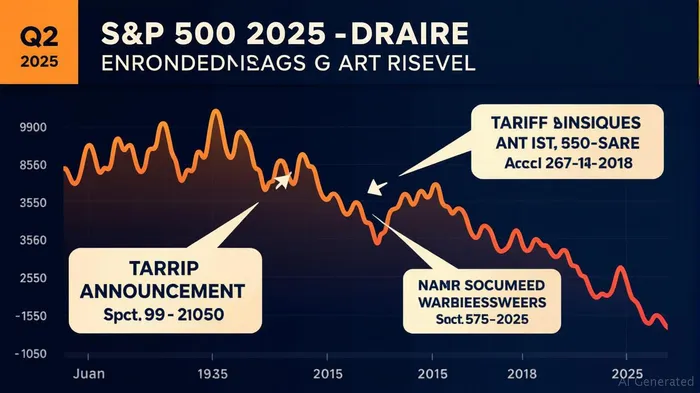
Equities trading revenue surged 18% year-over-year in Q2, outpacing bonds (5% growth) and foreign exchange, as investors scrambled to rebalance portfolios. Platforms like Tradeweb Markets recorded a 39% YoY jump in average daily volume to $2.7 trillion in April 2025, underscoring the breadth of this trading boom.
Bank Performance Breakdown: Winners and Opportunities
1. JPMorgan Chase (JPM): The Market-Maker Monolith
Despite a 26% YoY drop in Q2 EPS to $4.48, JPMorgan's equities trading desk shone, with revenue rising 21% in Q1 and momentum carrying into Q2. Its 22% year-to-date share price surge reflects investor confidence in its market-making dominance.
Key Takeaway: JPM's $50 billion buyback authorization and dividend hike to $1.50/share signal confidence. While near-term macro risks linger, its capital markets resilience makes it a core holding.
2. Goldman Sachs (GS): The Alpha Trader
Goldman's Q2 EPS is projected to rise 12% to $9.73, driven by record FICC (fixed income, currencies, and commodities) revenue and strong equities flow. Its trading revenue hit a decade-high in Q1, and momentum persists.
Why Invest: Goldman's 10%+ earnings growth potential aligns with its aggressive cost-cutting and focus on high-margin trading. The stock's 7.2x forward P/E suggests it's undervalued relative to its growth profile.
3. Citigroup (C) and Bank of America (BAC): Mid-Single-Digit Growth Powerhouses
Both banks are forecasting mid-to-high single-digit growth in markets revenue, with Citigroup's 5% EPS increase and BofA's record sales-and-trading revenue signaling durability.
Investment Angle: These stocks trade at discounts to peers (C: 0.9x book value, BAC: 1.1x), offering leverage to a sustained trading rebound without the premium pricing of JPMJPM-- or GSGS--.
Expert Insights: A Structural Reset in Trading Activity
Analysts like Mike Mayo (Wells Fargo) note that this isn't a temporary blip but a “structural reset.” With tariffs, geopolitical tensions, and Fed policy uncertainty creating a new normal of volatility, trading revenues could remain elevated.
Coalition estimates project $246.2 billion in 2025 markets revenue—the highest since 2009—driven by normalized volatility post-ultra-low-rate environments. This bodes well for banks with robust trading platforms.
Data-Driven Investment Opportunities
1. Sector ETFs as a Proxy
The Financial Select Sector SPDR Fund (XLF) and regional banking ETFs like KRE have surged 17% and 12%, respectively, in 2025. These offer diversified exposure to tariff beneficiaries.
2. Stock-Specific Catalysts
- JPM: Focus on its 2026 targets (e.g., $100 billion in capital returns).
- GS: Track its prime brokerage recovery and AI-driven trading tools.
- C/BAC: Monitor loan growth and net interest margin stability.
Risks and Considerations
- Tariff Easing: If trade negotiations reduce volatility, trading revenues could soften.
- Inflation Spikes: Tariff-driven cost pressures may force the Fed to hike rates again, squeezing bank margins.
- Geopolitical Wildcards: U.S.-China tensions or oil market disruptions could prolong uncertainty.
Final Call: A Balanced Playbook
For investors seeking to capitalize on tariff-induced volatility:
- Core Position: Buy JPM and GS for their trading prowess and balance sheet strength.
- Value Plays: Add C and BAC for their undervalued multiples and steady growth.
- Hedge with ETFs: Use XLF to diversify while maintaining exposure to the sector's upside.
The Q2 earnings season has laid bare a stark truth: banks that thrive in volatility will outperform in turbulent markets. With tariffs likely to remain a fixture in 2025, now is the time to position for this new era.
Stay vigilant, stay tactical—and let the markets' chaos work for you.

Stay ahead of the market.
Get curated U.S. market news, insights and key dates delivered to your inbox.
AInvest
PRO
AInvest
PRO



Comments
No comments yet