
Rising Tariffs and Their Hidden Impact on Consumer Staples Stocks: A Case for Value Plays in Domestic Equities
The U.S. tariff landscape has shifted dramatically since April RequestMethod:2025, with “Liberation Day” tariffs and subsequent geopolitical maneuvers reshaping global supply chains. While headlines focus on headline inflation and trade wars, a subtler opportunity lies in consumer staples stocks—specifically those with domestic manufacturing exposure. Harvard University's recent analysis of tariff impacts reveals a critical insight: short-term cost pressures are creating valuation gaps in companies well-positioned to thrive in this new economic reality. For investors, this is a chance to buy undervalued champions before the market catches up.
The Tariff Timeline: Pressure Points and Market Reactions
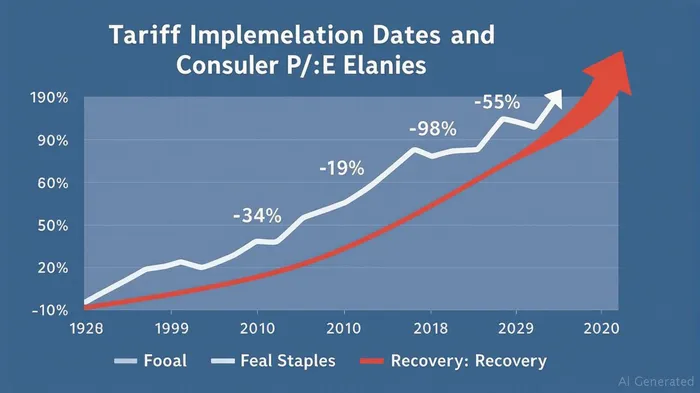
The 2025 tariff cycle began with a 25% levy on imports from Canada and Mexico and a 10% increase on Chinese goods in early April. By mid-May, a 90-day negotiation window opened, temporarily suspending further escalation. This stop-start dynamic has created volatility for consumer staples firms reliant on global supply chains. Harvard's study highlights that tariff announcements triggered swift pricing adjustments, but actual price hikes lagged behind tariff rates (e.g., a 25% tariff led to just a 1.2% price rise). The hidden cost? Domestic manufacturers face ripple effects, from rising input costs to margin squeezes, even as imported goods absorb tariffs.
The April 2 sell-off in staples stocks—like a 1% drop in Procter & Gamble (PG) and SyscoSYY-- (SYY)—reflected this uncertainty. Yet these dips may have masked long-term opportunities.
Harvard's Insights: Cost Pressures and Valuation Contractions
The Harvard study underscores two critical dynamics:
1. Domestic Goods Aren't Immune: Even U.S.-made products saw price increases, likely due to reliance on imported components (e.g., semiconductors for smart appliances) or competition from tariff-affected imports.
2. AI-Driven Data Precision: The team's use of generative AI to classify 300,000 products by origin (88% accuracy for domestic/import splits) revealed geographic arbitrage opportunities. Companies with supply chains insulated from tariff-heavy regions (e.g., reshored manufacturing) now have a competitive edge.
This data paints a clear path for investors: prioritize firms with vertical integration or nearshore production, as they can mitigate input costs better than their global peers.
P/E Contractions Signal Bargain Hunting Opportunities
Sector-specific P/E ratios post-April 2025 show a divergence between companies adapting to tariffs and those struggling:
- Procter & Gamble (PG): P/E dropped to 20.2x, below its 5-year average of 22x. Its localized production and cost-cutting (e.g., reducing packaging complexity) position it to outperform.
- Sysco (SYY): Trading at 16.3x P/E, down from a 5-year average of 19x. Its AI-driven logistics and focus on domestic suppliers make it a defensive play.
- Nomad Foods (NOMD): With a 10% earnings yield (implying a P/E of ~10x), its nearshore European production shields it from China-US trade tensions.
In contrast, Church & Dwight (CHD) maintains a higher 24.5x P/E due to aggressive reshoring investments, but its 14% margin expansion suggests it's worth the premium.
Risks and the Road Ahead
While the sector's defensive nature offers stability, risks remain:
- Geopolitical Volatility: A breakdown in trade talks could reignite tariff spikes, pressuring margins.
- Consumer Spending: Wage growth (+4% nominal) lags inflation (core PCE at 2.6%), risking demand erosion.
Yet Harvard's study also notes that tariffs may accelerate reshoring, benefiting domestic brands in the long term. For instance, semiconductor and EV manufacturers are already repatriating production—a trend staples companies could follow.
Investment Thesis: Buy the Dips, Target Resilient Firms
The data suggests a selective value strategy:
1. Focus on Domestic Exposure: Prioritize companies with U.S. or nearshore manufacturing (e.g., PG, NOMD).
2. Look for Operational Discipline: Firms like SYYSYY--, which use AI to streamline costs, offer margin resilience.
3. Avoid Global Supply Chain Reliance: Steer clear of companies with >40% imports from tariff-heavy regions (e.g., China).
The sector's current P/E of ~21x (vs. a 10-year average of 19.9x) is elevated but justifiable if earnings stabilize. With the 90-day tariff window ending in July, clarity on trade policies could trigger a rerating.
Final Take
Rising tariffs have exposed vulnerabilities in consumer staples valuations—but also created pockets of undervalued stocks. By focusing on domestic champions with cost control and supply chain agility, investors can capitalize on short-term sell-offs. The key is to avoid panic and instead view these pressures as a filter for companies built to endure.
The next six months will test these firms. For those willing to look beyond the noise, the rewards could be substantial.
Disclosure: This article is for informational purposes only and does not constitute financial advice. Always conduct your own research before making investment decisions.

Stay ahead of the market.
Get curated U.S. market news, insights and key dates delivered to your inbox.
AInvest
PRO
AInvest
PRO



Comments
No comments yet