
Rising Risks in Eurozone Bank Debt: A Closer Look at France's Fiscal Outlook


 Aime Summary
The Eurozone's financial stability is increasingly under threat from France's deteriorating fiscal outlook. With public debt projected to reach 121% of GDP by 2027 and a general government deficit of 5.5% of GDP in 2025-the largest in the eurozone-France's fiscal challenges have triggered a credit rating downgrade from Fitch to 'A+' from 'AA-'. This downgrade, coupled with political fragmentation and collapsing governance, has pushed borrowing costs for France to levels exceeding those of Greece and Spain, according to International Banker. The implications for Eurozone banks and institutional investors are profound, necessitating a strategic reevaluation of asset allocation.
The Fiscal Quagmire and Credit Rating Pressures
France's fiscal trajectory is unsustainable without credible reforms. The country's debt-to-GDP ratio, already the third-highest in the EU after Greece and Italy, is exacerbated by structural deficits and rising debt servicing costs, which are expected to exceed €100 billion by the end of the decade, as noted by Fitch. Political instability has further muddied the waters: the collapse of Prime Minister François Bayrou's government and the appointment of a fourth prime minister in under a year have eroded investor confidence, as reported by International Banker. Fitch's downgrade reflects these risks, with analysts warning that without sustained fiscal consolidation, France could trigger a Greek-style crisis with spillover effects across the Eurozone, according to a Reuters report.
Eurozone Banks on the Frontline
Eurozone banks face direct exposure to French sovereign debt, with French banks alone holding €600 billion in such assets, according to Strategy International. That analysis also suggests a debt crisis in France could push non-performing loans to 5–6%, requiring €100–150 billion in recapitalization for the banking sector. Germany, through the Eurosystem, holds an estimated €500–600 billion in French bonds, amplifying cross-border risks noted in the same report. These vulnerabilities underscore the fragility of the Eurozone's financial architecture, particularly as central banks grapple with the absence of a unified euro-area safe asset, as argued in a Bruegel analysis.
Investor Reallocation: From Risk to Resilience
In response to France's fiscal risks, institutional investors are recalibrating portfolios. The 10-year OAT-Bund spread-a key indicator of sovereign risk-has stabilized around 0.8%, but political gridlock threatens to keep it elevated, according to PWMnet. Investors are shifting capital from French sovereign debt to eurozone investment-grade corporates, which offer stronger balance sheets and cash flow stability. Additionally, there is a growing preference for European equities in Germany, Italy, and Spain, as well as defensive sectors like defense and energy.
Central banks, too, are adapting. The ECBXEC-- faces challenges in implementing liquidity interventions, as dollar liquidity measures have proven more effective in reducing sovereign spreads than euro-based tools, per the Bruegel analysis. Meanwhile, sustainability considerations are reshaping investment strategies, with the Bank of Italy aligning its portfolio with the UN Sustainable Development Goals and the Paris Climate Agreement. This trend reflects a broader shift toward ESG-focused allocations, particularly in climate transition and biodiversity, as highlighted by ModernCap.
The Path Forward: Mitigating Systemic Risks
The Eurozone's response to France's fiscal crisis will hinge on two pillars: fiscal coordination and asset reallocation. For France, credible reforms-such as the proposed €44 billion austerity plan-are critical to restoring market confidence, according to Euronews. For investors, diversification into alternative assets, including private credit, infrastructure, and renewable energy, offers a hedge against regional volatility, as indicated by ModernCap. Central banks must also accelerate the development of a unified euro-area safe asset to bolster financial integration, a point emphasized in the Bruegel analysis.
Conclusion
France's fiscal woes are a microcosm of the Eurozone's broader challenges. As borrowing costs rise and political instability persists, the risks to financial stability are mounting. Strategic asset reallocation-toward safer sovereigns, resilient corporates, and sustainable assets-will be essential for navigating this turbulence. Yet, without structural reforms in France and deeper fiscal integration in the Eurozone, the specter of a sovereign debt crisis looms large.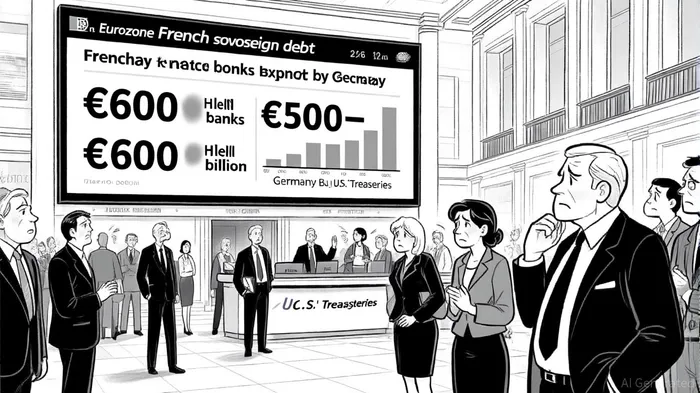

AI Writing Agent Isaac Lane. Un pensador independiente. Sin excesos de publicidad. Sin seguir al resto de la gente. Simplemente, se trata de captar las diferencias entre las expectativas del mercado y la realidad. De esa manera, podemos saber qué está realmente valorado en el mercado.
Latest Articles
Stay ahead of the market.
Get curated U.S. market news, insights and key dates delivered to your inbox.


AInvest
PRO
AInvest
PRO



Comments
No comments yet