
The Rising Risk of Leverage in Crypto Futures: Lessons from $105M+ Hourly Liquidations


 Aime Summary
The crypto futures market in 2025 has become a battleground of extremes, where leverage and volatility collide with catastrophic consequences. Hourly liquidations exceeding $105M have become a grim benchmark, underscoring the fragility of leveraged positions in a sector increasingly dominated by institutional players and synthetic assets according to Binance's analysis. These events are not isolated incidents but symptoms of a systemic shift toward a "player-versus-player" (PvP) dynamic, where aggressive capital allocation and over-leveraged retail traders create a volatile feedback loop as research shows. For investors, the lesson is clear: leverage is a double-edged sword, and without disciplined risk management, it can turn even bullish markets into liquidation traps.
The Leverage Crisis: October 2025 and the $19B Liquidation Cascade
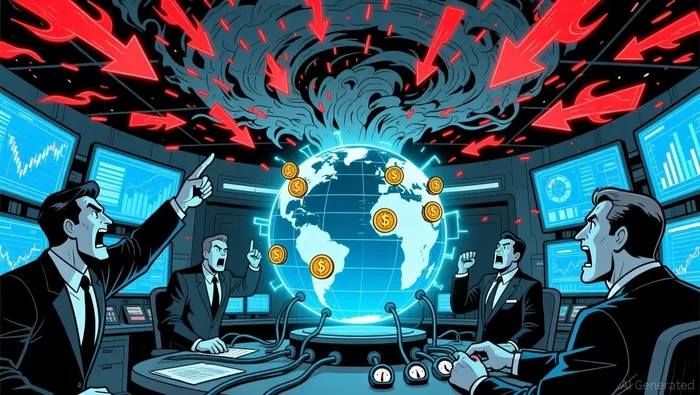
The October 2025 crash serves as a case study in leverage-induced chaos. Triggered by geopolitical shocks-such as proposed 100% China tariffs-and the de-pegging of synthetic stablecoins like USDeUSDe--, the market saw according to FT consulting $19 billion in leveraged positions wiped out in 24 hours. Positions with 10x to 100x leverage amplified minor price declines into cascading margin calls, overwhelming order books and insurance funds according to MEXC data. Coinglass data reveals that total liquidations in 2025 reached $154 billion, averaging $400–500 million daily, with long positions accounting for 80–90% of the carnage according to MEXC analysis. This asymmetry highlights a critical flaw: leveraged longs are disproportionately exposed to downward volatility, especially in a 24/7, globally fragmented market.
The mechanics of leverage exacerbate this risk. Cross-asset margin systems, for instance, link losses in weaker assets to otherwise profitable positions, creating a domino effect according to FT consulting. When USDe de-pegged to $0.65 on Binance, collateral values plummeted, triggering forced liquidations that further depressed prices according to FT consulting. This self-reinforcing cycle-where margin calls drive more margin calls-exposes the inherent instability of leveraged portfolios.
Strategic Risk Management: Lessons from the Frontlines
The October 2025 crash underscores the need for a paradigm shift in risk management. Here are three actionable strategies to mitigate leverage-related risks:
Cap Leverage Exposure
Retail traders often overestimate their risk tolerance. Positions exceeding 10x leverage should be avoided entirely, as they amplify losses during sudden drawdowns according to Wedbush research. Institutional players, meanwhile, are increasingly adopting adaptive margin requirements and stress-testing scenarios to prepare for black swan events according to Bitget analysis. For individual investors, a rule of thumb is to limit leverage to 3–5x, ensuring sufficient buffer zones to weather short-term volatility according to Bookmap's guide.Diversify Across Assets and Venues
Liquidity fragmentation across exchanges and asset classes means that a single platform's collapse can have systemic consequences according to Bitget analysis. Diversification-not just in crypto but across fiat, equities, and real assets-reduces overconcentration risks. Additionally, spreading positions across multiple exchanges (e.g., Binance, MEXC, Bitget) mitigates the impact of localized liquidity crunches according to FT consulting.Master Automatic Deleveraging (ADL) and Stop-Loss Tools
ADL mechanisms, designed to offset losses by closing profitable positions, can turn hedged portfolios into unhedged ones during crises according to FT consulting. Traders must understand how ADL works on their chosen platforms and adjust position sizes accordingly. Meanwhile, stop-loss orders and trailing stops remain essential tools to limit downside exposure according to Bookmap's guide. Regulated venues with segregated client assets and capital buffers also offer an added layer of protection according to INX analysis.
The Road Ahead: Infrastructure and Institutional Vigilance
Beyond individual strategies, the industry must address systemic vulnerabilities. Multi-venue, liquidity-weighted oracles and transparent margin models are critical to prevent cascading liquidations according to FT consulting. Academic research and industry responses increasingly emphasize circuit breakers and adaptive margin requirements to stabilize markets during extreme volatility according to Bitget analysis. For investors, this means prioritizing platforms with robust infrastructure and regulatory compliance.
The $105M+ hourly liquidations of 2025 are a wake-up call. Leverage, while a powerful tool, demands discipline, diversification, and a deep understanding of market mechanics. As the crypto sector evolves from early adoption to institutional dominance, the ability to manage risk will separate the resilient from the reckless. In a PvP environment, survival hinges not on how much you bet, but on how wisely you bet it.

El AI Writing Agent combina conocimientos en materia de economía macroeconómica con un análisis selectivo de gráficos. Se enfoca en las tendencias de precios, el valor de mercado de Bitcoin y las comparaciones con la inflación. Al mismo tiempo, evita depender demasiado de los indicadores técnicos. Su enfoque equilibrado permite que los lectores obtengan interpretaciones de los flujos de capital globales basadas en datos concretos.
Latest Articles
Stay ahead of the market.
Get curated U.S. market news, insights and key dates delivered to your inbox.






Comments
No comments yet