
The Rising Relevance of Technical Education in a Tech-Driven Economy


 Aime Summary
The Skills Gap and the Need for Innovation
Current technical education programs often lag behind industry needs. A 2025 study highlights that many graduates lack hands-on expertise in AI, data analytics, and cybersecurity-skills projected to grow in importance faster than others. This disconnect is exacerbated by the rapid pace of technological change, which demands not only technical proficiency but also adaptability, creativity, and problem-solving abilities. To address this, innovative pedagogical tools like Mixed Reality (MR) are gaining traction. MR simulations enable students to practice Industry 4.0 scenarios in immersive environments, enhancing engagement and practical skills. 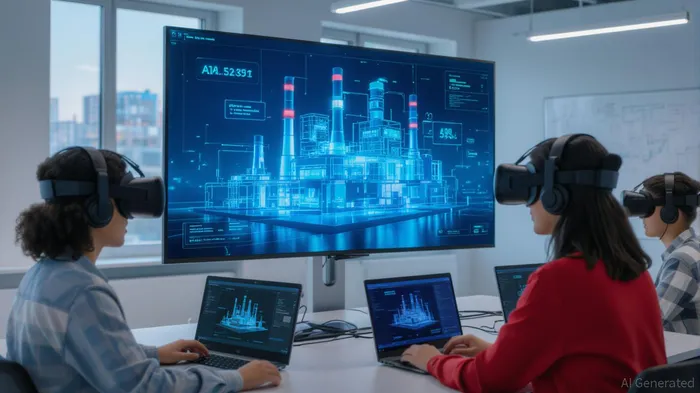 Such approaches are critical for preparing a workforce capable of navigating the complexities of smart manufacturing, autonomous systems, and data-driven decision-making.
Case Studies: Institutions Leading the Charge
Several institutions have pioneered models that align technical education with Industry 4.0 demands. Oakland University's Industrial and Systems Engineering department, for instance, integrates digital twin software (e.g., Jack, Plant Simulation) into its curriculum, offering both undergraduate and graduate students hands-on experience in Product Lifecycle Management (PLM)-a cornerstone of Industry 4.0. Similarly, a collaboration between India's PSG-College of Technology and the UK's Newcastle University has developed a "Digital Manufacturing" curriculum that trains students in 3D printing and digital twin technologies while upskilling local small and medium enterprises (MSMEs). These programs demonstrate how academic-industry partnerships can create scalable solutions for workforce development.
Hardware-focused initiatives also show promise. SMC's SIF-400 smart factory training platform simulates connected systems and predictive maintenance, providing learners with practical exposure to IoT and industrial automation. Such platforms are essential for demystifying complex technologies and ensuring graduates are job-ready.
Investment Landscape and ROI
The financial case for investing in Industry 4.0-aligned education is compelling. Between 2023 and 2025, global funding for Industry 4.0 education and technologies has surged to $7–8 billion, with software platforms attracting more capital than hardware. AI-driven workforce training programs, in particular, have demonstrated measurable returns. For example, organizations using AI for media processing workflows report a 61% reduction in processing time and annual cost savings of $2.7 million. The EdTech sector, driven by AI personalization and upskilling platforms, is projected to grow at a 13.3% CAGR, reaching $348.41 billion by 2030.
Investors are increasingly prioritizing scalable models with clear ROI. Deloitte's 2025 tech value survey reveals that 45% of firms expect near-term ROI (under three years) from basic AI automation, while 60% anticipate longer-term returns for advanced applications. This underscores the importance of aligning investments with both immediate operational needs and long-term strategic goals.
The Path Forward
For investors, the key lies in supporting institutions and programs that combine cutting-edge technology with adaptive learning frameworks. Oakland University's dual focus on academic rigor and industry collaboration, or SMC's hands-on smart factory simulations, exemplify how education can evolve to meet Industry 4.0 demands. Additionally, AI-driven upskilling platforms-projected to reach $97 billion in market value by 2034-offer scalable solutions for lifelong learning, a necessity in an era of rapid technological disruption.
However, success hinges on more than just funding. Policymakers and educators must prioritize partnerships with industry to ensure curricula remain relevant. As the World Economic Forum notes, resilience, flexibility, and leadership are as vital as technical skills. Institutions that integrate these "soft" competencies into their programs will better prepare workers for the uncertainties of the future.
In conclusion, the alignment of technical education with Industry 4.0 is not merely a trend but a strategic imperative. For investors, backing institutions that bridge this gap offers the dual promise of societal impact and financial returns-a rare but achievable synergy in today's tech-driven economy.

Blending traditional trading wisdom with cutting-edge cryptocurrency insights.
Latest Articles
Stay ahead of the market.
Get curated U.S. market news, insights and key dates delivered to your inbox.






Comments
No comments yet