
Rising Reciprocal Tariffs: A Historical Lens for Navigating Equity Volatility
The global economy is once again at a crossroads, with reciprocal tariffs between major trading partners reaching historic highs. As of April 2025, the U.S. imposed 125% tariffs on Chinese goods, while China retaliated with 84% levies—a stark echo of past trade conflicts. Investors now face a critical question: How can historical market reactions to trade policies guide allocations in this new era of tariff-driven volatility?
A Pattern of Volatility—and Opportunity
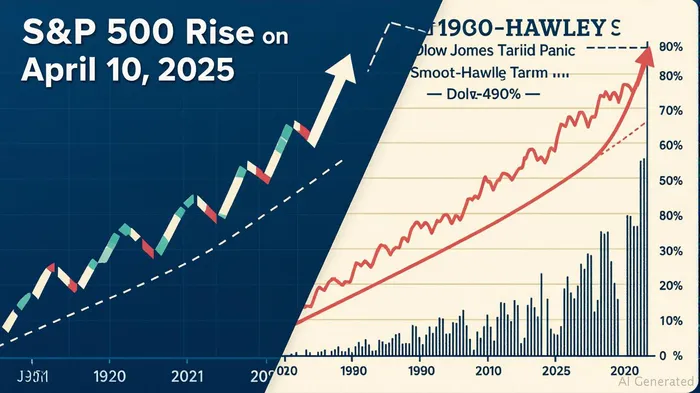
History reveals a clear cyclical pattern: sudden tariff announcements trigger sharp market drops, but negotiated pauses or rollbacks spark rallies. Consider the April 2025 tariff pause for 75 countries (excluding China), which sent the S&P 500 soaring 9.5% in a single day—its best performance since March 2020. This mirrored the 1994 rebound after the U.S.-Mexico peso crisis, when equity markets recovered swiftly once policy clarity emerged.
Yet the current environment differs in one key aspect: China's exclusion from the pause. The U.S. tech sector, which derives 43% of its phone imports from China, now faces prolonged uncertainty.
Lessons from Past Trade Wars
- The 1990s Tech Boom vs. 2000s Disruption
- During the 1990s, tech stocks thrived amid low trade tensions, delivering annualized returns of 24%.
By contrast, the 2000s saw tech underperform as trade disputes with China disrupted supply chains, with returns dropping to 7%.
Consumer Discretionary: The Most Vulnerable Sector
- The automotive and retail sectors, which rely heavily on global supply chains, have historically seen 15–20% drops in earnings during tariff spikes. In 2025, Mexican auto imports (35% of U.S. supply) and Canadian crude (59% of imports) face direct risks.
The Resilience of Tech—With Caveats
- Despite tariff pressures, tech stocks remain a growth magnet. The Nasdaq's 12% surge in April 2025 mirrors its post-1998 Asian financial crisis recovery. However, firms exposed to Chinese semiconductors or AI (e.g., NVIDIANVDA--, AMD) face margin compression.
Wealth Enhancement's Insights: A Playbook for Navigating the Crossfire
- Short-Term Volatility, Long-Term Value in Bonds
- Municipal bonds, despite recent yield spikes (4.2% as of April 25), offer a tax-equivalent yield of 7% for top earners—a rarity in a low-rate world.
Recommendation: Overweight munis for income stability, but avoid leveraged ETFs amid liquidity risks.
Sector Rotations: Shift to Defensives and Tech Selectivity
- Consumer Staples and Utilities: Allocate 20–25% of portfolios to these sectors, which held steady during the 2025 tariff scare.
Tech: Focus on domestic leaders insulated from supply chain risks (e.g., Microsoft's cloud dominance) while underweighting hardware firms reliant on Chinese components.
Avoid the “All-In” Mentality
- The April rally was driven by a pause, not a resolution. Missing this upswing cost investors 10%+ gains, but chasing further gains now risks overexposure.
- Strategy: Use dollar-cost averaging to build positions in consumer staples and munis, while waiting for clarity on China-U.S. trade.
The Bottom Line: Patience is the New Growth Equity
History shows that tariffs create short-term noise but long-term opportunities for disciplined investors. By prioritizing diversification—across sectors, geographies, and asset classes—portfolios can weather volatility while positioning for recovery. The 2020s will reward those who heed the lessons of the past: avoid overreacting to policy swings, and focus on quality, yield, and resilience.

Stay ahead of the market.
Get curated U.S. market news, insights and key dates delivered to your inbox.




Comments
No comments yet