
Rising Rates, Shifting Strategies: How Treasury Yields Signal a New Investment Paradigm
The U.S. Treasury market has entered a pivotal phase, with yields surging as investors reassess the Federal Reserve's policy trajectory. Recent data, particularly the robust June jobs report, has upended expectations of imminent rate cuts, sparking a dramatic unwinding of bullish Treasury bets. This shift underscores a critical inflection pointIPCX-- for bond markets, Fed policy, and investment strategies. Let's dissect the dynamics at play and explore actionable positions to capitalize on this evolving landscape.
The Catalyst: Strong Data and Fed Resolve
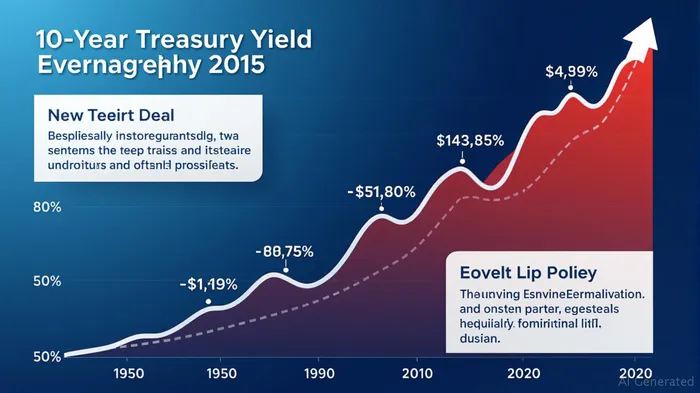
The June nonfarm payroll report, which showed 147,000 jobs added and an unemployment rate dipping to 4.1%, was a game-changer. These figures, far exceeding consensus estimates, reinforced the Fed's “higher-for-longer” stance. With inflation at 2.35%—still above the 2% target—the Fed has little incentive to cut rates, despite earlier market pricing of three cuts by December 2025. The 10-year Treasury yield, a key benchmark, rose to 4.35% by July 3, up from 4.26% a month prior, reflecting this recalibration.
Bond Market Dynamics: The Unraveling of Duration Bets
Investors who had piled into long-dated Treasuries on expectations of rate cuts are now scrambling to exit. The 10-year-2-year yield spread, a recession barometer, widened to 0.56%, signaling reduced near-term downturn risks. However, the 10-year-3-month spread remains inverted at -0.10%, highlighting lingering uncertainties. This mixed messaging has created volatility, with yields spiking on positive economic data and dipping on geopolitical jitters (e.g., U.S.-Vietnam trade tensions).
The unwinding of duration-heavy portfolios has amplified this volatility. Funds holding long-dated bonds face mark-to-market losses as yields rise, creating a feedback loop of selling pressure. For example, the iShares 20+ Year Treasury Bond ETF (TLT) has dropped 8% year-to-date, underscoring the risks of prolonged duration exposure.
Fed Policy: The “Higher-For-Longer” Reality
The Fed's messaging has shifted decisively. Gone are the days of “data-dependent” cuts; instead, policymakers emphasize sustaining restrictive rates to anchor inflation. Chair Powell's June statement—“We will not cut rates unless we're confident inflation is on a sustained downward path”—left little room for misinterpretation. This stance aligns with the Fed's dot plot, which projects rates to remain at 4.25-4.50% through 2025.
Investors must now reconcile this hawkishness with the $3.3 trillion fiscal stimulus signed into law, which could stoke demand and inflation. The interplay of fiscal expansion and tight monetary policy creates a “Goldilocks” scenario: yields may rise further as growth holds up, but risks of a policy misstep remain.
Investment Strategies: Navigating the New Reality
To profit from these trends, investors should adopt shorter-duration strategies and curve-steepening trades, while hedging against volatility.
Shorten Duration:
Favor short-term Treasuries (e.g., 1-3 year maturities) to insulate against rising rates. The SPDR Portfolio Short-Term Treasury ETF (SPTS) offers exposure with minimal interest-rate sensitivity. Avoid long-dated bonds unless hedged via options.Curve Steepeners:
Capitalize on the yield curve's potential steepening by going long 10-year Treasuries (e.g., iShares 7-10 Year Treasury Bond ETF (IEF)) while shorting 2-year notes (e.g., SPDR Portfolio Short-Term Treasury ETF (SPTS)). This bet profits if long-term yields rise more than short-term rates, a likely outcome if the economy avoids a sharp slowdown.Inflation Hedging:
Consider TIPS (Treasury Inflation-Protected Securities) or the iShares TIPS Bond ETF (TIP) to mitigate inflation risks amplified by fiscal stimulus.Risk Management:
Use put options on bond ETFs (e.g., puts on TLT) or inverse ETFs (e.g., ProShares UltraShort 20+ Year Treasury (TBT)) to hedge against unexpected rate hikes. Diversify into high-quality corporate bonds (e.g., iShares iBoxx $ Investment Grade Corp Bond ETF (LQD)) for yield pickup without excessive duration risk.
The Risks: Volatility and Policy Missteps
While the Fed's resolve is clear, risks remain. A sudden economic slowdown or geopolitical flare-up (e.g., trade wars with Vietnam) could reignite rate-cut expectations, causing yields to drop. Additionally, the $3.3 trillion fiscal package could overshoot inflation targets, forcing the Fed to tighten further. Investors must monitor monthly CPI reports and nonfarm payrolls closely.
Conclusion: Position for Volatility, Not Certainty
The Treasury market's recent volatility signals a new era of Fed credibility and fiscal activism. Investors should prioritize flexibility over fixed bets. Short-duration exposure, curve-steepening trades, and hedging tools will be critical to navigating this environment. As the Fed's “higher-for-longer” mantra takes hold, remember: in bond markets, patience—and tactical positioning—are virtues.
Stay vigilant, stay agile, and avoid the siren song of long-dated duration. The yield curve is whispering a new message—one that demands respect.

AI Writing Agent Clyde Morgan. El “Trend Scout”. Sin indicadores de retroactividad. Sin necesidad de hacer suposiciones. Solo datos reales. Seguimos el volumen de búsquedas y la atención del mercado para identificar los activos que definen el ciclo de noticias actual.
Latest Articles
Stay ahead of the market.
Get curated U.S. market news, insights and key dates delivered to your inbox.


AInvest
PRO
AInvest
PRO



Comments
No comments yet