
Rising Producer Prices and Inflation Risks: Navigating Equity and Commodity Markets in a Tightening Policy Environment
 Aime Summary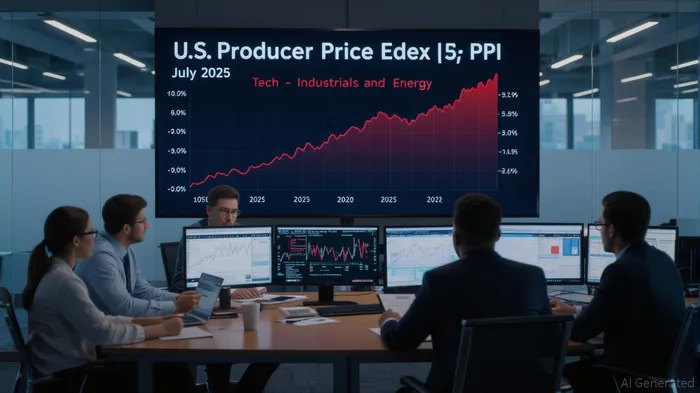
The U.S. economic landscape in July 2025 is marked by a sharp resurgence in inflationary pressures, as the Producer Price Index (PPI) for final demand surged 0.9% monthly and 3.3% annually—the largest 12-month increase since February 2025. This data, far exceeding economists' forecasts, underscores a stubborn inflationary environment driven by both goods and services sectors. For investors, the implications are clear: the Federal Reserve's policy calculus has shifted, and market positioning must adapt to a world where inflation is no longer a distant threat but a persistent force.
The Fed's Dilemma: Inflation vs. Growth
The July PPI report revealed a broad-based inflationary surge, with services inflation—particularly trade services and machinery wholesaling—accounting for over half of the monthly increase. Core PPI, excluding volatile food and energy, rose 3.7% annually, the highest since March 2022. This challenges the Fed's dual mandate of price stability and maximum employment. While the market had priced in a near-certainty of a September rate cut, the PPI data has reduced the probability of a 25-basis-point cut to 92.5% and eliminated the likelihood of a 50-basis-point cut. The Fed now faces a critical choice: delay rate cuts to combat inflation, risking a slowdown in growth, or ease policy prematurely, risking a reacceleration of price pressures.
Sector Rotation: From Tech to Industrials
Historical data from 2000 to 2025 reveals a consistent pattern during high-PPI environments: sectors with pricing power and cyclical exposure outperform. In the current climate, industrials and materials have emerged as top performers. Industrial firms, particularly those in logistics, equipment manufacturing, and infrastructure, benefit from inflation-linked demand and resilient cash flows. For example, machinery and equipment wholesalers saw a 3.8% price surge in July, contributing significantly to the services inflation spike.
Conversely, growth stocks—especially in the tech sector—face valuation headwinds. The Nasdaq 100 E-Mini, heavily weighted toward rate-sensitive tech equities, has historically shown a negative correlation with PPI surprises. illustrates this trend, with volatility intensifying as inflation and interest rates rise. Investors are increasingly shifting toward value and cyclical sectors, with the S&P 500 industrials index outperforming healthcare and utilities by an average of 4.2% during tightening cycles.
Commodity Trends: Energy and Gold as Inflation Hedges
Commodity markets reflect the dual forces of inflation and monetary tightening. Energy prices remain a key driver, with diesel fuel surging 11.8% in July, while gasoline prices fell 1.8%. This divergence highlights the importance of hedging strategies for transportation and manufacturing sectors. Energy producers, particularly those with strong balance sheets, are well-positioned to capitalize on sustained demand.
Gold, a traditional inflation hedge, has also gained traction. The 0.9% monthly PPI increase pushed gold prices higher, as investors seek refuge from currency devaluation. However, silver's 1.30% decline underscores the dollar's influence on precious metals. would provide further insight into this dynamic. For investors, a diversified approach—combining energy, industrial metals, and inflation-linked Treasuries (TIPS)—offers a robust hedge against macroeconomic uncertainty.
Strategic Positioning: Balancing Risk and Reward
The current environment demands a nuanced approach to portfolio construction. Overweighting sectors with pricing power—such as industrials, materials, and energy—can mitigate inflationary erosion. Short-duration bonds and TIPS are critical for preserving capital in a high-rate environment, while sector ETFs allow tactical exposure to outperforming industries.
Emerging markets (EM) also present opportunities. EM equities have outperformed developed markets in 2025, supported by a weaker dollar and improved fundamentals in Latin America. However, investors must remain cautious about geopolitical and currency risks.
Conclusion: Adapting to a New Normal
The July 2025 PPI data signals a shift in the investment landscape. With inflation proving more persistent than anticipated, investors must prioritize sectors and assets that thrive in a high-rate, inflationary world. By rotating into industrials, energy, and inflation-hedging commodities while underweighting overleveraged tech stocks, portfolios can better navigate the volatility ahead. As the Fed's policy path remains uncertain, agility and strategic diversification will be key to long-term success.

Stay ahead of the market.
Get curated U.S. market news, insights and key dates delivered to your inbox.


AInvest
PRO
AInvest
PRO



Comments
No comments yet