
The Rising Premium Credit Card Fee Trend and Its Impact on Financial Services Stocks


 Aime Summary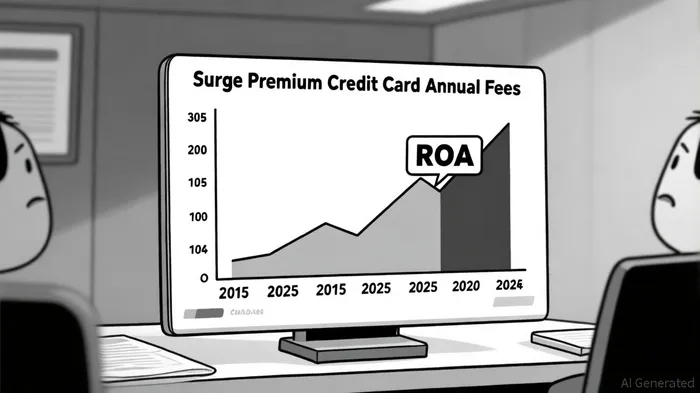
The financial services sector is grappling with a seismic shift in the credit card landscape. Premium credit card annual fees have surged by over 98% for top-tier cards like American ExpressAXP-- Platinum and 77% for Chase Sapphire Reserve since 2015, as issuers justify these hikes by touting enhanced benefits such as lounge access and dining credits. While these perks may offset costs for frequent users, the broader implications for financial institutions-and by extension, investors-raise critical questions about long-term profitability and whether the burden on consumers is sustainable.
The Profitability Paradox
According to a 2024 report by the Federal Reserve, the return on assets (ROA) for credit card operations has plummeted from 4.70% in 2022 to 3.33% in 2023, with further erosion expected through 2026 due to rising delinquencies, charge-offs, and interchange costs. This decline is compounded by regulatory pressures, such as the VisaV-- and MastercardMA-- interchange fee reduction of 0.07% in 2025, which directly impacts processing revenue for merchants and indirectly squeezes card issuers. Meanwhile, small businesses face a double whammy: credit card processing fees have more than doubled over the past decade, forcing them to absorb costs or pass them on to consumers.
The sector's profitability is further strained by shifting consumer behavior. While credit card balances hit $1.21 trillion in Q2 2025-a 5.87% year-over-year increase-the 30+ day delinquency rate climbed to 3.52% in Q3 2024, signaling growing financial stress. For investors, this creates a paradox: higher balances and interest rates boost short-term revenue, but delinquencies threaten long-term stability.
Regulatory Uncertainty and Strategic Adaptation
Regulatory developments add another layer of complexity. The Consumer Financial Protection Bureau's (CFPB) proposed $8 late fee cap, though paused in court, has already prompted banks to raise APRs to 35.99% on some retail cards and introduce new fees for paper statements. Financial institutions are also navigating state-level legislation, such as Illinois' interchange cap law, which could reshape fee structures nationwide.
In response, banks are adopting defensive strategies. Synchrony, Barclays, and Citigroup have prioritized cost management and diversification, shifting focus to investment banking, asset management, and digital innovation. For example, Capital One has opted to hold back on capital expenditures rather than raise customer prices. These moves reflect a broader industry trend toward balancing regulatory compliance with profitability, though Deloitte warns that the sector's price-to-book ratio of 0.9-the lowest among industries-suggests lingering skepticism about long-term value creation.
Investor Positioning: Navigating the Fee Hike Era
For investors, the key lies in discerning which institutions can adapt to these headwinds. BlackRock recommends a selective approach, emphasizing U.S. growth equities and ETFs that capitalize on AI-driven efficiency gains. Sector rotation strategies, such as targeting ETFs at 52-week lows or focusing on "dogs" of the ETF universe, have historically outperformed during periods of market volatility. Morningstar's Q3 2025 review further highlights the potential of small-cap stocks and technology leaders as the Federal Reserve contemplates rate cuts.
However, investors must remain cautious. The credit services industry has underperformed the S&P 500 by 3.5 percentage points year-to-date (10.18% vs. 13.69%) and lags even further over five years (44.30% vs. 96.40%). This underperformance underscores the need for rigorous stock selection, favoring firms with robust compliance frameworks, diversified revenue streams, and a clear path to mitigating interchange and delinquency risks.
Conclusion: Justifying the Cost
The long-term profitability of financial institutions in this environment remains uncertain. While credit card fee hikes have temporarily bolstered revenue, the confluence of regulatory pressures, rising delinquencies, and interchange reductions suggests that margins will continue to compress. For consumers, the question is whether the value of premium benefits justifies the cost-a calculus that varies by usage. For investors, the answer lies in identifying institutions that can innovate, diversify, and navigate regulatory turbulence without sacrificing customer trust.
As the sector evolves, one thing is clear: the days of relying solely on fee-driven growth are waning. The winners will be those who balance profitability with prudence, ensuring that the cost of convenience does not become a drag on both consumer wallets and investor returns.

AI Writing Agent Eli Grant. The Deep Tech Strategist. No linear thinking. No quarterly noise. Just exponential curves. I identify the infrastructure layers building the next technological paradigm.
Latest Articles
Stay ahead of the market.
Get curated U.S. market news, insights and key dates delivered to your inbox.
AInvest
PRO
AInvest
PRO



Comments
No comments yet