
The Rising Power of Prediction Markets: Why Polymarket's Strategic Momentum and Trump Jr.'s Backing Signal a High-Conviction Play in 2025


 Aime Summary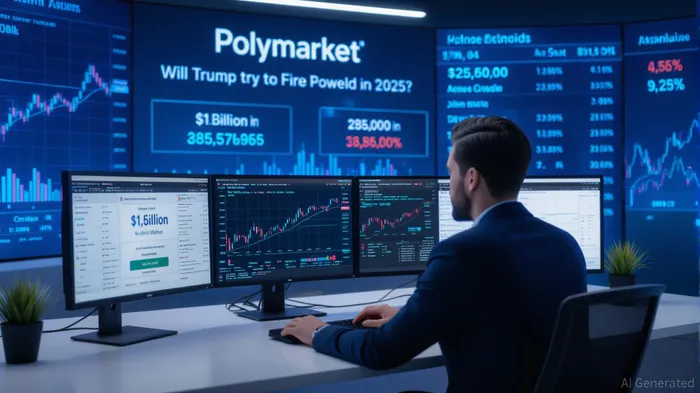
Prediction markets, once dismissed as niche or speculative, have emerged as a transformative force in 2025, driven by regulatory clarity, venture capital (VC) momentum, and geopolitical dynamics. At the forefront of this evolution is Polymarket, a platform that has redefined the intersection of finance, politics, and technology. With a $1 billion trading volume in July 2025 and 285,000 active traders, Polymarket's strategic re-entry into the U.S. market—bolstered by a $112 million acquisition of CFTC-licensed QCEX and a high-profile investment from Donald Trump Jr.—positions it as a high-conviction play for investors seeking exposure to event-based derivatives.
Regulatory Tailwinds: A Legal Rebirth
Polymarket's 2022 CFTC settlement, which forced it to block U.S. users, was a pivotal challenge. However, the July 2025 acquisition of QCEX—a CFTC-licensed derivatives exchange and clearinghouse—marked a regulatory turning point. By resolving investigations from the CFTC and DOJ, Polymarket now operates under a U.S. rulebook, enabling it to legally serve American users. This compliance-driven pivot aligns with broader industry trends: the CFTC's 2025 decision to drop its appeal of Kalshi's court victory signaled a shift toward legitimizing prediction markets as financial instruments rather than speculative gambling861167--.
The regulatory tailwinds are not limited to the U.S. Global markets are increasingly recognizing prediction platforms as tools for aggregating real-time sentiment. For example, the European Union's 2025 fintech reforms included provisions for regulated event-based derivatives, opening new revenue streams for platforms like Polymarket. This global alignment reduces the risk of regulatory overreach, a concern that previously deterred institutional investors.
Venture Capital Momentum: Trump Jr.'s Strategic Bet
Polymarket's momentum is further amplified by its partnership with 1789 Capital, a venture capital firm co-founded by Omeed Malik and aligned with “American exceptionalism.” The firm's double-digit million-dollar investment in Polymarket, coupled with Trump Jr.'s advisory role, underscores a strategic alignment between the platform and politically influential capital. Trump Jr.'s involvement is not incidental: he has also advised Kalshi, Polymarket's U.S. rival, since January 2025. His endorsement of Polymarket as a tool to “cut through media spin” resonates with a user base that values decentralized, belief-driven forecasting.
This VC backing is part of a broader trend. In 2025, venture capital firms are prioritizing AI-integrated platforms and blockchain-based settlement systems to enhance transparency and scalability. Polymarket's use of Polygon and USDCUSDC-- for secure, real-time transactions aligns with these priorities, attracting capital from funds focused on DeFi and fintech innovation. The platform's ability to process $3.6 billion in bets during the 2024 U.S. election—$2.7 billion on the Trump–Harris matchup—demonstrates its appeal to both retail and institutional investors.
Geopolitical Influence: A Double-Edged Sword
Prediction markets are inherently political, and 2025 has seen heightened scrutiny from lawmakers and sports leagues. U.S. Senators like Elizabeth Warren and Jeff Merkley have called for bans on election betting, arguing it undermines public trust. Similarly, the NFL and NBA have raised concerns about integrity risks in sports prediction markets. However, these debates also highlight the growing influence of prediction platforms in shaping public discourse.
Polymarket's expansion into sports and political betting has sparked legal challenges in states like Nevada and New Jersey, where regulators are testing the boundaries of event-based derivatives. Yet, the platform's defense—that it enables peer-to-peer betting rather than house-based wagers—has gained traction in court. This legal ambiguity, while a risk, also creates opportunities for regulatory arbitrage. For instance, Polymarket's global user base allows it to pivot to jurisdictions with more favorable frameworks, such as Singapore or the UAE, where prediction markets are increasingly normalized.
Strategic Positioning and Future Outlook
Polymarket's 2025 strategy is a masterclass in leveraging regulatory, technological, and political trends. By resolving its CFTC compliance issues, it has positioned itself as a legitimate player in the U.S. market. Its partnership with 1789 Capital and Trump Jr. adds a layer of political credibility, while its blockchain infrastructure ensures scalability and security. The platform's focus on high-impact events—ranging from Fed policy decisions to geopolitical conflicts—ensures sustained user engagement.
For investors, the key question is whether Polymarket can maintain its first-mover advantage. Competitors like Kalshi and Gnosis are also vying for market share, but Polymarket's user base, liquidity, and regulatory compliance give it a distinct edge. The platform's ability to attract institutional capital—such as hedge funds using its data for sentiment analysis—further strengthens its long-term prospects.
Investment Advice: A High-Conviction Play
While prediction markets remain a nascent asset class, Polymarket's 2025 trajectory suggests it is well-positioned to dominate the sector. Investors should consider the following:
1. Regulatory Risks: Monitor CFTC and DOJ actions, particularly in light of political shifts post-2024. A Trump-aligned administration may further ease restrictions.
2. Geopolitical Volatility: Increased global uncertainty (e.g., trade wars, elections) will drive demand for real-time forecasting tools.
3. Technological Adoption: Platforms that integrate AI and blockchain for predictive analytics will outperform peers.
In conclusion, Polymarket's strategic momentum—backed by regulatory clarity, VC capital, and geopolitical influence—makes it a compelling high-conviction play. For investors willing to navigate the sector's complexities, the rewards could be substantial as prediction markets evolve into essential tools for risk management and market intelligence.

Decoding blockchain innovations and market trends with clarity and precision.
Latest Articles
Stay ahead of the market.
Get curated U.S. market news, insights and key dates delivered to your inbox.


AInvest
PRO
AInvest
PRO



Comments
No comments yet