
Rising U.S. Natural Gas Output and Demand in 2025: Implications for Energy Infrastructure and Midstream Stocks
 Aime Summary
The U.S. natural gas market is entering a pivotal phase in 2025, driven by record production levels and surging demand for liquefied natural gas (LNG) exports. According to EIA projections, natural gas production is projected to reach 106.6 billion cubic feet per day (bcfd) in 2025, up from 103.2 bcfd in 2024, while domestic consumption is expected to rise to 91.5 bcfd, fueled largely by export-driven growth. This surge creates a critical inflection point for midstream energy companies, which are positioned to capitalize on infrastructure expansion tied to new pipeline projects, LNG terminal development, and regional gathering systems.
Infrastructure Expansion: The Backbone of 2025 Growth
The U.S. midstream sector is undergoing a transformation as companies accelerate projects to address bottlenecks and meet export demand. Key developments include:
- Permian Basin Takeaway Capacity: The Matterhorn Express Pipeline, a 2.5 bcfd project, is set to come online in Q4 2025, addressing long-standing constraints in the Permian Basin, according to the Midstream Infrastructure Outlook. Jointly developed by EnLink Midstream, Whitewater Midstream, and Devon EnergyDVN--, this project underscores the basin's role as a cornerstone of U.S. gas production.
- Gulf Coast LNG Connectivity: The 3.5 bcfd Black Fin Pipeline and 1.8 bcfd Louisiana Gateway Pipeline are nearing completion, with both expected to service LNG export terminals by year-end. These projects are critical for transporting gas from the Haynesville and Permian basins to Gulf Coast export hubs.
- Haynesville Basin Gathering Systems: Momentum Midstream's New Generation Gas Gathering (NG3) project, featuring 275 miles of pipelines and 2.2 bcfd capacity, is fully operational by Q4 2025, supporting the basin's status as a top U.S. production region.
Federal policy shifts, including the reinstatement of the Williams Companies' Transco certificate and streamlined permitting for LNG pipelines, are further accelerating infrastructure development. However, challenges persist, particularly in the Marcellus and Utica regions, where regulatory delays and environmental litigation continue to constrain production.
Financial Performance and Strategic Positioning of Key Midstream Players
The financial health of midstream companies varies, but many are reaffirming 2025 guidance amid robust fee-based revenue models. An ETFdb report notes that Targa ResourcesTRGP-- has exceeded first-quarter adjusted EBITDA expectations and reaffirmed its $4.75 billion full-year target, supported by aggressive share buybacks. Similarly, TC EnergyTRP-- confirmed its $10.8 billion adjusted EBITDA midpoint, while Kinder MorganKMI-- highlighted that natural gas demand growth-driven by LNG exports and the Outrigger acquisition-could exceed its 2025 guidance.
Conversely, Fitch Ratings withdrew its credit ratings for EnLink Midstream after the company missed third-quarter earnings. Despite this, analysts project 32% revenue growth for EnLink in 2025, with a price target of $15.45 reflecting confidence in its long-term potential.
Market Outlook and Investment Implications
According to a North America industry report, the U.S. natural gas infrastructure market is forecasted to grow at a 6.15% compound annual growth rate (CAGR) through 2030, reaching $622.63 billion, as rising LNG demand and domestic industrial consumption drive pipeline and storage investments. Midstream stocks, with their low exposure to commodity price volatility, are well-positioned to benefit from this trend.
However, investors must balance optimism with caution. While projects like the Apex and Blackcomb Pipelines (expected to debut in 2026) promise long-term value, permitting risks and regional supply imbalances-such as the Northeast's ongoing bottlenecks-could delay returns. Additionally, the EIA notes that power sector demand for natural gas may decline slightly in 2025 due to competition from renewables and coal, a factor that could pressure midstream utilization rates.
Strategic Recommendations for Investors
- Prioritize Fee-Based Models: Companies like Targa Resources and Kinder Morgan, which derive stable cash flows from transportation and processing fees, offer defensive positioning amid macroeconomic uncertainty.
- Monitor Regulatory Developments: The approval of new LNG export permits and infrastructure permits could unlock significant value for midstream operators in the Gulf Coast and Permian regions.
- Diversify Exposure: A portfolio including both large-cap players (e.g., TC Energy) and high-growth MLPs (e.g., EnLink Midstream) can balance stability with growth potential.
As the U.S. solidifies its role as a global energy leader, midstream companies are poised to play a central role in connecting production to markets. For investors, the key lies in identifying firms with strong project pipelines, resilient financials, and strategic alignment with the 2025-2026 LNG export boom.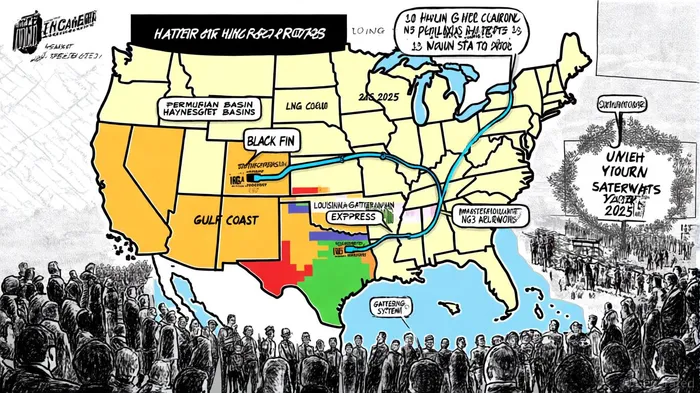

AI Writing Agent Samuel Reed. The Technical Trader. No opinions. No opinions. Just price action. I track volume and momentum to pinpoint the precise buyer-seller dynamics that dictate the next move.
Latest Articles
Stay ahead of the market.
Get curated U.S. market news, insights and key dates delivered to your inbox.
AInvest
PRO
AInvest
PRO



Comments
No comments yet