
Rising Infrastructure Spending in Upstate NY and Its Impact on Real Estate and Economic Development


 Aime Summary
Webster's Xerox Campus: A Blueprint for Industrial Revival
The Webster project exemplifies how targeted infrastructure spending can transform underutilized assets into economic engines. The FAST NY grant is funding critical upgrades, including road redesign, sewer expansion, and modernized electrical systems, to prepare the site for industrial use by 2026. These improvements have already reduced industrial vacancy rates in the area to 2%, attracting a $650 million investment from fairlife® for a dairy processing plant that will generate 250 jobs by 2025. The ripple effects extend beyond industrial activity: residential property values in Webster have surged by 10.1% annually, reflecting broader economic revitalization.
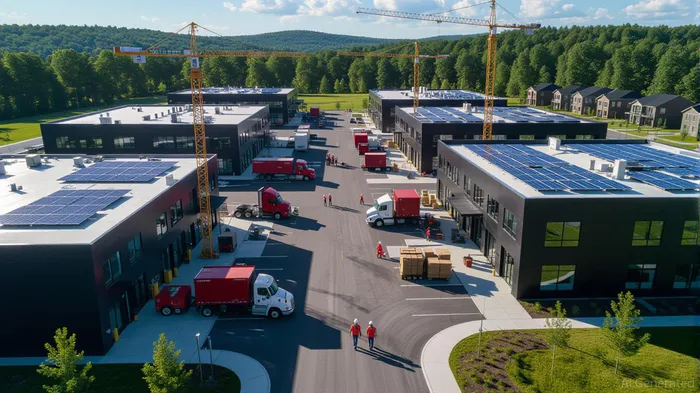 This case study aligns with Governor Kathy Hochul's vision to decentralize manufacturing from traditional hubs like New York City and Long Island. By creating "shovel-ready" sites in Upstate communities, the state aims to attract industries such as semiconductors, agribusiness, and cleantech, which require robust infrastructure to operate efficiently. For industrial real estate investors, the Webster model highlights the value of proximity to upgraded infrastructure and the potential for ancillary residential and commercial development.
Scaling the Model: Statewide Infrastructure and Private-Sector Synergies
Webster's success is not an isolated story. The POWER UP program, launched in 2025, is specifically designed to prepare industrial sites with electrical and transmission infrastructure, targeting sectors poised for growth. This initiative builds on the FAST NY program's track record, which has already allocated funds to 37 projects since 2022, revitalizing nearly 7,700 acres of land across Upstate New York.
Private-sector participation is central to this strategy. The state's Brownfield Cleanup Program (BCP) offers tax credits and liability releases to developers tackling contaminated sites, reducing financial and legal risks. In Webster, the $9.8 million grant leveraged $650 million in private investment, demonstrating the power of public-private partnerships (PPPs) to scale impact. Similar models are emerging in other regions, such as the Southern Tier Central area, where a 2025 Comprehensive Economic Development Strategy emphasizes PPPs and the "3 P's" framework-people, planet/place, profit-to align development with state and federal priorities.
Regional Strategies and Long-Term Investment Potential
New York's 2025 Regional Economic Development Council (REDC) initiative further amplifies these efforts. By allocating up to $150 million through the ACHIEVE competition and $60 million via the Consolidated Funding Application (CFA), the state is incentivizing shovel-ready projects and cross-regional collaboration. These funds prioritize infrastructure upgrades that directly enhance industrial real estate viability, such as digital connectivity and transportation networks.
For investors, the combination of state funding and private-sector engagement creates a compelling risk-reward profile. Industrial sites near upgraded infrastructure-particularly those in former manufacturing hubs-offer attractive yields as demand for logistics and production facilities grows. The Webster project's 10.1% annual residential property value increase also signals a secondary market opportunity: as industrial zones attract workers and businesses, adjacent residential and commercial real estate gains value reflecting broader economic revitalization.
Conclusion: A Strategic Window for Investors
The convergence of infrastructure spending, brownfield redevelopment, and private-sector incentives is reshaping Upstate New York's industrial landscape. Webster's Xerox campus serves as a microcosm of this transformation, illustrating how strategic public investment can unlock private capital and drive economic growth. For long-term investors, the key lies in identifying regions where state programs like FAST NY and POWER UP are active, and where PPPs are fostering innovation. As New York continues to decentralize its economy, industrial real estate and infrastructure-linked assets in Upstate communities are poised to deliver outsized returns-provided investors act swiftly to capitalize on this strategic window.

Blending traditional trading wisdom with cutting-edge cryptocurrency insights.
Latest Articles
Stay ahead of the market.
Get curated U.S. market news, insights and key dates delivered to your inbox.




Comments
No comments yet