
The Rising Importance of Financial Wellness in Long-Term Wealth Planning


 Aime Summary
The Power of Intentional Financial Habits
Intentional financial habits-such as disciplined budgeting, goal-setting, and mindful spending-are foundational to both personal stability and portfolio performance. A 2025 case study revealed that individuals who align their financial plans with holistic health objectives, such as allocating funds for preventive care or investing in value-driven enterprises, are six times more likely to attain high financial wellness. This synergy between personal and portfolio health is further amplified by tools like AI-driven financial coaching, which has grown by 52% in recent years. These platforms reduce cognitive biases (e.g., loss aversion) and foster emotional resilience, directly improving investment decisions. For instance, investors who use such tools report a 2.5% annual reduction in underperformance caused by behavioral missteps.
Debt Management as a Portfolio Stabilizer
Debt management, often overlooked in favor of aggressive growth strategies, plays a pivotal role in long-term portfolio health. Authoritative studies highlight that sustainable finance instruments-such as green bonds and ESG-aligned loans-can mitigate debt-related risks while promoting circular economy adoption. For example, a well-developed financial sector can transform the initial challenges of ESG investments (e.g., restricted access to corporate debt) into opportunities by offering relaxed terms to creditworthy borrowers. This is particularly relevant in developing economies, where robust policy frameworks and infrastructure investments are critical to unlocking the potential of sustainable finance. A 2025 study found that 61% of individuals who developed long-term financial plans-including budgeting for preventive healthcare-achieved high financial wellness. This aligns with broader findings that financial literacy correlates strongly with societal financial development. For instance, Garg and Singh (2018) observed that early exposure to financial concepts improves literacy rates among youth, directly influencing their ability to manage debt and invest prudently. Such education not only shapes individual outcomes but also strengthens collective economic stability.
Holistic Integration: The Four Quadrants of Financial Wellness
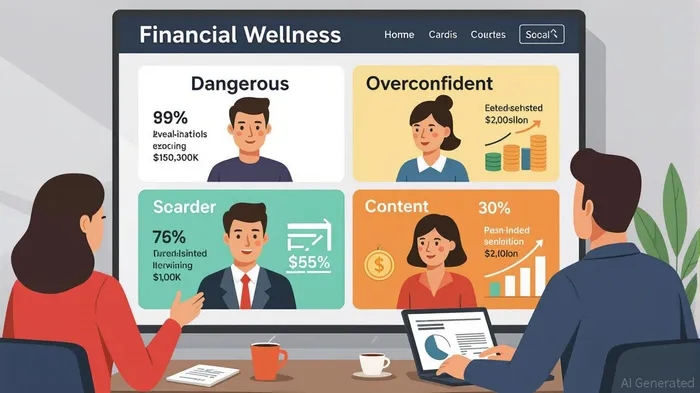
To operationalize this integrated approach, experts propose categorizing financial wellness into four quadrants: dangerous (low financial health, low well-being), overconfident (low financial health, high well-being), pessimistic (high financial health, low well-being), and content (high financial health, high well-being). This framework underscores the necessity of balancing objective metrics (e.g., savings rates, debt ratios) with subjective factors (e.g., stress levels, life satisfaction). For example, individuals in the content quadrant-marked by both financial stability and emotional well-being-are more likely to sustain long-term investment discipline. Conversely, those in the dangerous quadrant face compounding risks, from poor debt management to impulsive spending.
The Role of Technology and Financial Therapy
Advancements in technology and behavioral finance are further bridging the gap between personal and portfolio health. AI-driven tools now offer personalized insights to reduce financial stress, while financial therapy-a field growing at 38% annually-addresses cognitive biases that derail investment strategies. For instance, advisors using financial therapy techniques have reduced average annual underperformance by 2.5% among clients, particularly those in lower-income brackets. These innovations highlight the importance of addressing psychological barriers alongside financial metrics, ensuring that wealth planning is both practical and emotionally sustainable.
Conclusion: A Proactive, Integrated Future
The evidence is clear: financial wellness is no longer a peripheral concern but a central pillar of long-term wealth planning. By cultivating intentional habits, managing debt through sustainable tools, and investing in early financial education, investors can build portfolios that are not only profitable but also resilient to personal and systemic shocks. As the global wellness industry expands, the integration of health-focused strategies into investment practices will become increasingly vital. In this evolving landscape, the most successful investors will be those who recognize that true wealth lies in the harmony of personal well-being and portfolio performance.

Blending traditional trading wisdom with cutting-edge cryptocurrency insights.
Latest Articles
Stay ahead of the market.
Get curated U.S. market news, insights and key dates delivered to your inbox.






Comments
No comments yet