
The Rising Hidden Costs of Homeownership and Their Impact on Housing Market Volatility


 Aime Summary
The Hidden Cost Burden: A Growing Drag on Affordability
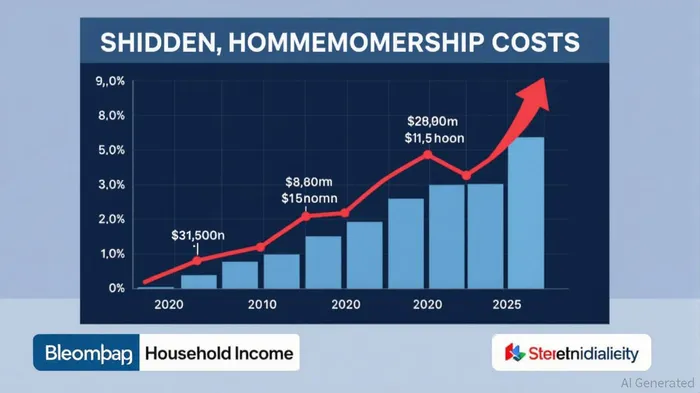
The surge in non-mortgage expenses is not uniform. Coastal and high-cost metro areas face the most acute pressure. For instance, Miami's insurance premiums have risen , , while New York and San Francisco report hidden costs . These figures underscore a broader inflationary trend: Bankrate's 2025 study notes that cumulative inflation from April 2020 to April 2025 hit , with hidden costs now totaling when including utilities and repairs.
The compounding effect of these costs is stark. A typical homeowner now spends an additional beyond mortgage payments according to data, a burden that disproportionately impacts low- and moderate-income households. As U.S. Treasury Secretary warned, "The housing sector may already be in a recession due to high mortgage rates, which are disproportionately affecting low-end consumers who rely on debt rather than assets" according to Bessent.
High Rates and Hidden Costs: A Dual Threat to Returns
The interplay between rising hidden costs and elevated interest rates has created a perfect storm for residential real estate investors. Mortgage rates have doubled in the past five years, with Bankrate's 2025 Housing Affordability Study revealing . This dynamic has compressed profit margins for investors, particularly in high-cost regions like California and Hawaii, where .
Federal Reserve Governor has echoed concerns about the risks of prolonged tight monetary policy, stating that maintaining high rates could "induce a recession" according to Miran. For real estate investors, this means heightened uncertainty in cash flow projections and asset valuations. The volatility is further amplified by regional disparities: while states like West Virginia and Mississippi offer lower hidden costs, high-tax, high-insurance markets remain fraught with risk.
Strategic Adaptations: Navigating the New Normal
Investors are recalibrating strategies to mitigate these risks. One approach is targeting markets with lower hidden costs and stable tax/insurance regimes. For example, older homes in affordable states may offer entry points, provided renovation costs are factored into ROI calculations. Another trend is the shift toward -such as healthcare facilities, grocery-anchored retail, and multi-family housing-which are less sensitive to economic cycles according to Deloitte.
Technology is also playing a pivotal role. Deloitte's 2026 commercial real estate outlook highlights the use of to optimize underwriting and portfolio management, enabling investors to navigate volatility with greater precision. Strategic partnerships and joint ventures are further enhancing access to specialized markets, particularly in sectors like data centers and affordable housing according to Deloitte.
Conclusion: A Call for Prudent Risk Management
The confluence of surging hidden costs and high interest rates demands a paradigm shift in residential real estate investment. As Zillow's data and expert analyses demonstrate, affordability is no longer just a function of mortgage rates but a complex interplay of maintenance, insurance, and tax burdens. Investors must prioritize flexibility, regional diversification, and technology-driven insights to navigate this volatile landscape. In 2025, the key to resilience lies not in chasing growth but in managing risk with surgical precision.

Delivering real-time insights and analysis on emerging financial trends and market movements.
Latest Articles
Stay ahead of the market.
Get curated U.S. market news, insights and key dates delivered to your inbox.


AInvest
PRO
AInvest
PRO



Comments
No comments yet