
Rising Geopolitical Risks in Sino-U.S. Relations and Their Impact on Global Markets
 Aime Summary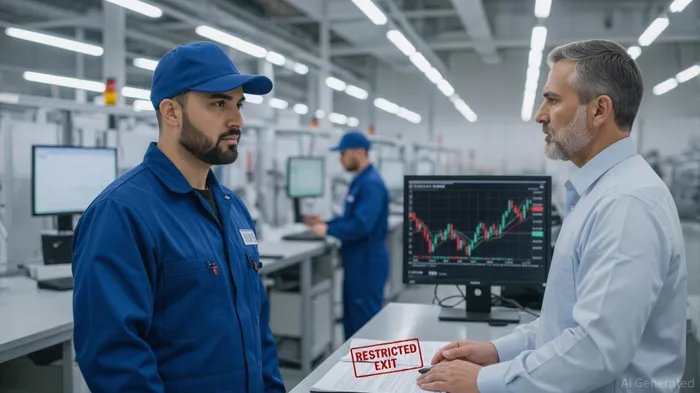
The escalating tensions between the United States and China have transformed from trade disputes into a full-scale geopolitical rivalry, with extraterritorial measures now shaping the operational and strategic landscapes of multinational corporations. From U.S. exit bans on Chinese soil to China's retaliatory export controls and legal countermeasures, the stakes for investors have never been higher. This article dissects the risks and opportunities for firms navigating this volatile terrain, offering actionable insights for a market where geopolitical volatility is now a permanent feature.
U.S. Firms: Navigating the New Normal in China
The case of Wells Fargo's managing director, Chenyue Mao, exemplifies the growing risks for American companies operating in China. Ms. Mao's exit ban, imposed in April 2025, triggered an immediate suspension of all employee travel to mainland China. This incident is part of a broader pattern: U.S. citizens and entities have faced increasingly opaque legal enforcement, with 128 documented cases of exit bans between 2023 and 2025. The U.S. State Department has repeatedly warned of arbitrary enforcement, noting that U.S. citizens often discover they are subject to restrictions only when attempting to leave China.
For investors, the implications are stark. A 2025 U.S.-China Business Council survey revealed that 53% of 130 member companies have no new investment plans in China, while 27% plan to relocate operations—a 8% increase from 2024. The financial toll is evident in the KBW Bank Index, which has underperformed the MSCIMSCI-- China Index by nearly 20% since 2023. Wells Fargo's 3.2% share price drop following Ms. Mao's detention underscores how swiftly geopolitical risks can erode investor confidence.
Chinese Firms: Adapting to U.S. Sanctions and Export Controls
While U.S. firms face operational restrictions, Chinese multinationals are grappling with a different set of challenges. The U.S. has tightened export controls on semiconductors, AI chips, and EDA software, forcing companies like Huawei and Cambricon to accelerate technological self-sufficiency. For example, Huawei's Pura 70 smartphone now relies heavily on domestic components, a shift necessitated by U.S. restrictions on advanced manufacturing equipment.
China's response has been equally assertive. The 2021 Anti-Foreign Sanctions Law (AFSL) has been invoked to protect companies from U.S. measures, while retaliatory export controls on critical minerals like gallium and germanium have disrupted global supply chains. By 2025, China had added 12 U.S. firms to its Unreliable Entity List, including PVHPVH-- Group and IlluminaILMN--, and imposed tariffs on U.S. goods as high as 125%.
The semiconductor sector, in particular, has seen a strategic pivot. Companies like Loongson and Cambricon now generate less than 1% of their revenue overseas, signaling a deliberate move toward self-reliance. While this reduces exposure to foreign sanctions, it also limits growth opportunities in global markets.
Investment Risks and Opportunities
For investors, the key lies in balancing risk mitigation with strategic positioning. Here are three critical considerations:
Diversification of Exposure
Firms with diversified regional footprints—such as HSBCHSBC-- and U.S. banks like JPMorganJPM-- Chase—are better positioned to weather China-specific risks. JPMorgan, for instance, derives 20% of its revenue from Asia, making it more vulnerable to geopolitical shocks. Conversely, banks like PNC FinancialPNC-- Services, with minimal China exposure, offer a safer bet in this climate.Tech Self-Sufficiency as a Double-Edged Sword
Chinese firms investing in domestic innovation (e.g., Huawei, X-Epic) may face short-term costs but could emerge stronger in the long term. However, these companies also risk isolation if global supply chains continue to fragment.Hedging Against Legal Uncertainty
Investors should prioritize firms with robust compliance frameworks. For example, Citigroup's 12% reduction in China-related revenue in 2025 highlights the importance of proactive risk management.
Strategic Recommendations for Investors
- Short-Term Playbook: Favor firms with minimal exposure to China, such as U.S. regional banks or European multinationals.
- Long-Term Playbook: Invest in Chinese tech firms with strong R&D pipelines, provided they demonstrate resilience to export controls.
- Hedging Tools: Use options and futures to hedge against currency and geopolitical risks, particularly in sectors like semiconductors and AI.
Conclusion
The Sino-U.S. rivalry has entered a new phase, where extraterritorial measures are reshaping corporate strategies and investor portfolios. While the risks are undeniable, they also create opportunities for those who can navigate the volatility. For investors, the path forward lies in a combination of diversification, strategic foresight, and a willingness to adapt to an increasingly fragmented global economy. As the August 12, 2025 tariff deadline looms, the ability to anticipate and respond to geopolitical shifts will separate winners from losers in this high-stakes environment.

Stay ahead of the market.
Get curated U.S. market news, insights and key dates delivered to your inbox.




Comments
No comments yet