
Rising Fiscal Coordination Between South Korea and Global Credit Agencies: Implications for Asian Emerging Markets
 Aime Summary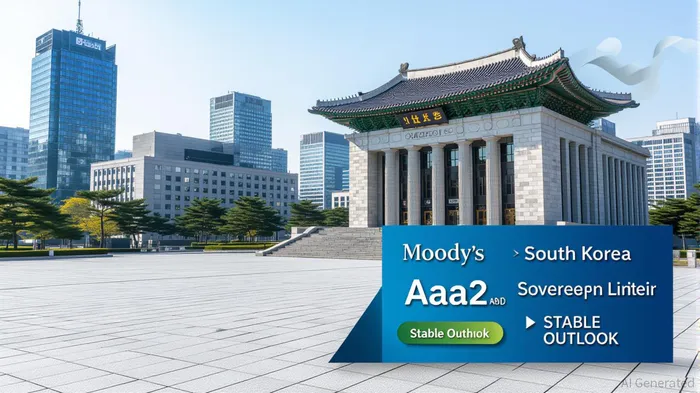
South Korea's recent fiscal coordination with global credit rating agencies like Moody'sMCO-- has emerged as a pivotal factor in shaping the country's economic trajectory and its influence on broader Asian emerging markets. As the August 2025 policy dialogues with Moody's underscore, South Korea is proactively aligning its fiscal and economic strategies with international standards, a move that could reinforce its sovereign credit rating and catalyze capital inflows across the region.
The Current State of Fiscal Coordination
Moody's annual consultations with South Korea, led by Senior Credit Officer Anushka Shah, have become a cornerstone of the country's efforts to maintain its Aa2 rating with a stable outlook. These dialogues, involving key institutions like the Ministry of Economy and Finance, Bank of Korea, and Korea Institute of Public Finance, focus on addressing structural challenges such as demographic aging, external trade volatility, and fiscal sustainability. South Korea's 2025 economic policy directions—centered on supporting livelihoods, managing external creditworthiness, adapting to trade uncertainties, and boosting industrial competitiveness—reflect a strategic alignment with the priorities of rating agencies.
The government's proactive approach, including extended meetings with Moody's and cross-ministerial coordination, signals a commitment to transparency and stability. This is critical in a context where South Korea's aging population and productivity constraints could otherwise weigh on its credit profile. By emphasizing reforms such as extended foreign exchange (FX) market hours and enhanced corporate bond market transparency, the country is addressing both domestic and global concerns about its long-term economic resilience.
Credit Rating Implications and Capital Flows
South Korea's sovereign credit rating remains a linchpin for investor confidence in Asian emerging markets. A stable or upgraded rating from Moody's would likely attract foreign capital, particularly to its corporate and sovereign debt markets. For instance, South Korea's corporate bond market, where 79% of rated bonds are investment-grade, serves as a benchmark for regional investors. The government's FX reforms—allowing foreign institutions to trade onshore KRW and extending trading hours—further enhance market accessibility, potentially drawing inflows from global investors seeking higher-yielding assets.
The ripple effects extend beyond South Korea. As a regional economic leader, its creditworthiness influences investor perceptions of other emerging markets in Asia. A downgrade could trigger a reassessment of risk across the region, particularly in countries facing similar demographic and fiscal challenges. Conversely, a reaffirmed or upgraded rating could bolster confidence in Asia's broader capital markets, encouraging portfolio diversification into Korean and neighboring economies.
Long-Term Investment Strategies in Emerging Asia
For investors, South Korea's fiscal coordination with Moody's offers a dual opportunity: hedging against regional volatility and capitalizing on structural reforms. The country's focus on industrial competitiveness—through sectors like semiconductors, green energy, and AI—positions it as a growth engine in Asia. Additionally, its FX market reforms, including digital aggregators and real-time rate comparisons, reduce transaction costs and settlement risks, making KRW-denominated assets more attractive.
However, geopolitical risks—such as North Korean tensions or U.S.-China trade dynamics—remain critical variables. Investors should balance exposure to South Korean equities and bonds with diversification into other Asian markets with strong fiscal fundamentals. For example, ETFs like the iShares MSCIMSCI-- South Korea ETF (EWY) or regional fixed-income funds could offer a blend of growth and stability.
Conclusion: Strategic Opportunities and Caution
South Korea's fiscal coordination with Moody's is more than a regulatory exercise—it is a strategic effort to anchor its role as a regional economic leader. By addressing demographic and fiscal challenges while enhancing market infrastructure, the country is creating a favorable environment for capital inflows. For investors, this translates into opportunities in Korean equities, corporate bonds, and FX-linked instruments, provided they remain mindful of geopolitical and macroeconomic risks.
As the next sovereign credit rating decision looms in 2026, South Korea's ability to maintain its Aa2 rating will be a key indicator for Asian emerging markets. Investors who align their portfolios with the country's reform agenda—and its broader regional influence—may find themselves well-positioned to navigate the evolving dynamics of the region's capital flows.

Stay ahead of the market.
Get curated U.S. market news, insights and key dates delivered to your inbox.
AInvest
PRO
AInvest
PRO



Comments
No comments yet