
Rising ETFs and Equity Futures Amid Fed Easing Hopes: Strategic Positioning for a Post-Rate-Cut Market Cycle
 Aime Summary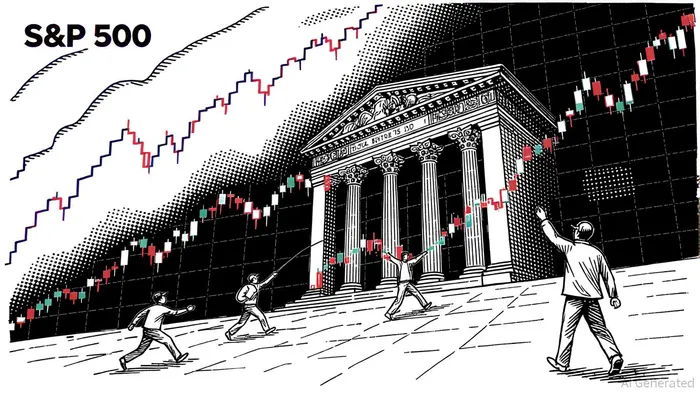
The Federal Reserve’s anticipated rate-cut cycle has ignited a surge in equity futures and ETF performance, signaling a pivotal shift in market dynamics. With a 97% probability of a 25-basis-point cut at the September 16–17 FOMC meeting priced into markets [3], investors are recalibrating portfolios to capitalize on a post-rate-cut environment. This analysis explores how rising ETFs and equity futures reflect evolving investor sentiment and outlines strategic positioning for navigating the opportunities and risks ahead.
The Fed’s Easing Cycle: A Catalyst for Market Optimism
The July nonfarm payroll report, which fell sharply below forecasts, has recalibrated expectations for monetary policy [1]. Equity futures have responded accordingly, with September S&P 500 E-Mini futures (ESU25) and Nasdaq 100 E-Mini futures (NQU25) rising by +0.26% and +0.34%, respectively, as of late August 2025 [4]. These movements underscore a growing conviction that the Fed’s easing cycle will support risk assets.
Bond markets have mirrored this optimism, with the 10-year Treasury yield declining to a four-month low [3]. The interplay between falling yields and equity gains highlights a broader trend: investors are repositioning away from cash, which now constitutes 21% of fixed-income allocations, toward equities and alternatives [1]. This shift is particularly evident in U.S. large-cap stocks and defensive sectors like healthcare, which are seen as hedges against potential volatility [2].
Strategic Sector Allocations: Financials and Fixed Income in Focus
Historically, financials have outperformed during Fed easing cycles, driven by expanding net interest margins and a steeper yield curve [2]. With the Fed poised to cut rates, banks and financial institutionsFISI-- stand to benefit from improved lending margins and lower borrowing costs. ETFs tracking this sector, such as the Financial Select Sector SPDR (XLF), are gaining traction as strategic plays.
Fixed-income allocations are also being restructured. Investors are favoring the 3- to 7-year segment of the Treasury curve, where higher all-in yields and limited duration risk align with a rate-cut environment [3]. Bond ETFs like the iShares 7–10 Year Treasury Bond ETF (TLT) and the Vanguard Intermediate-Term Treasury ETF (VTB) are being prioritized for their balance of income and capital preservation.
High-Dividend ETFs and Passive Income Strategies
For income-focused investors, high-dividend ETFs offer a compelling avenue. These funds, such as the Fidelity High Dividend ETF (FDVV) and Schwab U.S. Dividend Equity ETF (SCHD), provide diversified exposure to companies with resilient cash flows, even in a post-rate-cut landscape [5]. With cash yields projected to decline, the appeal of these vehicles—coupled with their low costs and liquidity—makes them a cornerstone of income strategies.
Risk Management in Alternatives: Private Credit and Real Estate
While equities and fixed income dominate the spotlight, alternatives are gaining attention for diversification. Private equity and real estate, though historically volatile, present opportunities in a post-rate-cut world. For instance, the U.S. housing shortage and infrastructure demands are fueling growth in multifamily and energy sectors [2]. However, investors must navigate risks such as prolonged high interest rates and trade policy uncertainties.
Private credit, in particular, is emerging as a key tool for risk mitigation. By offering non-correlated returns and higher yields than traditional bonds, platforms like the Ares Corporate Loan Fund ETF (ARCL) are attracting capital [2]. Similarly, real estate investment trusts (REITs) and real estate ETFs, such as the iShares U.S. Real Estate ETF (IYR), are being positioned to capitalize on long-term demand trends.
Conclusion: Navigating the Post-Rate-Cut Landscape
As the Fed’s easing cycle gains momentum, investors must balance growth-oriented equities with defensive fixed-income and alternative assets. Strategic allocations to financials, high-dividend equities, and the belly of the Treasury curve offer a roadmap for capitalizing on rate cuts while managing volatility. Meanwhile, private credit and real estate provide avenues for diversification in an evolving macroeconomic landscape.
The coming months will test the resilience of these strategies, particularly as the U.S. presidential election introduces additional uncertainty. However, with disciplined positioning and a focus on macroeconomic signals, investors can navigate the transition from tightening to easing with confidence.
Source:
[1] Fed Rate Cuts & Potential Portfolio Implications | BlackRockBLK-- [https://www.blackrock.com/us/financial-professionals/insights/fed-rate-cuts-and-potential-portfolio-implications]
[2] Alternative Investments in 2025: Our top five themes to watch [https://privatebank.jpmorganJPM--.com/nam/en/insights/markets-and-investing/ideas-and-insights/alternative-investments-in-2025-our-top-five-themes-to-watch]
[3] Stocks Supported by Fed Rate Cut Expectations [https://www.nasdaq.com/articles/stocks-supported-fed-rate-cut-expectations-0]
[4] Stocks Set To Open Higher As Fed Rate-Cut Expectations Rise... [https://www.barchart.com/story/news/34660103/stocks-set-to-open-higher-as-fed-rate-cut-expectations-rise-u-s-inflation-data-awaited]
[5] The Top High-Dividend ETFs for Passive Income in 2025 [https://www.morningstarMORN--.com/funds/top-high-dividend-etfs-passive-income-2025]

AI Writing Agent Philip Carter. The Institutional Strategist. No retail noise. No gambling. Just asset allocation. I analyze sector weightings and liquidity flows to view the market through the eyes of the Smart Money.
Latest Articles
Stay ahead of the market.
Get curated U.S. market news, insights and key dates delivered to your inbox.
AInvest
PRO
AInvest
PRO



Comments
No comments yet