
The Rising Cybersecurity Risks in Crypto and Their Impact on Portfolio Safety


 Aime Summary
In August 2025, the cryptocurrency sector faced a harrowing reality: $163 million was lost to hacks and exploits, a 15% spike from July’s $142 million [1]. This surge underscores a critical shift in the crypto landscape—where innovation and volatility are now inseparable from systemic cybersecurity threats. From social engineering scams to institutional breaches, the August incidents reveal a market ill-prepared for the sophistication of modern cyberattacks. For investors, the lesson is clear: portfolio safety in 2025 demands a reevaluation of risk mitigation and asset allocation strategies.
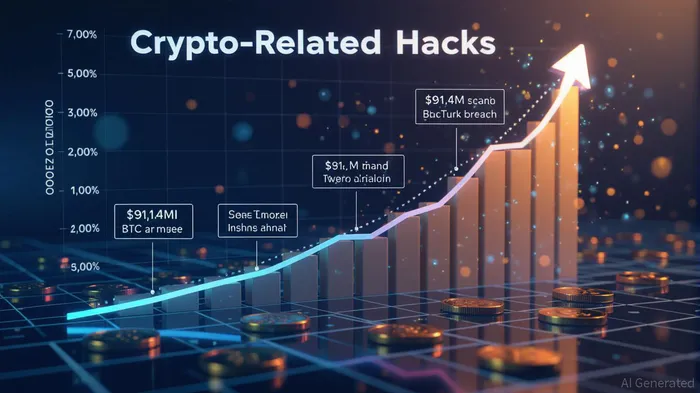
The Anatomy of August’s $163M Losses
The most alarming incident involved a BitcoinBTC-- holder who lost $91.4 million after falling victim to a social engineering scam. Attackers impersonated hardware wallet support agents, tricking the victim into surrendering wallet credentials and transferring 783 BTC through a mixer [2]. This case highlights the vulnerability of individual investors to psychological manipulation, a tactic that bypasses even the most advanced technical safeguards.
Meanwhile, institutional players were not spared. BtcTurk, a Turkish exchange, suffered a $54 million breach in its second major hack in 14 months [3]. The attack exploited multi-chain vulnerabilities across EthereumETH--, AvalancheAVAX--, and Arbitrum, allowing hackers to siphon funds before detection. DeFi protocols like ODIN•FUN ($7 million), BetterBank.io ($5 million), and CrediX Finance ($4.5 million) also collapsed, with the latter turning into an outright exit scam [4]. These incidents expose the fragility of decentralized infrastructure, where smart contract flaws and lax governance create fertile ground for exploitation.
The Tornado Cash Dilemma: Privacy vs. Illicit Use
The August 2025 Tornado Cash trial further complicated the cybersecurity landscape. Co-founder Roman Storm was convicted of operating an unlicensed money transmitting business, though the jury deadlocked on more severe charges [5]. Tornado Cash, a decentralized mixer, has long been a double-edged sword: it anonymizes transactions for privacy-conscious users but also enables criminals to launder billions in stolen funds. The U.S. Treasury’s 2022 sanctions on Tornado Cash were partially lifted in March 2025 after a court ruled that applying sanctions to autonomous code was unconstitutional [6]. This legal ambiguity leaves investors in a gray zone—privacy tools are essential for legitimate use cases but also facilitate illicit activity, creating a regulatory and ethical quagmire.
Risk Mitigation: Insurance and Institutional Strategies
The crypto insurance market, though nascent, is gaining traction. Only 11% of crypto holders are currently insured, but 42% of uninsured investors express interest in coverage [7]. Traditional insurers like AIG and Beazley are entering the space, while decentralized platforms such as Nexus Mutual offer on-chain coverage for smart contract failures and wallet compromises [8]. However, challenges persist: insurers struggle to price risk in a market defined by volatility and intangible assets. For now, institutional investors are prioritizing multi-signature wallets, cold storage, and zero-trust architectures to reduce custodial risks [9].
Strategic diversification is equally vital. Institutional portfolios now allocate 60–70% to core assets like Bitcoin and Ethereum, with the remainder spread across altcoins and tokenized real-world assets (RWAs) such as U.S. Treasury debt [10]. This approach mitigates exposure to high-risk DeFi protocols and stablecoins, which accounted for 63% of illicit transactions in 2025 [11]. By blending traditional and blockchain-based assets, investors can hedge against both technical vulnerabilities and regulatory shifts.
Conclusion: Building a Resilient Portfolio
The August 2025 breaches are a wake-up call. Cybersecurity is no longer a peripheral concern—it is a core component of portfolio strategy. Investors must adopt a multi-layered approach: insuring against theft, diversifying across asset classes, and leveraging institutional-grade security tools. As the Tornado Cash case illustrates, the line between innovation and risk is increasingly blurred. In this high-stakes environment, survival hinges on adaptability. The crypto market of 2025 belongs to those who treat security not as an afterthought, but as a foundational pillar of their investment philosophy.
Source:
[1] Crypto Hacks Jump 15% in August with $163M Lost Across 16 Major Exploits
https://cryptonews.com/news/crypto-hacks-jump-15-in-august-with-163m-lost-across-16-major-exploits/
[2] August Crypto Exploits Top $163M as BTC Hodler ...
https://www.ccn.com/news/crypto/august-crypto-exploits-163ms-btc-hodler-btcturk-losses/
[3] $163 Million Crypto Hacked in August, Up 15% from July
https://beincrypto.com/163-million-crypto-hacked-in-august-up-15-from-july/
[4] Bitcoin News Today: The Crypto Sector's Security Blind ...
https://www.ainvest.com/news/bitcoin-news-today-crypto-sector-security-blind-spot-exposed-163m-august-hacks-2509/
[5] The Tornado Cash Trial's Mixed Verdict: Implications for Developer Liability
https://www.mayerbrown.com/en/insights/publications/2025/08/the-tornado-cash-trials-mixed-verdict-implications-for-developer-liability
[6] Tornado Cash: Where Code, Privacy, and Sanctions Collide
https://www.btcpolicy.org/articles/tornado-cash-where-code-privacy-and-sanctions-collide
[7] Crypto Insurance GapGAP-- Reveals $3.31 Trillion Market Opportunity
https://riskandinsurance.com/crypto-insurance-gap-reveals-3-31-trillion-market-opportunity/
[8] Decentralized Insurance and the Future of Risk Management
https://www.anchain.ai/blog/tornado-cash-turning-point
[9] Institutional Crypto Risk Management Statistics 2025
https://coinlaw.io/institutional-crypto-risk-management-statistics/
[10] Building a Diversified Crypto Portfolio: Best Practices for Institutions in 2025
https://www.xbto.com/resources/building-a-diversified-crypto-portfolio-best-practices-for-institutions-in-2025
[11] Crypto Security Vulnerabilities and Rising Scam Risks in 2025
https://www.ainvest.com/news/crypto-security-vulnerabilities-rising-scam-risks-2025-investor-preparedness-strategic-allocation-cybersecurity-infrastructure-decentralized-insurance-solutions-2508/

Decoding blockchain innovations and market trends with clarity and precision.
Latest Articles
Stay ahead of the market.
Get curated U.S. market news, insights and key dates delivered to your inbox.






Comments
No comments yet