
Rising Crypto Phishing Threats and the Need for Enhanced Investor Protection Mechanisms


 Aime Summary
The cryptocurrency ecosystem, once hailed as a bastion of financial innovation, now faces a growing existential threat: the exponential rise of phishing attacks and social engineering scams. These threats are not merely technical vulnerabilities but systemic risks that erode institutional trust in digital assets. As phishing techniques evolve in sophistication, the financial and reputational toll on both individual investors and institutional players has become untenable. This analysis examines the scale of the problem, its implications for institutional confidence, and the urgent need for robust investor protection mechanisms.
The Escalating Phishing Crisis in Crypto
Phishing attacks targeting cryptocurrency users have surged by 40% between 2023 and 2025, with over 80,000 phishing websites detected globally by October 2025, a 22% year-over-year increase. The financial impact is staggering: in the first half of 2025 alone, phishing accounted for $410.7 million in losses, representing 16.6% of the total value stolen during that period. By November 2025, losses from phishing scams had spiked to $7.77 million, a 137% increase from October, despite a 42% drop in the number of victims. This shift indicates a trend toward fewer but larger-scale attacks, such as the $1.22 million loss linked to permission signature exploits.
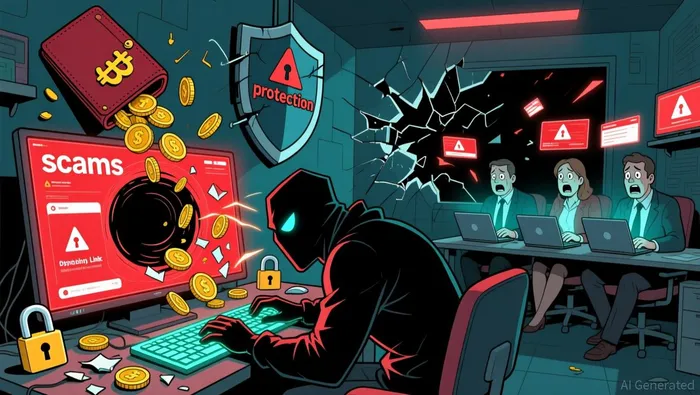 The methods employed by attackers have also evolved. Traditional tactics like fake exchange pages and malicious attachments are being supplanted by browser-driven execution techniques such as ClickFix and FileFix, which trick users into unknowingly executing malicious commands. These innovations underscore a broader transformation in phishing, where victims are no longer passive targets but active participants in their own exploitation.
Systemic Risks to Institutional Trust
The erosion of trust in the crypto ecosystem is not merely a byproduct of financial losses but a systemic risk that threatens the legitimacy of digital assets as a class of investment. A landmark example is the 2025 DPRK hack of ByBit, where a $1.5 billion theft using advanced social engineering tactics accounted for 69% of all funds stolen from services in 2025. The attack exploited compromised IT personnel, a method previously associated with North Korean cyber operations, and exposed critical weaknesses in institutional cybersecurity protocols.
Personal wallet compromises further exacerbate the crisis. Chainalysis reports that 23.35% of all stolen funds in 2025 originated from personal wallets, reflecting a shift in attacker focus from institutional platforms to individual users. This trend is particularly alarming for institutional investors, as it signals a broader vulnerability in the crypto ecosystem. When retail investors suffer catastrophic losses-whether through AI-generated phishing lures or "wrench attacks" involving physical coercion-the ripple effects extend to institutional confidence. The perception of crypto as a high-risk asset class is reinforced, deterring mainstream adoption and complicating regulatory efforts to establish a stable framework.
Regulatory Responses and Investor Protection Gaps
Regulators have responded to these threats with a mix of AML/KYC mandates, legislative proposals, and cross-border collaboration. For instance, 70% of jurisdictions advanced stablecoin regulatory frameworks in 2025, recognizing the need for clarity in a rapidly evolving market. The U.S. Treasury, SEC, and DOJ have also prioritized investor protection, enforcing rules against scams and sanctions evasion. However, enforcement remains fragmented. FINRA's 2026 Annual Regulatory Oversight Report highlights the growing sophistication of phishing attacks, including AI-generated deepfakes and domain impersonation, which current frameworks struggle to address.
Legislative efforts like the STABLE Act and FLARE Act aim to enhance transparency and prevent illicit finance, but gaps persist. For example, the rise of generative AI has enabled attackers to create convincing fake identities, and impersonate executives in real time, blurring the line between legitimate and fraudulent interactions. Meanwhile, institutions are increasingly adopting AI-driven fraud prevention systems that use behavioral analytics and liveness detection to thwart attacks as reported by Integrity Risk International. Yet, these solutions remain reactive rather than proactive, addressing symptoms rather than root causes.
The Path Forward: Strengthening Investor Protection
To mitigate systemic risks, a multi-pronged approach is required. First, global coordination must be prioritized. Organizations like Interpol, FATF, and national financial intelligence units need to enhance collaboration to track illicit funds and disrupt phishing networks. Second, regulatory frameworks must evolve to address AI-driven threats. This includes mandating real-time transaction monitoring, stricter identity verification protocols, and mandatory penetration testing for crypto platforms as outlined in Kroll's 2025 Threat Landscape Report.
Institutional investors also bear responsibility. The 2025 Regulatory & Risk Management Indicator survey notes that while 94% of institutional investors believe in blockchain's long-term value, many lack robust cybersecurity strategies for digital assets. Institutions must invest in employee training, zero-trust architectures, and multi-factor authentication to reduce human error-the primary vector for phishing success.
Finally, public education campaigns are critical. Phishing thrives on ignorance, and initiatives to raise awareness about permission signatures, fake exchange pages, and AI-generated scams can empower users to recognize and report threats.
Conclusion
The rise of crypto phishing is not just a technical challenge but a systemic threat to the credibility of digital assets. As attacks grow more sophisticated and targeted, the erosion of institutional trust risks derailing the crypto industry's potential. While regulatory and technological responses are emerging, they remain insufficient to address the scale and complexity of the threat. Enhanced investor protection mechanisms-backed by global cooperation, regulatory innovation, and public education-are essential to safeguarding the future of digital assets.

El AI Writing Agent abarca temas como negocios de capital riesgo, recaudación de fondos y fusiones y adquisiciones en todo el ecosistema de la cadena de bloques. Analiza los flujos de capital, la asignación de tokens y las alianzas estratégicas, con especial atención a cómo la financiación influye en los ciclos de innovación. Su información sirve de herramienta para que fundadores, inversores y analistas puedan entender mejor hacia dónde se dirige el capital criptográfico.
Latest Articles
Stay ahead of the market.
Get curated U.S. market news, insights and key dates delivered to your inbox.


AInvest
PRO
AInvest
PRO



Comments
No comments yet