
Rising Credit Rating Agency Influence on Global Fiscal Policy
 Aime Summary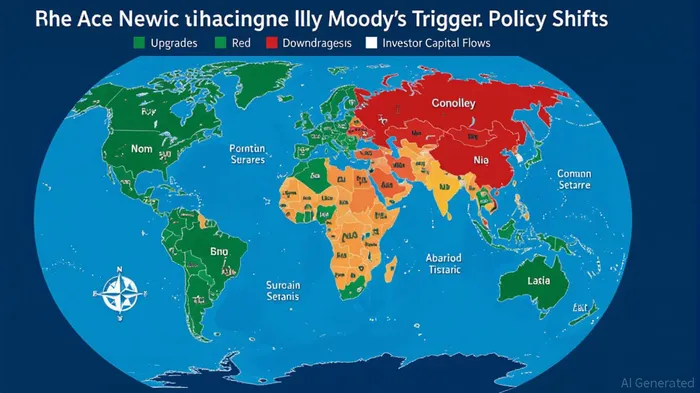
The global financial landscape is undergoing a quiet but profound transformation as credit rating agencies, particularly Moody'sMCO--, increasingly shape sovereign risk perception and fiscal policy decisions. Over the past two years, Moody's engagement with nations—from downgrading the United States to upgrading Canada—has not only altered investor sentiment but also forced governments to recalibrate their fiscal strategies. This shift underscores a new era where credit ratings are no longer passive assessments but active catalysts for policy reform and capital reallocation.
Moody's as a Policy Catalyst
Moody's recent downgrade of the United States from Aaa to Aa1 in May 2025 marked a watershed moment. The agency cited “gradual decline in fiscal strength” due to widening deficits and rising debt service costs, which now exceed $1.8 trillion annually. This action, the last of the “Big Three” rating agencies to strip the U.S. of its top-tier rating, has forced policymakers to confront long-avoided fiscal realities. The U.S. now faces a $36.22 trillion national debt (124% of GDP), with interest payments projected to surpass defense spending by 2035.
Similarly, Moody's downgraded the United Kingdom to A1 in 2024, citing fiscal imbalances and post-Brexit economic fragility. The UK's government responded by announcing a fiscal consolidation plan, including spending cuts and tax reforms, to stabilize its debt-to-GDP ratio. In contrast, Canada's upgrade to Aaa in 2024—rewarding its disciplined fiscal management—has emboldened the government to invest in green infrastructure, leveraging its improved credit profile to secure lower borrowing costs.
These examples illustrate how Moody's ratings act as a mirror, reflecting fiscal health while also serving as a magnifying glass for policy shortcomings. Governments are increasingly aware that a downgrade can trigger higher borrowing costs, capital flight, and investor skepticism, compelling them to adopt austerity measures or structural reforms.
Investor Strategies in the Moody'sMCO-- Era
For investors, Moody's ratings and risk indicators have become indispensable tools. The agency's Alpha Factor (AF) and Deterioration Probability (DP) metrics have enabled institutional investors to construct high-performing, low-risk portfolios. AF identifies undervalued bonds by comparing market spreads to fair-value spreads, while DP predicts the likelihood of a downgrade. Together, they allow investors to avoid “fallen angel” risks and capitalize on mispriced assets.
A case in point is Carnival Corporation, whose DP score spiked months before its 2020 downgrade to Ba2. Investors using DP as a filter could have divested early, avoiding a 30% loss. Conversely, high-AF, low-DP portfolios have consistently outperformed benchmarks, with empirical data showing a 15% higher annualized return from 2017 to 2024.
The New Normal: Ratings as Strategic Constraints
The U.S. downgrade exemplifies how credit ratings are becoming strategic constraints. With debt service costs crowding out spending on defense and infrastructure, policymakers now face a stark choice: raise taxes, cut entitlements, or default on obligations. The latter is unlikely, but the former two options risk political backlash. This tension is not unique to the U.S. Japan's A2 rating with a negative outlook, for instance, has spurred debates over pension reforms and corporate tax hikes.
Emerging markets are equally vulnerable. Argentina's B2 rating (2024) and South Africa's Baa3 rating (2025) have forced governments to prioritize fiscal discipline over populist spending. In Brazil, a negative outlook prompted the central bank to raise interest rates aggressively, even as inflation remains stubbornly high.
Investment Advice for the Moody's Era
For investors, the key takeaway is to integrate Moody's metrics into portfolio strategies. Here's how:
1. Prioritize High-AF, Low-DP Bonds: Use AF to identify undervalued sovereign and corporate bonds, and DP to screen out downgrade risks.
2. Diversify Across Ratings: Avoid overexposure to high-risk markets. For example, while the U.S. remains a safe haven, its Aa1 rating warrants closer scrutiny of fiscal reforms.
3. Monitor Policy Shifts: Sovereign ratings often precede fiscal adjustments. Track government announcements on tax reforms, spending cuts, or debt restructuring.
Conclusion
Moody's influence on global fiscal policy is no longer a theoretical concern but a practical reality. As governments grapple with the dual pressures of rating agency scrutiny and investor expectations, the line between credit ratings and policy outcomes continues to blur. For investors, the challenge lies in leveraging Moody's tools to navigate this evolving landscape—balancing risk mitigation with the pursuit of alpha. In an era of fiscal uncertainty, the ability to read the tea leaves of credit ratings may well determine the difference between resilience and ruin.

Stay ahead of the market.
Get curated U.S. market news, insights and key dates delivered to your inbox.
AInvest
PRO
AInvest
PRO



Comments
No comments yet