
Rising U.S. CPI Amid Tariff-Driven Inflation: Navigating Equity and Fixed Income Portfolios in a Shifting Policy Landscape
 Aime Summary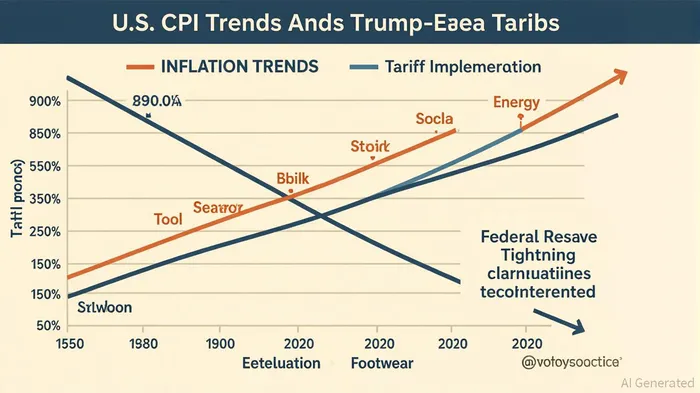
The U.S. economy is navigating a complex and volatile environment as rising consumer price inflation (CPI) converges with the Trump administration's aggressive tariff policies. The July 2025 CPI report, which showed a 2.7% annual increase in headline inflation and a 3.1% rise in core CPI, underscores the growing tension between policy-driven supply-side disruptions and the Federal Reserve's mandate to stabilize prices. This dynamic has created a policy-pivoting environment where investors must reassess risk-return profiles across equities and fixed income portfolios.
Tariffs and the Uneven Inflationary Landscape
The Trump administration's tariffs—now averaging 19% on imports—have begun to manifest in consumer prices, particularly in goods-intensive sectors. Core goods inflation, for instance, surged to a two-year high of 1.2% annually, driven by price increases in imported tools, footwear861165--, and coffee. While businesses initially absorbed much of these costs, the data suggests a shift toward consumer price pass-through, with economists projecting that households will bear 67% of tariff costs by October 2025.
However, the inflationary impact is far from uniform. Sectors like apparel and new vehicles have shown resilience, with prices remaining stable despite tariffs on steel and aluminum. This “messy” distribution of effects reflects supply chain adjustments, inventory stockpiling, and varying degrees of pricing power across industries. For investors, this unevenness necessitates a granular approach to sector selection, favoring defensive or inflation-protected areas over cyclical ones.
Equity Market Reactions: Stagflation and Sector Rotation
The equity market's response to this environment has been marked by volatility and shifting leadership. The S&P 500's 21.4% bear market correction in early 2025, triggered by fears of a full-scale tariff rollout, highlights the sensitivity of growth stocks to macroeconomic uncertainty. The Magnificent 7 (Mag 7) companies, once dominant, saw their valuations contract as investors rotated into sectors perceived as more resilient to inflation, such as energy, utilities, and healthcare.
The ISM Services Index, which covers 80% of the U.S. economy, fell into contraction territory in mid-2025, signaling broader economic strain. This has pressured consumer discretionary and industrial sectors, while defensive sectors like utilities and healthcare have gained traction. The negative correlation between the 10-year Treasury yield and the S&P 500—a departure from historical norms—further complicates equity valuations, as rising yields compress future cash flow estimates.
Fixed Income: Yields, Volatility, and Policy Uncertainty
Fixed income markets have also been roiled by the interplay of inflation and policy uncertainty. The 10-year Treasury yield fluctuated between 4.0% and 4.5% in Q1 2025, reflecting divergent expectations about the Fed's response to tariffs and inflation. The yield curve steepened as short-term rates (2-year Treasuries) fell in anticipation of rate cuts, while long-term yields remained elevated due to inflation concerns and robust Treasury issuance.
The Federal Reserve's cautious stance—maintaining rates in the 4.25%-4.50% range despite a weak labor market—has added to market volatility. With the Fed signaling potential rate cuts by year-end, investors are balancing the risk of higher inflation with the possibility of accommodative monetary policy. Municipal bonds and high-quality corporate bonds have gained appeal, particularly as tax-exempt yields and credit spreads offer attractive risk-adjusted returns.
Strategic Implications for Investors
In this policy-pivoting environment, investors must adopt a dual strategy: hedging against inflation while capitalizing on dislocated opportunities. For equities, sector rotation toward inflation-protected areas (e.g., energy, utilities) and away from high-beta growth stocks is prudent. Defensive positioning in sectors with pricing power and stable cash flows can mitigate downside risks.
For fixed income, a barbell approach—combining short-duration bonds to benefit from potential rate cuts and long-duration bonds to capture inflation-linked yields—may offer balance. Investors should also consider adding high-quality corporate bonds and municipals, which provide yield and diversification benefits.
Conclusion: Navigating the Policy Crossroads
The U.S. economy stands at a crossroads, with rising CPI and tariff-driven inflation creating a stagflationary backdrop. While the Fed's policy response remains uncertain, investors can mitigate risks by focusing on resilience, diversification, and active portfolio management. As the full effects of tariffs work through the economy, the ability to adapt to shifting policy priorities and inflation dynamics will be critical to long-term success.

Stay ahead of the market.
Get curated U.S. market news, insights and key dates delivered to your inbox.


AInvest
PRO
AInvest
PRO



Comments
No comments yet