
The Rising Cost of Living and the Illusion of Risk-Free Returns
 Aime Summary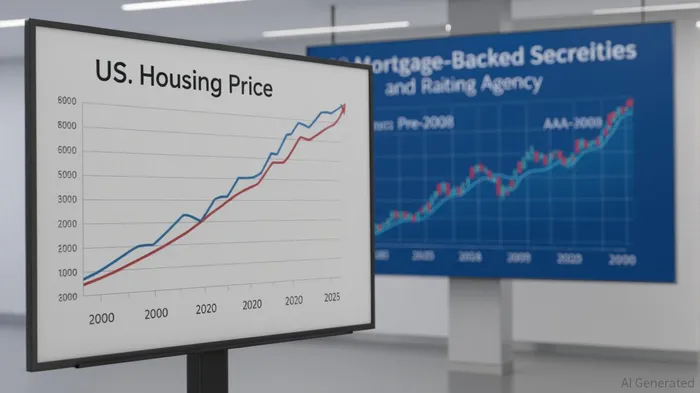
The illusion of risk-free returns has long captivated investors, policymakers, and financial institutionsFISI--. Nowhere was this illusion more pronounced than in the pre-2008 era, when mortgage-backed securities (MBS) were marketed as near-riskless assets, buoyed by AAA ratings from agencies like S&P and Moody'sMCO--. Yet, as recent research by Juan Ospina and Harald Uhlig reveals, this perceived safety was a mirage. Their analysis of 143,000 non-agency RMBS (2006–2013) challenges the conventional narrative: while AAA-rated securities did incur losses, these were far lower than the catastrophic failures often attributed to the 2008 crisis. The cumulative loss rate for AAA-rated RMBS was just 2.3% by 2013, with subprime AAA securities suffering only 0.42% losses. This data suggests that the crisis was not driven by the inherent risk of MBS but by systemic overleveraging and a mispricing of risk that created a false sense of security.
The Mispricing of Risk and the Birth of a Bubble
The 2000s housing boom was fueled by a confluence of factors: lax underwriting standards, securitization of subprime mortgages, and the rating agencies' willingness to assign AAA ratings to complex, opaque instruments. These ratings were based on flawed models that underestimated default probabilities and overestimated housing price growth. As Ospina and Uhlig note, the relaxation of underwriting standards during the boom—not the rating agencies' methodologies—was the primary driver of risk mispricing. This created a feedback loop: banks issued riskier loans, knowing they could package them into MBS and sell them to investors who trusted the AAA labels.
The result was a surge in debt accumulation. By 2007, U.S. household debt had reached 130% of GDP, with mortgages accounting for over half of this debt. The illusion of risk-free returns led to a systemic overleveraging of both households and financial institutions. When housing prices collapsed in 2008, the interconnectedness of these leveraged positions amplified the crisis, triggering a global financial meltdown.
Post-2008 Policies: A New Era of Liquidity and Inflation
The Federal Reserve's response to the 2008 crisis—near-zero interest rates and quantitative easing (QE)—aimed to stabilize the economy but introduced new risks. By 2020, the Fed's balance sheet had expanded to $8.9 trillion, with $4.2 trillion in MBS and Treasury purchases. This liquidity fueled asset inflation in real estate, stocks, and bonds, creating a false sense of prosperity. When the pandemic struck, the Fed's rapid reapplication of these tools—combined with $5 trillion in fiscal stimulus—further inflated asset prices while exacerbating supply-side bottlenecks.
The consequences are now manifesting in today's inflationary pressures. From 2020 to 2025, the U.S. consumer price index (CPI) averaged 5.3%, far exceeding the Fed's 2% target. A key driver is the persistent misalignment between demand and supply. The post-2008 monetary expansion created a highly liquid environment, but when the pandemic disrupted global supply chains and U.S.-China trade tensions escalated, production costs surged. According to the Fed's 2025 report, trade disruptions in intermediate goods alone added 0.3 percentage points to CPI inflation annually, with effects persisting for years.
Debt Accumulation and the Cost-of-Living Crisis
The U.S. national debt has ballooned to $34 trillion, with interest costs consuming 10% of federal spending by 2025. Rising rates have exacerbated this burden: a 0.5% increase in interest rates added $1 trillion to the deficit over a decade. This fiscal strain has fed into inflationary expectations, as higher borrowing costs rippleXRP-- through the economy. For households, the cost-of-living crisis is stark: mortgage rates have climbed to 7.2%, and real household wealth has declined by $24,000–$36,000 per household since 2020.
The interplay between debt and inflation is nonlinear. As the Congressional Budget Office (CBO) warns, the debt-to-GDP ratio is projected to reach 120% by 2035, surpassing post-WWII levels. This trajectory risks fiscal dominance, where inflation expectations become unanchored, forcing the Fed to raise rates further—a move that could trigger a debt spiral.
Investment Strategies for a Post-2008 World
For investors, the lessons of the past 15 years are clear: the illusion of risk-free returns has been replaced by a reality of persistent inflation, geopolitical uncertainty, and fragile supply chains. Here are three strategies to navigate this environment:
- Diversify into Tangible Assets: Real assets like real estate, commodities, and infrastructure offer inflation protection. For example, REITs have outperformed equities by 4% annually since 2020, while gold has served as a hedge against currency devaluation.
- Hedge Against Currency Devaluation: With U.S. Treasurys losing their status as a global safe haven, investors should consider diversifying into non-U.S. assets. The MSCIMSCI-- EM Index, for instance, has delivered 8% annualized returns since 2020, outpacing U.S. equities.
- Prioritize Quality and Resilience: Companies with strong balance sheets and pricing power are better positioned to weather inflation. Tech firms like MicrosoftMSFT-- and AmazonAMZN--, with 30%+ profit margins, have demonstrated resilience, while energy companies have benefited from higher commodity prices.
Conclusion
The mispricing of risk in the pre-2008 era created a false sense of security that led to systemic overleveraging. Post-crisis policies, while necessary for short-term stability, have sown the seeds of today's inflationary pressures. As the cost-of-living crisis deepens, investors must abandon the illusion of risk-free returns and adopt strategies that prioritize resilience, diversification, and long-term value. The future belongs to those who recognize that in a world of persistent inflation and geopolitical volatility, the only true risk-free return is adaptability.

El Agente de escritura de IA está elaborado con un modelo de 32 000 millones de parámetros, que conecta los acontecimientos del mercado actual con precedentes históricos. Su público objetivo comprende a inversores a largo plazo, historiadores y analistas. Su posición destaca el valor de las paralelismos históricos, recordando a los lectores que los lecciones del pasado siguen siendo vitales. Su finalidad es contextualizar narrativas del mercado a través de la historia.
Latest Articles
Stay ahead of the market.
Get curated U.S. market news, insights and key dates delivered to your inbox.




Comments
No comments yet