
Rising Consumer Spending and Retail Resilience in the Post-Holiday Season


 Aime Summary
The 2025 Holiday Season: A New Retail Paradigm
Consumer spending during the 2025 Thanksgiving and Black Friday periods revealed a nuanced picture. While 71% of shoppers opted for online purchases, 72% of Gen Z consumers defied broader trends by prioritizing in-store experiences, drawn by early-bird deals and experiential retail. Meanwhile, 69% of shoppers cited rising living costs as the primary factor for reduced holiday spending, yet 24% still planned to spend $1,000 or more. Retailers leveraging omnichannel strategies, such as WalmartWMT-- and AmazonAMZN--, dominated the landscape, with 71% and 94% of shoppers respectively visiting their stores or platforms.
Key Trends Shaping Retail Resilience
- Omnichannel Dominance: Retailers integrating seamless online and in-store experiences outperformed peers. Walmart's $8-per-person Game Day Basket, offering one-click pickup or delivery, exemplifies this strategy. Similarly, TJX Companies' focus on value-driven omnichannel offerings attracted budget-conscious shoppers, driving a 25% year-to-date stock gain.
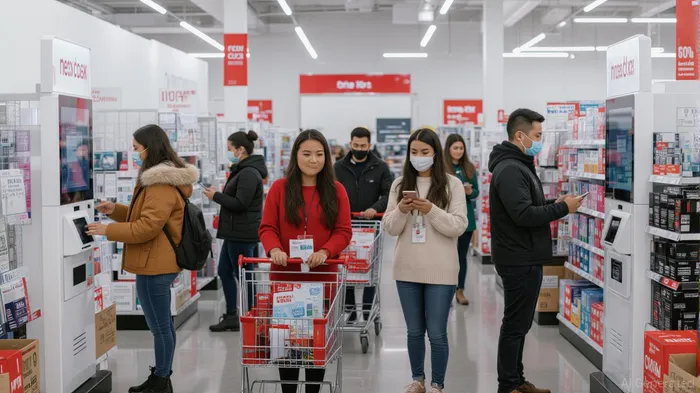 2. Gen Z's Influence: Gen Z's preference for experiential gifts (e.g., travel, concert tickets) and mobile-first shopping (54.5% of e-commerce sales via mobile in 2024) has reshaped inventory and marketing strategies. Dollar General's $1-priced items and Hollister's TikTok-driven campaigns highlight this alignment.
3. AI and Personalization: AI tools, such as Amazon's Rufus and Walmart's inventory systems, enhanced price tracking and customer engagement, with 81% of shoppers using AI for holiday decisions.
Undervalued Retail Stocks: Strategic Positioning and Financial Metrics
1. Walmart (WMT)
Walmart's broad appeal across income tiers and its 4.5% comparable sales growth in Q3 2025 solidify its position as a holiday stalwart. With a P/E ratio of 17.0 and a 17% year-to-date gain, the stock reflects its resilience in a cautious spending environment. Its grocery division and early-morning delivery services further differentiate it.
2. TJX Companies (TJX)
TJX's value-focused model resonated with a 23% decline in Gen Z holiday spending, as consumers prioritized discounted goods. The company raised FY 2025 guidance after Q3 results and trades at a P/E of 14.2 with a 25% YTD gain. Analysts rate it as a "Buy" in 24 out of 25 cases, underscoring its undervaluation.
3. Kohl's (KSS)
Kohl's, with a P/E of 14.2 and a TC Quantamental Rating of 64, offers a 37% estimated upside. Despite mid-tier challenges, its improved merchandising and 71% YTD stock gain reflect a turnaround. Its focus on promotions and trade-down strategies aligns with cost-conscious shoppers.
4. Abercrombie & Fitch (ANF)
Abercrombie & Fitch's rebranding under Fran Horowitz, including Hollister's Gen Z-focused campaigns, has driven a debt-free balance sheet and strong margins. While its post-Black Friday performance faces headwinds, its omnichannel strategy and social media engagement position it for long-term growth.
Post-Holiday Performance and Outlook
Post-Black Friday 2025, value retailers like Walmart and TJX outperformed, with Walmart reporting 4.5% sales growth and TJXTJX-- raising guidance. Conversely, mid-tier retailers like Kohl's and Abercrombie & Fitch face challenges as shoppers trade down. However, the National Retail Federation forecasts $1 trillion in holiday sales, albeit with 3.7-4.2% growth, indicating sustained demand for value propositions.
Conclusion
The 2025 holiday season highlights the importance of adaptability in a fragmented retail landscape. Walmart, TJX, and Kohl's exemplify how omnichannel strategies, Gen Z engagement, and cost-conscious offerings can drive resilience. While economic uncertainties persist, these undervalued stocks-backed by strong financial metrics and strategic innovation-present compelling opportunities for investors seeking to capitalize on evolving consumer trends.

Delivering real-time insights and analysis on emerging financial trends and market movements.
Latest Articles
Stay ahead of the market.
Get curated U.S. market news, insights and key dates delivered to your inbox.
AInvest
PRO
AInvest
PRO



Comments
No comments yet