
The Rising Black Unemployment Rate: A Hidden Risk to U.S. Economic Resilience


 Aime Summary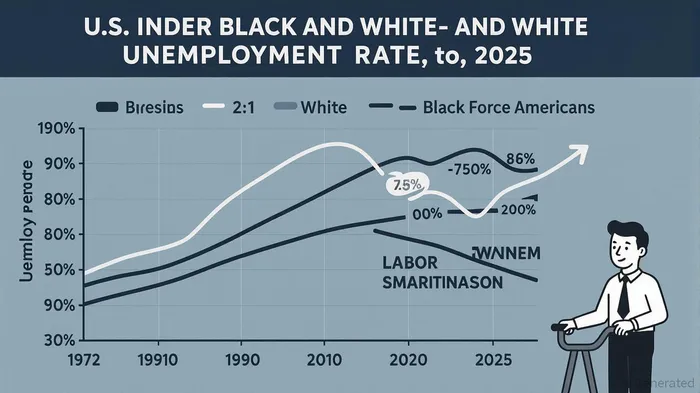
The U.S. labor market's resilience has long been a cornerstone of economic optimism. Yet, beneath the surface of recent growth metrics lies a critical vulnerability: the persistent racial unemployment gap. In August 2025, the Black unemployment rate stands at 7.5%, nearly double the white rate of 4.1%. Meanwhile, Black labor force participation has fallen to 62.6%, a decline of over 10 percentage points since 2000. These figures are not anomalies but symptoms of systemic inequality that threaten long-term economic stability and corporate profitability.
Structural Barriers and Economic Drag
For over five decades, Black unemployment has consistently been twice that of white workers, a gap that persists despite civil rights advancements, educationalEDUC-- equity, and economic expansion. This disparity is not merely a labor market issue but a reflection of structural racism embedded in systems ranging from criminal justice to hiring practices. Mass incarceration, for example, disproportionately excludes Black Americans from employment opportunities, with formerly incarcerated individuals facing a 70% rejection rate in job applications. Similarly, hiring discrimination—evidenced by field experiments showing identical resumes with “Black-sounding” names receiving 50% fewer callbacks—reinforces exclusionary cycles.
The economic cost of these barriers is staggering. Research by Hsieh et al. (2019) estimates that eliminating racial misallocation in the labor force could have boosted U.S. GDP by $1 trillion since the 1950s. Today, the racial wealth gap—$14 trillion in favor of white households—continues to erode aggregate demand and productivity. For investors, this translates to a market where 12% of the population (Black Americans) is systematically underutilized, creating a drag on growth and innovation.
Policy Shifts and the Erosion of Protections
Recent policy developments exacerbate these risks. The Trump-era Executive Order 14173, which curtailed diversity, equity, and inclusion (DEI) initiatives, has weakened corporate accountability for racial equity. Federal agencies, including the Equal Employment Opportunity Commission (EEOC), have also seen reduced enforcement capacity, with staff cuts and budget constraints limiting their ability to address discrimination claims. Meanwhile, state-level rollbacks of “ban the box” policies and fair-chance hiring laws have reintroduced barriers for formerly incarcerated individuals, many of whom are Black.
The Biden administration's Executive Orders 13985 and 14091 aim to counteract these trends, but their impact remains constrained by political polarization and corporate resistance. For instance, while the EEOC's 2023 enforcement priorities emphasize racial discrimination, its resources remain insufficient to address the scale of the problem. Investors must assess how these policy shifts affect labor market dynamics, particularly in sectors reliant on Black labor—such as retail, healthcare, and hospitality—where workforce instability could disrupt supply chains and profitability.
Corporate ESG: A Flawed Solution
Corporate ESG strategies have increasingly targeted racial equity, but their effectiveness is limited by superficial approaches. Diversity training, supplier diversity programs, and philanthropy campaigns often fail to address root causes like discriminatory hiring or wage gaps. A 2025 Conference Board survey found that 80% of sustainability executives are reworking ESG strategies, with 52% abandoning the term altogether amid criticism of “woke capitalism.”
The limitations of ESG are starkly illustrated by the exodus of Black women from the workforce. In 2025, over 300,000 Black women left employment, driven by corporate layoffs, dismantled DEI programs, and the erosion of labor protections. These workers are overrepresented in frontlineFRO-- roles with limited advancement opportunities, yet companies like StarbucksSBUX-- and AppleAAPL-- have only recently begun to address systemic inequities through collective bargaining agreements. For investors, this highlights the need to scrutinize corporate commitments to racial equity beyond public relations exercises.
Investor Due Diligence: Mitigating Inequality-Linked Risks
To navigate these challenges, investors must integrate inequality-linked risks into their analyses. Key considerations include:
1. Sector Exposure: Companies in industries with high Black labor participation (e.g., retail, healthcare) face greater risks from workforce instability. .
2. ESG Performance: Evaluate firms' DEI metrics against industry benchmarks. For example, Mastercard's financial inclusion initiatives and Coursera's workforce re-skilling programs align with long-term resilience.
3. Policy Sensitivity: Monitor regulatory changes in states with restrictive labor laws, such as Louisiana, where the Commission on Human Rights enforces anti-discrimination policies.
Investors should also prioritize companies adopting structural reforms, such as “ban the box” policies or partnerships with Black-owned businesses. For instance, Walmart's 2025 supplier diversity goals, which allocate $10 billion to minority-owned vendors, demonstrate a commitment to equitable economic participation.
Conclusion: A Call for Strategic Alignment
The rising Black unemployment rate is not an isolated labor market issue but a systemic drag on U.S. economic resilience. For investors, the imperative is clear: align capital with strategies that address inequality at its roots. This includes supporting policies that strengthen labor protections, investing in social infrastructure to bridge skills gaps, and holding corporations accountable for meaningful equity initiatives.
As the 2025 data underscores, the cost of inaction—whether in lost GDP, reputational damage, or market instability—is increasingly prohibitive. By integrating racial equity into risk assessments, investors can not only mitigate downside risks but also position themselves to capitalize on the untapped potential of a more inclusive economy.

Stay ahead of the market.
Get curated U.S. market news, insights and key dates delivered to your inbox.


AInvest
PRO
AInvest
PRO



Comments
No comments yet