
The Rise of Verkle Trees in Blockchain Efficiency and Decentralized Finance (DeFi) Innovation
 Aime Summary
Verkle Trees: A Technical Leap for Blockchain Scalability
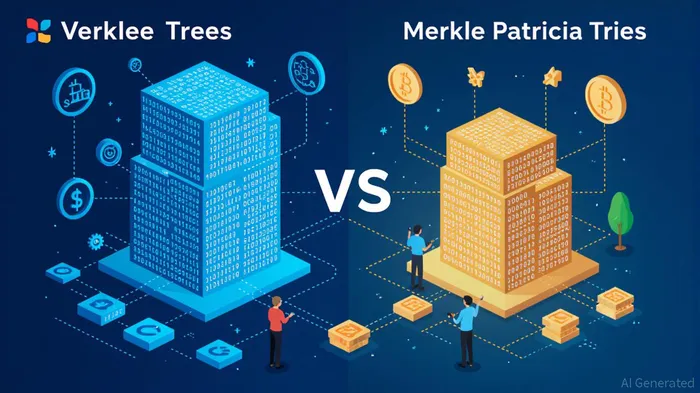
Verkle Trees represent a paradigm shift in how blockchain networks manage state data. Unlike Ethereum's current Merkle Patricia Trie (MPT), which requires full nodes to store the entire state locally, Verkle Trees enable nodes to verify blocks using compact proofs. This innovation drastically reduces storage requirements-potentially by 90%-making it feasible for individuals to run full nodes without enterprise-grade hardware. By compressing state data, Verkle Trees address Ethereum's long-standing issue of state bloat, which has hindered scalability and increased operational costs for node operators according to industry analysis.
The benefits extend beyond technical efficiency. Smaller proof sizes will reduce data availability costs for Layer 2 (L2) rollups, accelerating the migration of DeFi activity to L2s. For instance, Arbitrum and Optimism-two leading L2s-have already seen Total Value Locked (TVL) surge to $19 billion and $8 billion, respectively, by mid-2025 according to market data. With Verkle Trees, these platforms will further optimize transaction throughput and gas fees, fostering broader adoption of DeFi protocols and decentralized applications (dApps).
Market Implications: DeFi's Next Frontier
The integration of Verkle Trees is poised to unlock new opportunities for DeFi. By reducing the resource burden on nodes, Ethereum's network will support lightweight and stateless clients, ensuring decentralization remains intact even as transaction volumes grow according to technical reports. This is critical for DeFi, where smart contract execution efficiency directly impacts user experience. For example, protocols like GMX and Uniswap will benefit from faster transaction finality and lower latency, enabling seamless trading and liquidity provision.
Moreover, the reduction in proof sizes will enhance the viability of zero-knowledge (ZK) rollups like zkSync Era and Starknet. These solutions, which already process high-throughput transactions for compute-heavy use cases (e.g., NFT minting and complex on-chain proofs), will see further cost reductions, making them more attractive for institutional-grade DeFi applications according to market projections. As a result, the L2 TVL is projected to surpass Ethereum's L1 TVL by Q3 2026, signaling a structural shift in where value is concentrated within the Ethereum ecosystem according to industry forecasts.
Competitive Dynamics: Ethereum's Edge and Emerging Rivals
While Ethereum remains the dominant smart contract platform, competitors like Solana, Avalanche, and Polkadot are vying for market share by emphasizing high-throughput transactions and modular architectures. However, Ethereum's adoption of Verkle Trees-coupled with its robust L2 ecosystem-positions it as a foundational infrastructure layer for the tokenized financial ecosystem.
Projects like Celestia and Polygon 2.0 are exploring modular blockchain designs, but Ethereum's focus on interoperability and real-world asset (RWA) tokenization gives it a unique edge. For instance, Ethereum's role in tokenizing U.S. Treasuries and private credit-supported by institutions like BlackRock and HSBC-highlights its potential to become the settlement layer for global finance according to institutional analysis. By 2028, it is predicted that 25% of global tokenized RWAs will settle on Ethereum, representing $2.5 trillion in market value according to market projections.
Institutional Investment Strategies: Navigating the Verkle Era
For institutional investors, the rise of Verkle Trees necessitates a strategic reallocation of capital toward Ethereum-centric infrastructure and L2 solutions. Key considerations include:
- Staking and Yield Generation: Ethereum's proof-of-stake (PoS) model offers staking yields of 3–6% annually, making it an attractive alternative to traditional fixed-income assets according to financial analysis. With the Verkle upgrade, staking efficiency will improve further, enhancing returns for institutional participants.
2. L2 Node Operators: As L2s become the primary execution layer for DeFi, investing in node operators that support these networks (e.g., Arbitrum and Starknet) will yield long-term value. The Fusaka upgrade in late 2025, which introduced PeerDAS to boost data availability, underscores the growing importance of L2 infrastructure according to technical documentation.
3. RWA Tokenization: Ethereum's dominance in RWA tokenization-facilitated by its scalable and secure architecture-positions it as a key asset class for institutional portfolios. Projects leveraging Ethereum for tokenized real estate, commodities, and carbon credits will likely see increased capital inflows.
Conclusion: A New Era for Blockchain Investment
The adoption of Verkle Trees marks a pivotal moment in blockchain history, bridging the gap between scalability and decentralization while unlocking new frontiers for DeFi. For institutional investors, this means prioritizing Ethereum's ecosystem, particularly its L2 solutions and RWA tokenization initiatives. As the network transitions to a more efficient state structure, the competitive landscape will favor platforms that leverage these advancements to deliver robust, scalable, and user-friendly financial systems.
In the coming years, the ability to navigate this evolving landscape will define the success of institutional investment strategies in the digital asset space.

Blending traditional trading wisdom with cutting-edge cryptocurrency insights.
Latest Articles
Stay ahead of the market.
Get curated U.S. market news, insights and key dates delivered to your inbox.


AInvest
PRO
AInvest
PRO



Comments
No comments yet