
The Rise of Verkle Trees in Blockchain Efficiency
 Aime Summary
The Technological Shift: Verkle Trees and Scalability
Verkle Trees represent a paradigm shift in blockchain data structures. Unlike Ethereum's current Merkle Patricia Trie (MPT), which suffers from state bloat and inefficiencies in block validation, Verkle Trees leverage polynomial commitments-specifically KZG commitments-to generate smaller, fixed-size proofs for state verification. This innovation enables stateless clients, where nodes no longer need to store the entire blockchain state, drastically reducing storage and synchronization times. By flattening the tree structure, Verkle Trees also allow multiple values to be verified with a single compact proof, a critical feature for Layer 2 (L2) rollups.
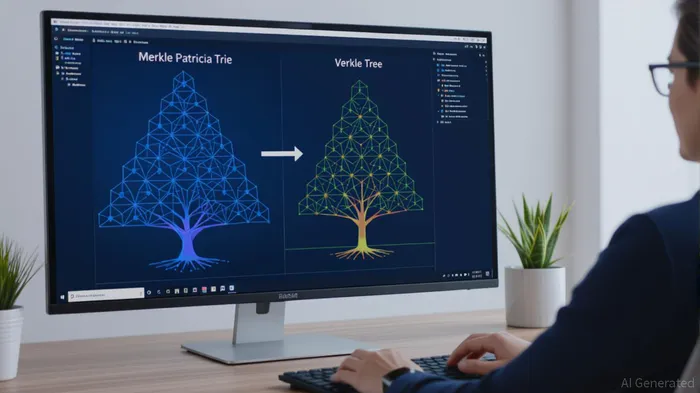
The implications are profound. Ethereum's transition to Verkle Trees is part of its broader roadmap to enhance throughput and reduce transaction costs, complementing upgrades like Proto-Danksharding (EIP-4844) and sharding. According to a report by , this shift is expected to lower gas fees by up to 70% while enabling thousands of transactions per second (TPS) on the network. For investors, this means EthereumETH-- is evolving into a "modular" blockchain, where execution, consensus, and data availability layers operate independently, fostering interoperability and scalability.
Energy Efficiency and Transaction Cost Reductions
The environmental and economic benefits of Verkle Trees are equally compelling. By reducing the computational and storage demands on nodes, Verkle Trees lower energy consumption and hardware requirements, making blockchain more accessible. This aligns with Ethereum's transition to Proof-of-Stake (PoS), which already reduced its carbon footprint by 99.95% compared to Proof-of-Work (PoW). According to Forbes, this shift is expected to significantly reduce environmental impact.
Energy-efficient protocols like AlgorandALGO--, which uses a Pure Proof-of-Stake (PPoS) consensus, further illustrate the potential. Algorand's transactions consume just 0.000008 kWh of energy-over 99.99% less than Bitcoin's 1,375 kWh per transaction. As blockchain adoption expands, the demand for protocols with minimal energy footprints will only grow.
Transaction cost reductions are another key driver. For instance, Power Ledger's TraceX platform, which uses blockchain for renewable energy certificate (REC) trading, has cut administrative costs by 72% through streamlined verification processes. Similarly, Ethereum's Fusaka upgrade is projected to reduce L2 transaction costs by 50%, making decentralized applications (dApps) more viable for mainstream users.
Investment Opportunities: Firms and Protocols to Watch
The firms and protocols best positioned to benefit from Verkle Tree adoption are those deeply integrated into Ethereum's ecosystem and scalable infrastructure.
- Ethereum-Centric Entities:
- BitMine Immersion Technologies (NASDAQ: BMNR) has accumulated over 3.86 million ETH, representing 3.2% of the circulating supply. As Ether's price surged in late 2025, BitMine's shares rose 14%, reflecting its exposure to Ethereum's growth.
- SharpLink Gaming (NASDAQ: SBET) and The Ether Machine (NASDAQ: ETHM) are also leveraging Ethereum's staking rewards and ETF inflows, with SharpLink staking 95% of its ETH holdings. According to research, this trend is expected to continue.
Coinbase Global (NASDAQ: COIN), the largest U.S. ETH staking provider, benefits from Ethereum's institutional adoption and the rising demand for spot ETFs.
Layer 2 Solutions:
Arbitrum and Optimism, two leading L2 rollups, are poised to capitalize on Ethereum's reduced data availability costs. As noted in a Hashkey Capital analysis, these platforms will see increased transaction volumes as dApps migrate to cheaper, faster environments.
Energy-Efficient Protocols:
Algorand (ALGO) and Nano (NANO) are attracting ESG-focused investors with their near-zero energy consumption and zero-fee transactions.
Infrastructure Providers:
- Firms like Arbitrum and zkSync are also innovating in zero-knowledge proofs and optimistic rollups, further enhancing scalability.
Conclusion: A New Era for Blockchain Infrastructure
The adoption of Verkle Trees is not merely a technical upgrade but a catalyst for a broader transformation in blockchain infrastructure. By addressing scalability, energy efficiency, and transaction costs, this innovation is creating a virtuous cycle of growth for Ethereum and its ecosystem. For investors, the key lies in identifying firms and protocols that are not only aligned with Ethereum's roadmap but also positioned to leverage the modular, interoperable future of blockchain. As the industry moves toward a post-Merkle era, those who recognize the strategic value of Verkle Trees will find themselves at the forefront of a new wave of innovation.

Blending traditional trading wisdom with cutting-edge cryptocurrency insights.
Latest Articles
Stay ahead of the market.
Get curated U.S. market news, insights and key dates delivered to your inbox.




Comments
No comments yet