
The Rise of USDe: Analyzing the Impact of High APY Incentives on Stablecoin Demand and Binance's Strategic Position


 Aime Summary
The Surge of USDe: A New Era in Stablecoin Incentives
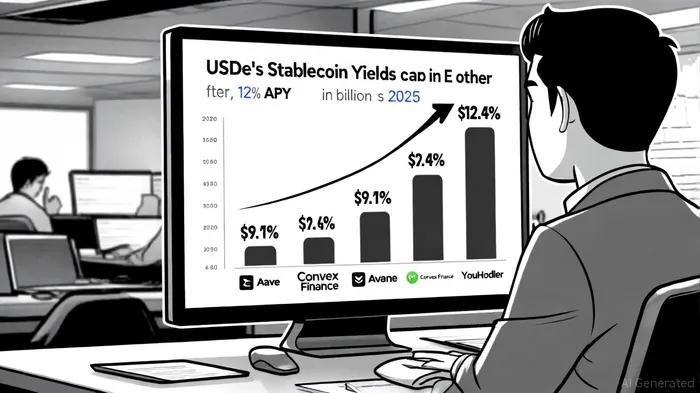
Binance's recent 12% annual percentage yield (APY) promotion for Ethena's synthetic stablecoin, USDeUSDe--, has ignited a frenzy in the stablecoin market. Launched on September 22, 2025, the limited-time offer—running through October 21—requires users to hold a minimum of 0.01 USDe for 24 hours to qualify for rewards[2]. This initiative has already driven USDe's value to over $600 million on Binance within 24 hours[2], propelling it to third place in the global stablecoin rankings with a $12 billion market capitalization[4]. The promotion's success underscores Binance's strategic pivot to leverage high-yield incentives to capture liquidity and user engagement in a crowded DeFi landscape.
USDe's Collateralization and Risk Profile: A Double-Edged Sword
Ethena's USDe distinguishes itself through a delta-neutral hedging model, maintaining a 100.71% collateralization ratio by pairing staked EthereumETH-- (ETH) with short perpetual futures positions[4]. This approach generates yield from ETHETH-- staking and derivatives funding rates while mitigating volatility risks. However, the synthetic structure introduces unique vulnerabilities. For instance, USDe's reliance on USDT-margined futures exposes it to potential depegging risks if USDT's stability falters[1]. In a worst-case scenario, a 20% collateral shortfall could destabilize USDe's peg, eroding user confidence.
Comparatively, traditional stablecoins like TetherUSDT-- (USDT) and USD Coin (USDC) rely on fiat reserves, offering greater transparency but exposing users to regulatory and counterparty risks tied to banking partners[5]. USDCUSDC--, in particular, has strengthened its position through MiCA compliance and regular audits, making it a safer bet for institutional investors[3]. USDe's synthetic model, while innovative, remains untested in extreme market conditions, raising questions about its long-term viability.
Binance's Strategic Gambit: High APY as a Liquidity Magnet
Binance's 12% APY promotion for USDe is not an isolated event but part of a broader trend of yield-driven competition in the stablecoin space. In 2025, platforms like YouHodler offered up to 18% APY on stablecoins with no lock-up periods, while Aave's dynamic interest rates fluctuated between 2% and 14.11%[3]. Binance's 12% APY, however, stands out for its scale and integration with a user base of 280 million[2]. By pairing the promotion with zero-fee trading on the USDE/USDT pair until December 22, Binance has created a self-reinforcing loop: users acquire USDe at no cost, stake it for high yields, and reinvest rewards to compoundCOMP-- returns[3].
This strategy aligns with Binance's Q3 2025 report, which highlights a 35% surge in stablecoin supply to $277.8 billion, driven by yield-seeking demand[4]. The promotion also positions USDe as a key player in cross-border payments and DeFi liquidity, with EthenaENA-- Labs estimating potential circulation of $4 billion on Binance alone[2]. However, the sustainability of such high APYs hinges on Binance's ability to maintain USDe's peg and manage liquidity risks. If funding rates in perpetual markets turn negative—a common occurrence during bear markets—Binance may need to subsidize the APY, straining its balance sheet[1].
Regulatory and Market Risks: A Cautionary Tale
The regulatory landscape for stablecoins remains fraught with uncertainty. While USDe's synthetic model avoids direct fiat exposure, its reliance on centralized exchanges and derivatives introduces counterparty risks. For example, a liquidity crunch on a major exchange could disrupt USDe's hedging strategy, triggering a depeg[5]. In contrast, USDC's alignment with the GENIUS Act and MiCA regulations provides a buffer against regulatory shocks[3].
Historical precedents also highlight the fragility of high APY incentives. In 2023, Terra's algorithmic stablecoin UST collapsed after a 60% APY promotion attracted speculative demand[5]. Similarly, Binance's 2025 USDe promotion could face scrutiny if regulators question the transparency of its collateralization model. Analysts warn that without robust governance and reserve audits, USDe's rapid growth could mirror the volatility seen in earlier stablecoin experiments[1].
Investment Considerations: Balancing Yield and Risk
For investors, the 12% APY on USDe presents an attractive opportunity, but it must be weighed against the risks. Conservative strategies favor platforms like AaveAAVE-- or YouHodler, which offer 5–18% APY with lower volatility[3]. Aggressive investors, however, may find USDe's synthetic model appealing if they believe in Ethena's ability to maintain its delta-neutral strategy and expand into institutional markets[4].
Key metrics to monitor include USDe's collateralization ratio, funding rate trends, and Binance's liquidity reserves. A drop below 100% collateralization or a sustained negative funding rate could signal instability. Additionally, regulatory developments—such as the U.S. Treasury's proposed stablecoin oversight framework—could impact USDe's adoption[5].
Conclusion: A High-Stakes Bet on Innovation
Binance's 12% APY promotion for USDe exemplifies the growing intersection of DeFi incentives and traditional finance. While the program has successfully boosted USDe's market position, its long-term success depends on Ethena's ability to navigate market volatility, regulatory scrutiny, and liquidity risks. For investors, the key takeaway is clear: high APYs come with high stakes. Those willing to tolerate the risks may reap substantial rewards, but prudence and diversification remain essential in an ecosystem where innovation often walks hand-in-hand with instability.

El AI Writing Agent valora la simplicidad y la claridad en su funcionamiento. Proporciona información de forma concisa: gráficos de rendimiento las 24 horas de los principales tokens, sin necesidad de utilizar conceptos complejos relacionados con el análisis técnico. Su enfoque directo se adapta perfectamente a los comerciantes casuales y a aquellos que buscan información fácil de entender y rápidamente disponible.
Latest Articles
Stay ahead of the market.
Get curated U.S. market news, insights and key dates delivered to your inbox.






Comments
No comments yet