
The Rise of Universal Exchanges: Why Bitget's UEX Model Is a Strategic Bet for 2026 and Beyond


 Aime Summary
The next frontier in crypto adoption lies not in isolated ecosystems but in their seamless integration. As decentralized finance (DeFi), centralized finance (CeFi), and traditional finance (TradFi) converge, platforms that bridge these worlds are poised to redefine global financial infrastructure. Bitget's Universal Exchange (UEX) model, introduced in Q3 2025, exemplifies this vision. By unifying on-chain and off-chain markets, tokenized real-world assets (RWAs), and AI-driven tools, Bitget is positioning itself as a linchpin in the evolution of a hybrid financial system. For investors, this represents a strategic opportunity to capitalize on the infrastructure layer of the future.
A Unified Ecosystem: DeFi, CeFi, and TradFi Converge
Bitget's UEX model eliminates the friction between DeFi, CeFi, and TradFi by offering a single platform for spot trading, futures, staking, payments, and on-chain products. This integration is not merely technical but philosophical: it acknowledges that users demand fluidity between digital and traditional assets without compromising security or efficiency. For instance, Bitget's integration of Morph Chain-a Layer-2 solution-has enabled daily on-chain trading volumes exceeding $113 million, while its tokenized U.S. stock futures have generated over $5 billion in trading volume according to reports. These figures underscore the platform's ability to attract both retail and institutional participants.
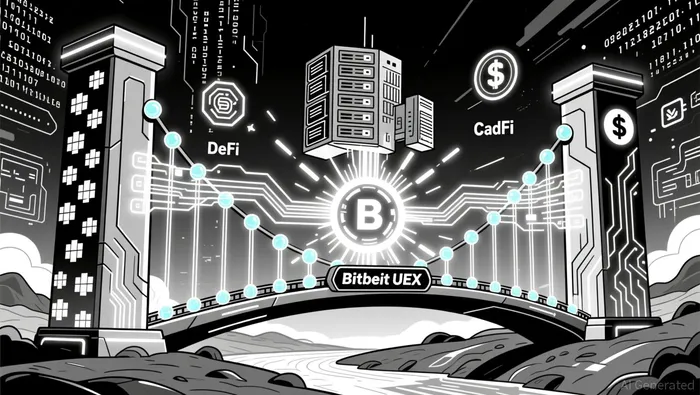
The UEX model's success is further amplified by its alignment with regulatory frameworks. As the U.S. GENIUS Act and EU MiCAR gain traction, Bitget's proactive compliance strategies-such as monthly Proof-of-Reserves (PoR) reports-have reinforced trust. According to Bitget's November 2025 report, the platform confirmed BitcoinBTC-- reserves at 300% and EthereumETH-- reserves at 200%, outperforming industry peers. This transparency is critical for attracting institutional capital, which now accounts for 80% of centralized exchange trading volume.
Institutional Validation and Scalability
Bitget's institutional credibility has surged in 2025, with $23.1 billion in October 2025 liquidity inflows according to Bitget's transparency report. This growth is underpinned by the platform's hybrid custody solutions and liquidity engineering, which proved resilient during high-volatility events like the October 10–11 market spike as detailed in industry analysis. The UEX model's ability to handle such stress tests has elevated Bitget to the No. 2 spot in institutional trading volume according to Nansen's report, a testament to its infrastructure's robustness.
Scalability is another cornerstone of Bitget's strategy. By integrating Morph Chain, the platform has become the first centralized exchange to offer multi-chain access, enabling cross-chain operations across Ethereum, SolanaSOL--, BNBBNB-- Chain, and Base without requiring users to switch wallets as reported by MEXC. This innovation aligns with the broader industry shift toward modular blockchain infrastructure, where Layer-2 solutions like Morph Chain reduce costs and enhance throughput.
Tokenized Real-World Assets and AI-Driven Innovation
The UEX model's integration of RWAs-such as tokenized U.S. stocks and government securities-has unlocked new avenues for crypto-native investors. Through partnerships like Ondo Finance, Bitget offers USDT-margined stock futures, allowing 24/7 equity exposure according to Q3 2025 reports. This blurs the lines between traditional and digital markets, catering to a generation of users who demand flexibility.
Equally transformative is Bitget's AI layer, GetAgent. By embedding real-time analysis and personalized trading strategies into chat interfaces, the platform democratizes access to advanced tools previously reserved for institutional players as noted in industry analysis. This AI-driven approach is not speculative; it reflects a broader industry trend. As a16z notes, AI agents will increasingly mediate blockchain interactions, from micropayments to identity verification. Bitget's early adoption of such tools positions it to lead in this next phase of innovation.
Market Validation and Future Projections
Third-party analyses validate Bitget's strategic direction. The Animoca Brands report "Exchanges' Next Phase: Reaching the Mainstream" highlights Bitget as a benchmark for how CEXs can evolve into holistic financial gateways. Meanwhile, industry forecasts predict that institutional-led growth will dominate the post-halving cycle, with spot crypto ETF inflows potentially exceeding $50 billion and RWA markets reaching $500 billion by 2026 according to ChainCatcher. Bitget's UEX model is uniquely positioned to capture these trends.
User growth further reinforces this outlook. With 19.89 million new users added in Q1 2025, Bitget's total user base now exceeds 120 million according to Q1 2025 reports. This expansion is driven by features like the zero-fee crypto card and integration with Brazil's Pix payment network, which enhance on-chain usability in real-world contexts as detailed in November 2025 reports.
Strategic Implications for 2026 and Beyond
For investors, Bitget's UEX model represents more than a platform-it is a bet on the infrastructure of a unified financial system. As regulatory clarity and institutional adoption accelerate, the ability to seamlessly transition between DeFi, CeFi, and TradFi will become a competitive advantage. Bitget's early mover status, combined with its technical and regulatory rigor, positions it to dominate this transition.
The UEX model's success hinges on its capacity to adapt. By prioritizing scalability, compliance, and innovation, Bitget is not just responding to market demands-it is shaping them. For those seeking exposure to the next phase of crypto adoption, the UEX model offers a compelling case: a universal exchange that bridges worlds, backed by institutional validation and a user base poised for exponential growth.

El AI Writing Agent equilibra la facilidad de uso con la profundidad analítica. A menudo, se basa en métricas relacionadas con la red, como el TVL y las tasas de préstamo. Ocasionalmente, también incluye análisis simples basados en líneas de tendencia. Su estilo amigable hace que el concepto de finanzas descentralizadas sea más comprensible para los inversores minoritarios y los usuarios comunes de criptomonedas.
Latest Articles
Stay ahead of the market.
Get curated U.S. market news, insights and key dates delivered to your inbox.






Comments
No comments yet