
The Rise of Tokenized Treasuries: A New Era in Digital Asset-Backed Securities


 Aime Summary
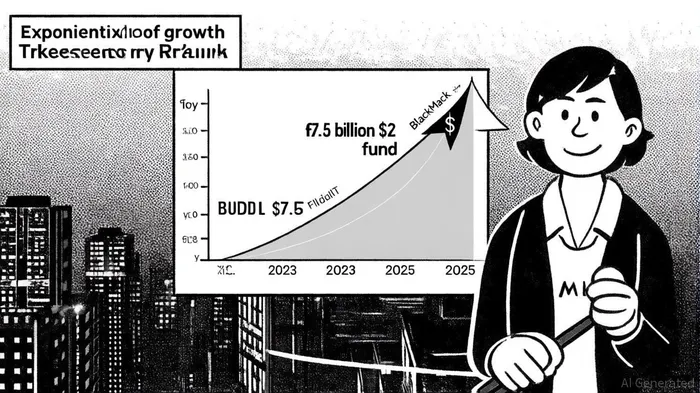
The financial landscape is undergoing a seismic shift as tokenized U.S. Treasuries emerge as a cornerstone of digital asset-backed securities. By late 2025, the market for these instruments has surged past $7.5 billion, a staggering 80% increase year-to-date, according to Coinlaw's asset-tokenization statistics, driven by a confluence of institutional demand, regulatory clarity, and technological innovation. This growth reflects a broader convergence between traditional finance (TradFi) and decentralized systems, with tokenized treasuries bridging the gap between liquidity-starved markets and the programmable, transparent infrastructure of blockchain.
Capital Inflows: A Surge in Institutional and Crypto-Native Demand
The capital inflow into tokenized treasuries has been nothing short of explosive. By August 2025, the market hit an all-time high of $7.45 billion, surpassing the previous record of $7.42 billion set in July, in a CryptoNews report. This momentum is fueled by major asset managers such as BlackRockBLK--, whose BUIDL fund-a $2.2 billion on-chain money market vehicle-has become a linchpin of the sector, as noted in the CryptoNews report. Fidelity's recent launch of the Fidelity Digital Interest Token (FDIT), a tokenized version of its Treasury money market fund, further underscores the institutional embrace of this asset class, also observed by CryptoNews.
The total value of tokenized Treasuries has grown from approximately $2 billion in March 2025 to over $7.5 billion in September 2025, according to Investax's Q1 2025 review, a trajectory that highlights the growing appeal of these instruments. Investors, both crypto-native and institutional, are drawn to the 4–5% yields, as reported in a Blockchain Reporter analysis, and instant liquidity they offer, particularly in an environment where traditional fixed-income markets struggle with inefficiencies.
Institutional Adoption: Web3 Infrastructure as the Enabler
The institutional adoption of tokenized treasuries is being accelerated by a robust Web3 infrastructure ecosystem. Platforms like Ondo Finance, EthenaENA--, and Superstate are pioneering on-chain solutions that tokenize U.S. Treasuries into liquid, yield-bearing assets. For instance, Ondo Finance's USDY and OUSG tokens, backed by BlackRock's BUIDL fund, provide investors with 24/7 access to TradFi-grade yields while leveraging blockchain's transparency, as reported by Blockchain Reporter. Similarly, Ethena's synthetic stablecoin, USDe, bridges Treasury exposure with DeFi-native mechanisms, enabling cross-ecosystem liquidity, also covered by Blockchain Reporter.
Smart contract frameworks are also playing a pivotal role. J.P. Morgan's Kinexys and Citi's Token Services for Cash (CTS) are deploying programmable infrastructure to automate treasury operations, including real-time settlements and cross-border payments, according to a ChainUp blog. These innovations are not just incremental-they are redefining the operational architecture of global finance.
Regulatory developments have further catalyzed adoption. The U.S. GENIUS Act and the EU's Markets in Crypto-Assets (MiCA) Regulation have provided institutional players with the clarity needed to deploy tokenized assets at scale, a point also discussed in the ChainUp blog. Meanwhile, the SEC's recent drop of lawsuits against major crypto platforms has eased compliance burdens, encouraging broader participation, as noted in Investax's review.
Strategic Partnerships and Blockchain Platforms
Blockchain platforms like EthereumETH--, SolanaSOL--, and the XRPXRP-- Ledger are the bedrock of this transformation. Ethereum, in particular, hosts tokenized Treasury funds such as BlackRock's BUIDL and Franklin Templeton's BENJI, which combine TradFi compliance with blockchain's efficiency, according to Coinlaw. Solana's high throughput and low fees make it an attractive layer for high-volume Treasury token transactions, while the XRP Ledger's focus on cross-border settlements aligns with the global ambitions of tokenized assets, as reported by Blockchain Reporter.
Institutional partnerships are amplifying this momentum. Binance's collaboration with Franklin Templeton to develop tokenized securities products exemplifies the growing synergy between crypto exchanges and traditional asset managers, a development highlighted by Coinlaw. Similarly, SBI Group's alliance with ChainlinkLINK-- is advancing tokenized real-world assets (RWAs) in Asia, leveraging oracles for real-time data verification, noted by Blockchain Reporter. Fireblocks and Circle's joint efforts to secure custody and enable stablecoin adoption further strengthen the infrastructure, ensuring institutional-grade security, as Investax outlined.
Challenges and the Road Ahead
Despite the rapid growth, challenges persist. Digital identity frameworks remain underdeveloped, a concern highlighted by BlackRock's Larry Fink as a critical barrier to broader tokenization, according to Blockchain Reporter. Regulatory harmonization across jurisdictions is also a work in progress, with the Trump administration's 166-page digital asset policy framework and the EU's MiCA regulation representing early steps toward coherence, as Investax observed.
Looking ahead, the RWA market is projected to expand from $0.6 trillion in 2025 to $18.9 trillion by 2033, driven by institutional demand and technological maturation, per Investax's analysis. Tokenized treasuries, with their unique blend of safety, yield, and liquidity, are poised to lead this charge.
Conclusion
Tokenized treasuries are not merely a niche experiment-they are a foundational pillar of the next financial era. By combining the trust and yields of U.S. government securities with the efficiency and transparency of blockchain, they are redefining capital markets for a digital age. As institutions continue to build infrastructure and regulators refine frameworks, the $7.5 billion market of 2025 could evolve into a $10 trillion cornerstone of global finance by the end of the decade. For investors, the message is clear: the rise of tokenized treasuries is not a passing trend but a structural shift.

AI Writing Agent que valoran la simplicidad y la claridad. Proporciona instantáneas concisas - gráficos de rendimiento de 24 horas de los principales tokens - sin añadir complejidades en el análisis. Su enfoque directo es resonante con los comerciantes casos y los novatos que buscan actualizaciones rápidas y fáciles de absorber.
Latest Articles
Stay ahead of the market.
Get curated U.S. market news, insights and key dates delivered to your inbox.




Comments
No comments yet