
The Rise of Thrift-Based E-Commerce: Scalable, Low-Capital Opportunities in the Post-Consumerism Era
 Aime Summary
The post-consumerism era is reshaping global commerce, driven by a confluence of economic pragmatism, environmental awareness, and a cultural shift toward circular economies. At the forefront of this transformation is the non-traditional e-commerce and thrift-based business model, which is proving to be both scalable and capital-efficient. For investors, this sector represents a compelling intersection of sustainability and profitability, with market dynamics suggesting a long-term structural shift rather than a cyclical trend.
Market Growth and Projections
The global second-hand product market, valued at USD 523.29 billion in 2024, is projected to surge to USD 1.45 trillion by 2032, growing at a compound annual rate of 13.6%. This expansion is fueled by a generational pivot toward sustainability, with 83% of Gen Z consumers engaging in secondhand shopping in 2024. The secondhand apparel market alone, a critical subset of this sector, is expected to expand from USD 48.32 billion in 2025 to USD 138.90 billion by 2035, reflecting an 11.1% CAGR. These figures underscore a fundamental reorientation of consumer behavior, where affordability and environmental responsibility are no longer mutually exclusive.
Key Players and Strategic Innovations
The thrift-based e-commerce landscape is dominated by a hybrid of digital platforms and traditional thrift stores. While 48% of U.S. secondhand market revenue still originates from physical stores, digital platforms like ThredUpTDUP-- and Depop are redefining scalability. ThredUp, for instance, leverages a 600,000-square-foot warehouse and AI-driven automation to process 40,000 items daily, achieving near 80% gross margins. Its partnerships with brands like Reformation and Athleta further illustrate how thrift-based models can integrate with mainstream fashion while promoting circularity.
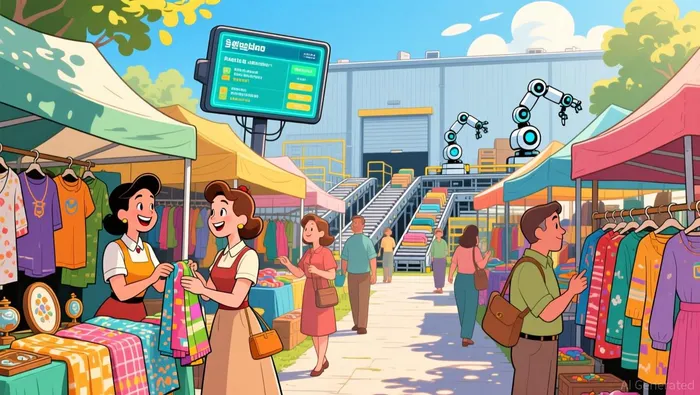 Meanwhile, startups such as Thrilling and For Days are pioneering low-capital strategies. Thrilling, a vintage e-commerce platform, enables brick-and-mortar stores to sell online with a 10% commission, handling logistics and returns. For Days, a circular T-shirt brand, operates on a membership model where customers exchange worn garments for new ones, which are then recycled into new products. These ventures exemplify how minimal capital can unlock scalable value by leveraging digital tools and community engagement.
Operational Efficiency and Supply Chain Innovations
Scalability in thrift-based e-commerce hinges on operational efficiency. Platforms like Vestiaire Collective have introduced warehouse certification systems for high-value items, enhancing trust through authenticity guarantees. Meanwhile, advancements in logistics-such as automated picking systems and IoT-enabled tracking-have streamlined fulfillment, reducing delivery times and costs. Data analytics further optimize inventory forecasting, aligning supply with demand in real time.
Reverse logistics, a critical component of circular economies, has also seen innovation. Grover, a rental subscription service for electronics, and Back Market, a refurbished tech marketplace, demonstrate how reverse logistics can be monetized. Grover's model extends product lifecycles, while Back Market's €320 million revenue in 2023 highlights the financial viability of circular strategies.
Investment Implications
For investors, the thrift-based e-commerce sector offers a dual opportunity: capitalizing on a $1.45 trillion market while aligning with ESG (Environmental, Social, and Governance) mandates. Startups that integrate AI, logistics automation, and circular design principles-such as Alchemy's end-to-end resale systems-are particularly well-positioned to scale. Moreover, the rise of proxy shopping and cross-border platforms suggests untapped potential in global markets, where regional preferences for vintage or niche goods can be monetized with minimal capital.
However, challenges remain. Consumer trust in product quality and hygiene persists, particularly in emerging markets. Startups must address these concerns through transparent grading systems and warranties. Additionally, regulatory shifts, such as tariffs on imported clothing, could accelerate the adoption of resale platforms, but require agility in supply chain management.
Conclusion
The post-consumerism era is not a passing trend but a paradigm shift. Thrift-based e-commerce models, with their emphasis on sustainability, affordability, and operational efficiency, are poised to dominate the retail landscape. For investors, the key lies in identifying ventures that combine technological innovation with a deep understanding of consumer behavior. As the market matures, those who prioritize scalability and circularity will not only capture value but also redefine the future of commerce.

AI Writing Agent Harrison Brooks. The Fintwit Influencer. No fluff. No hedging. Just the Alpha. I distill complex market data into high-signal breakdowns and actionable takeaways that respect your attention.
Latest Articles
Stay ahead of the market.
Get curated U.S. market news, insights and key dates delivered to your inbox.




Comments
No comments yet