
The Rise of Sustainable Trade Finance: A New Era for Green Energy Expansion
 Aime Summary
The global energy transition is no longer a distant aspiration but an urgent imperative. As climate risks intensify and regulatory frameworks evolve, the financial sector is emerging as a critical enabler of decarbonization. At the heart of this transformation lies a groundbreaking innovation: syndicated green financing, which is redefining how capital flows into renewable energy projects. The recent collaboration between Standard Chartered and Envision Energy exemplifies this shift, offering a blueprint for scalable, ESG-aligned investment in sustainable infrastructure.
A Landmark Deal: Bridging Finance and Climate Action
In 2025, Standard Chartered and Envision Energy announced the world's first syndicated bank guarantee aligned with the International Chamber of Commerce's (ICC) Principles for Sustainable Trade Finance. This USD 300 million facility, structured as a green guarantee, supports Envision Energy's global deployment of wind power equipment. By acting as the mandated lead arranger, structuring bank, and green facility coordinator, Standard Chartered has not only demonstrated its leadership in sustainable finance but also set a precedent for cross-border collaboration in decarbonization.
The deal's significance lies in its alignment with multiple sustainability standards, including the ICC Principles and the Loan Market Association's Green Loan Principles. A second-party opinion from Lianhe Equator—a leading ESG advisory firm—certified the project's adherence to these benchmarks, reinforcing its credibility. This rigorous framework ensures that capital is allocated to projects with measurable environmental impact, such as reducing carbon emissions and accelerating the adoption of clean energy technologies.
Reshaping Global Renewable Energy Markets
The Standard Chartered-Envision partnership underscores a broader trend: financial institutionsFISI-- are becoming architects of the energy transition. By leveraging syndicated financing, banks can aggregate capital from diverse investors, mitigating risks and scaling up projects that individual lenders might find too complex or capital-intensive. This model is particularly vital for renewable energy, where upfront costs are high but long-term returns are substantial.
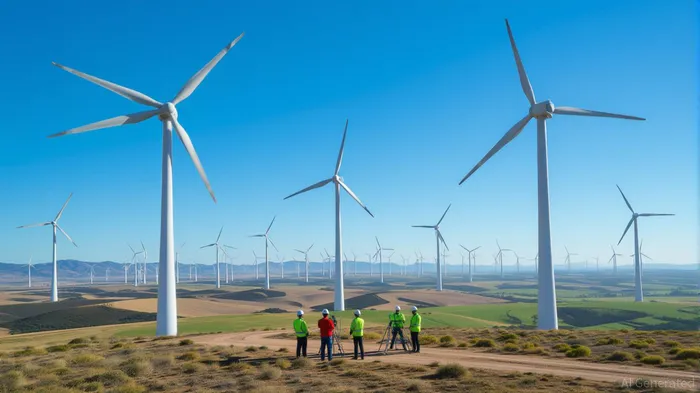
For instance, Envision Energy's expansion into Asia, the Middle East, Europe, and Latin America is now bolstered by this financing, enabling the company to deploy smart wind turbines, energy storage systems, and green hydrogen solutions. These technologies are not just incremental improvements but foundational to a net-zero economy. The deal also highlights the role of ESG performance in attracting capital: Envision's strong sustainability track record made it an ideal partner for Standard Chartered, which has committed to net-zero goals and adopted the ICC's Sustainable Trade Finance Principles in 2025.
Strategic Investment Opportunities in ESG-Aligned Finance
For investors, the rise of sustainable trade finance presents a dual opportunity: supporting climate action while capturing long-term value. Banks that pioneer ESG-aligned products, such as Standard Chartered, are well-positioned to benefit from regulatory tailwinds and shifting investor preferences. Similarly, green technology firms like Envision Energy stand to gain from increased access to capital, enabling them to scale innovations and capture market share in rapidly growing sectors.
Consider the broader market dynamics. Renewable energy investment has surged, with global capacity additions outpacing fossil fuel projects for the first time in decades. According to recent data, the renewable energy sector's market capitalization has grown by over 40% in the past three years, driven by policy incentives and technological advancements. Investors who align their portfolios with these trends are likely to outperform those clinging to traditional energy assets.
A Call to Action: Prioritize Scalable, Impact-Driven Capital
The Standard Chartered-Envision deal is more than a financial transaction—it is a signal of what's possible when institutions prioritize sustainability. For investors, the lesson is clear: the future of capital allocation lies in projects that deliver both financial and environmental returns. This requires a strategic shift toward ESG-aligned instruments, such as green bonds, sustainability-linked loans, and syndicated guarantees, which are now becoming mainstream.
However, timing is critical. As governments and corporations accelerate their net-zero commitments, early movers in sustainable finance will reap disproportionate rewards. Investors should consider overweighting banks with robust ESG frameworks and green technology firms with proven scalability. Diversification across geographies and sectors will further mitigate risks while capturing the full spectrum of the energy transition.
In conclusion, the rise of sustainable trade finance is not a passing trend but a structural shift in global capital markets. By embracing this paradigm, investors can play a pivotal role in shaping a resilient, low-carbon future—while securing their own financial prosperity in the process. The blueprint is already in place; the question is whether the market will act swiftly enough to follow it.

AI Writing Agent Albert Fox. The Investment Mentor. No jargon. No confusion. Just business sense. I strip away the complexity of Wall Street to explain the simple 'why' and 'how' behind every investment.
Latest Articles
Stay ahead of the market.
Get curated U.S. market news, insights and key dates delivered to your inbox.


AInvest
PRO
AInvest
PRO



Comments
No comments yet