
The Rise of Structured Clean Energy Markets and the Role of REsurety's CleanTrade
 Aime Summary
The Emergence of Structured Clean Energy Markets
Structured clean energy markets are centralized, transparent platforms designed to facilitate the trading of renewable energy contracts such as Virtual Power Purchase Agreements (vPPAs), physical Power Purchase Agreements (PPAs), and Renewable Energy Certificates (RECs). Historically, these markets were fragmented, with bilateral transactions plagued by opaque pricing, limited liquidity, and high counterparty risk. CleanTrade, launched in 2025, has disrupted this status quo by offering real-time data, automated workflows, and compliance-ready tools, enabling faster deal execution and reducing transaction costs according to the IEA report.
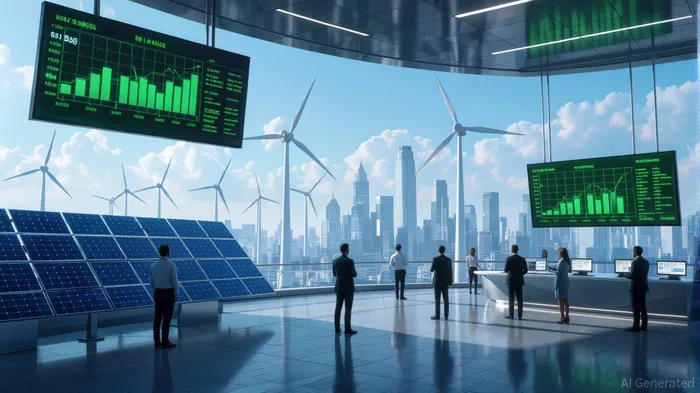 The platform's success is underscored by its rapid adoption: within two months of operation, CleanTrade facilitated $16 billion in notional value, a testament to growing institutional demand for ESG-aligned investments. By providing a regulated, data-driven infrastructure, CleanTrade addresses critical pain points such as price volatility and regulatory complexity, making clean energy assets more accessible to a broader range of investors.
Growth Drivers: From Market Volatility to AI Integration
The expansion of structured clean energy markets is fueled by several interrelated factors. First, the rapid deployment of renewable energy has introduced volatility into energy markets. As thermal plants retire faster than replacements are installed, reserve margins have tightened, creating uncertainty in supply and pricing. Clean energy derivatives, such as those traded on CleanTrade, allow market participants to hedge against these risks through tools like short-term hedging and real-time optimization according to industry analysis.
Second, the rise of data centers-projected to consume 11.7% of U.S. power demand by 2030-is reshaping load curves and creating demand for flexible, long-term energy contracts according to market research. This trend is particularly relevant for corporations seeking to decarbonize their operations while managing energy costs. CleanTrade's ability to facilitate tailored vPPAs and RECs positions it as a critical enabler for these entities.
Third, geopolitical tensions and shifting policies are redirecting capital toward energy security and affordability. For instance, China's dominance in next-generation energy technologies-from solar panels to energy storage-is influencing global supply chains, while India's ambitious clean energy targets are creating new markets for investment. Meanwhile, the integration of AI in energy forecasting is becoming essential, as AI models improve the accuracy of demand and price predictions.
Market Size and Projections: A $125 Trillion Opportunity
The clean energy derivatives market is poised for exponential growth. By 2025, it is projected to reach $39 trillion, with a further surge to $125 trillion by 2032, driven by institutional adoption and regulatory advancements. CleanTrade's CFTC approval as a SEF has been a pivotal milestone, addressing fragmentation and boosting liquidity in a sector historically constrained by bilateral negotiations.
Regionally, the Asia-Pacific region is expected to dominate, holding over 55% of the global renewable energy market share in 2025, fueled by China's combined solar and wind capacity of 1,400 GW. North America, meanwhile, is forecasted to grow at a compound annual rate of 12.7%, with the U.S. renewable energy market expanding from 481.5 GW in 2025 to 893.2 GW by 2032 according to market analysis. Europe's steady growth, led by Germany, Spain, and the U.K., is underpinned by policy support and increased solar photovoltaic construction according to market insights.
Investor Participation: Volatility and Policy Uncertainty
Despite the sector's promise, investor participation has shown volatility. In Q2 2025, U.S. renewable energy investments dropped by 36% compared to the latter half of 2024, partly due to policy shifts under the Trump administration. However, the Inflation Reduction Act (IRA) has counterbalanced these headwinds by incentivizing domestic manufacturing. For example, Section 45X of the IRA has spurred $60 billion in clean technology manufacturing investments in 2024, with 161 facilities operational by Q1 2025.
Yet challenges persist. Tariff escalations and regulatory uncertainty have led to project cancellations, such as six projects representing $6.9 billion in investment being scrapped in Q1 2025. These risks highlight the importance of platforms like CleanTrade, which mitigate counterparty risk through standardized contracts and real-time compliance tools.
Opportunities and Challenges for Investors
For investors, the clean energy derivatives ecosystem offers a dual opportunity: financial returns and environmental impact. The industrial sector, which accounts for 54.2% of the U.S. renewable energy market in 2025, is particularly attractive, as corporations seek to align with ESG goals while managing energy costs according to market research. CleanTrade's carbon impact assessment tools further enhance this alignment by quantifying the environmental benefits of each transaction according to IEA data.
However, success in this space requires navigating complex regulatory landscapes and technological shifts. For instance, the integration of AI in energy forecasting is still nascent, and early adopters may face higher implementation costs. Additionally, geopolitical risks-such as China's influence on supply chains-could disrupt market dynamics, necessitating diversified investment strategies.
Conclusion: A New Era for Clean Energy Finance
The rise of structured clean energy markets, spearheaded by platforms like CleanTrade, marks a paradigm shift in how renewable energy is traded and financed. With a projected $125 trillion market by 2032 and growing institutional participation, this sector presents a compelling opportunity for investors seeking to capitalize on the energy transition. However, the path forward is not without challenges, from policy volatility to technological complexity. For those who can navigate these hurdles, the rewards are substantial: a chance to align financial performance with planetary sustainability while tapping into one of the most dynamic markets of the 21st century.

Blending traditional trading wisdom with cutting-edge cryptocurrency insights.
Latest Articles
Stay ahead of the market.
Get curated U.S. market news, insights and key dates delivered to your inbox.


AInvest
PRO
AInvest
PRO



Comments
No comments yet