
The Rise of Stablecoin Yields: How Coinbase USDC APY is Reshaping Institutional and Retail Investment Strategies


 Aime Summary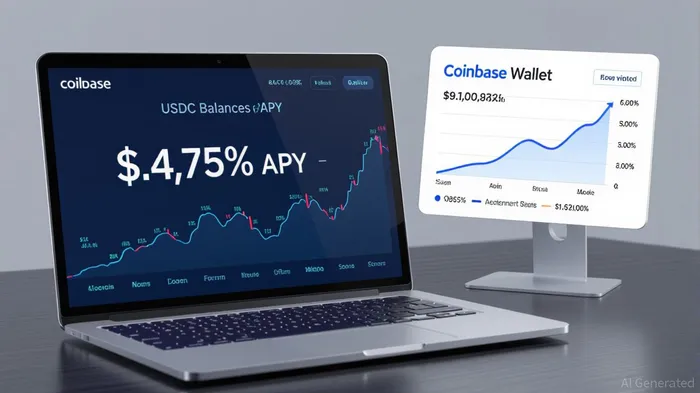
In 2025, the digital asset landscape is undergoing a seismic shift as stablecoins transition from mere transactional tools to foundational pillars of yield generation. At the forefront of this transformation is Coinbase's USDCUSDC-- Annual Percentage Yield (APY) program, which has become a linchpin for both institutional and retail investors seeking stable, high-return alternatives to traditional banking. With macroeconomic headwinds and regulatory clarity converging, the surge in demand for USDC-based yields signals a paradigm shift in how capital is allocated across digital and traditional finance.
Regulatory Clarity Fuels Institutional Adoption
The U.S. Guiding and Establishing National Innovation for US Stablecoins Act (GENIUS Act) and the EU's Markets in Crypto-Assets (MiCA) framework have been pivotal in legitimizing stablecoins as regulated financial instruments. These frameworks mandate 100% reserve backing for stablecoins like USDC, ensuring transparency and mitigating the risks of insolvency that plagued earlier stablecoins. For institutions, this regulatory clarity has eliminated a critical barrier to entry.
Goldman Sachs and BlackRockBLK--, for instance, have launched stablecoin-backed funds, with Goldman's Stablecoin Reserves Fund now holding $79.2 billion in collateral, 80% of which is USDC. This institutional validation is not accidental. The GENIUS Act's prohibition on yield-bearing stablecoins (a restriction that applies to the stablecoins themselves, not the platforms that generate yields on behalf of users) has redirected capital flows toward intermediaries like CoinbaseCOIN--, which offer APYs through lending, staking, and DeFi integrations.
Coinbase's 4.10% APY for USDC on its centralized exchange and 4.7% APY in the Coinbase Wallet have attracted $41.9 billion in balances, a 39% quarter-over-quarter increase. This growth is driven by institutions seeking to capitalize on the yield gap between traditional savings accounts (which average 0.50% APY) and Coinbase's offerings. For example, the 4.7% APY in the Coinbase Wallet—distributed monthly on the Base blockchain—has drawn 60% of new U.S. users to the platform, reflecting a broader appetite for passive income strategies.
Yield Innovation: From APY to Yield Stacking
While Coinbase's base APYs are compelling, the real innovation lies in yield stacking—layering multiple strategies to compound returns. Institutions and advanced investors are combining Coinbase's APY with DeFi protocols like AaveAAVE-- and Ethena to generate additional returns. By depositing USDC into Aave's lending pools, users earn an extra 2–3% in interest, pushing total returns to ~7%. More aggressive strategies, such as converting USDC into liquid-staked EthereumETH-- (stETH) via LIDO and then wrapping those assets into platforms like Merkl for governance token rewards, can yield up to 12.2% APY.
This innovation is not limited to speculative DeFi. Projects like Ondo Finance's USDY token—a yield-bearing version of USDC—have attracted $472 million in real-world asset (RWA) supply, demonstrating the expanding utility of stablecoins in institutional-grade applications. Meanwhile, cross-border payroll solutions like BiGGER's onchain platform are leveraging USDC to reduce costs by 50%, further cementing its role as a cash-equivalent in global finance.
Macro Trends Driving Demand
The surge in USDC APY demand is underpinned by three macroeconomic forces:
- Yield Starvation in Traditional Markets: With U.S. banks offering sub-1% APYs and global interest rates remaining subdued, investors are flocking to stablecoin yields. The 4.35% APY on USDC (as of August 2025) outperforms traditional savings accounts by over 400 basis points.
- Regulatory Tailwinds: The GENIUS Act's requirement for stablecoin reserves to be held in U.S. Treasuries has created a $1 trillion demand for short-duration sovereign debt, indirectly boosting Treasury markets.
- Global Dollarization: USD-backed stablecoins now account for 99% of total AUM, reinforcing the dollar's dominance in digital finance. Emerging markets are adopting USDC for cross-border transactions, further expanding its utility.
Circle, the issuer of USDC, has capitalized on this momentum. Its public market debut in June 2025 saw a 750% surge in stock price within a month, while USDC's market cap expanded to $65.2 billion. This growth reflects investor confidence in the stablecoin's role as a bridge between traditional and digital finance.
Risks and Strategic Considerations
While the opportunities are vast, investors must remain cognizantCTSH-- of risks:
- Smart Contract Vulnerabilities: DeFi protocols like Aave and LIDO carry smart contract risks, though Coinbase's institutional-grade infrastructure mitigates many of these.
- Regulatory Uncertainty: The GENIUS Act's prohibition on yield-bearing stablecoins could evolve, potentially disrupting layered yield strategies.
- Market Volatility: While USDC is pegged to the dollar, DeFi-based strategies (e.g., stETH) expose investors to crypto market fluctuations.
For conservative investors, Coinbase's base APYs offer a low-risk entry point. For those seeking higher returns, yield stacking with DeFi protocols provides a path to compounding, albeit with increased complexity.
Strategic Entry Point for Diversified Portfolios
The convergence of regulatory clarity, macroeconomic demand, and yield innovation positions USDC-based returns as a strategic asset class. For investors seeking diversification, allocating a portion of capital to USDC APY programs—whether through Coinbase or DeFi—offers a hedge against traditional market volatility while generating consistent income.
Moreover, the integration of stablecoins into institutional portfolios (e.g., Goldman's Stablecoin Reserves Fund) signals a broader acceptance of digital assets as core components of modern finance. As the U.S. Treasury forecasts stablecoin demand for T-bills to reach $1 trillion by 2028, early adopters stand to benefit from both yield generation and capital appreciation in the stablecoin ecosystem.
In conclusion, the rise of Coinbase USDC APY is not merely a product of favorable rates—it is a symptom of a larger shift toward onchain finance. For investors, this represents a unique opportunity to participate in a system where stablecoins are no longer speculative but foundational, offering a blend of stability, yield, and innovation that traditional markets cannot match.

Blending traditional trading wisdom with cutting-edge cryptocurrency insights.
Latest Articles
Stay ahead of the market.
Get curated U.S. market news, insights and key dates delivered to your inbox.
AInvest
PRO
AInvest
PRO



Comments
No comments yet