
The Rise of Stablecoin Yield: How Coinbase's USDC APY is Reshaping Passive Income in the Post-DeFi Era
 Aime Summary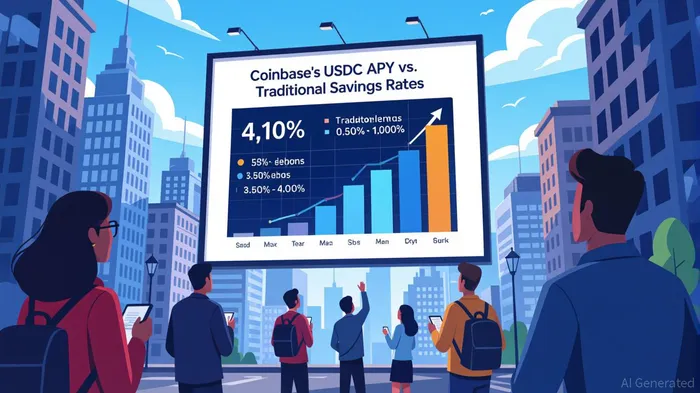
In the post-DeFi era, where volatility and complexity have tempered the initial euphoria of decentralized finance, stablecoins have emerged as a pragmatic bridge between traditional and digital asset ecosystems. Coinbase's recent 4.10% APY for USDC—a stablecoin pegged 1:1 to the U.S. dollar—exemplifies this shift, offering a compelling case study in revenue-generating stablecoin strategies. By enabling users to earn passive income with no lock-up periods or fees, CoinbaseCOIN-- is democratizing access to yield generation while catering to both retail and institutional demand for low-risk returns [1].
The Mechanics of Coinbase's USDCUSDC-- Yield Program
Coinbase's USDC yield program operates on a simple premise: users earn 4.10% annually by holding USDC in their Coinbase accounts [1]. This rate is competitive with traditional savings accounts, which typically offer 0.50%–1.00% APY in the U.S. and EU [2]. The program's accessibility—requiring as little as $1 in USDC to participate—lowers barriers for retail investors, while institutional clients can leverage Coinbase Prime or Coinbase Exchange to scale their exposure [1]. Crucially, the rewards are automatically applied to eligible balances, with no need for staking or liquidity provision, aligning with the post-DeFi ethos of simplicity and reliability [1].
For institutions, the program extends beyond mere yield generation. USDC's role in cross-border transactions and DeFi integration allows firms to streamline operations while mitigating volatility risks [1]. By pairing stablecoin yields with the efficiency of blockchain infrastructure, Coinbase is positioning USDC as a cornerstone of hybrid financial strategies that blend traditional and digital assets.
Implications for a Low-Interest-Rate Environment
The 4.10% APY offered by Coinbase is particularly significant in a global context where central banks have maintained historically low interest rates to stimulate post-pandemic economies. For example, the Federal Reserve's target range for the federal funds rate (5.25%–5.50% as of August 2025) contrasts sharply with the meager returns on cash deposits [2]. Stablecoin yields like Coinbase's USDC APY thus provide a tangible alternative for investors seeking to outpace inflation without exposing themselves to the risks of equities or cryptocurrencies.
Retail investors, in particular, benefit from the program's user-friendly design. Unlike traditional banking products, which often require minimum balances or complex account structures, Coinbase's offering is accessible via a mobile app, with rewards compounding daily [1]. This convenience, coupled with USDC's full backing by cash and U.S. Treasuries [1], addresses a critical pain point in the post-DeFi landscape: the need for trust and transparency in yield-generating assets.
Risks and Considerations
While the 4.10% APY is attractive, investors must remain cognizantCTSH-- of potential risks. First, Coinbase reserves the right to adjust the APY at any time, subject to market conditions and regulatory changes [1]. Second, the program's reliance on USDC's peg to the U.S. dollar means that any de-pegging event—though unlikely given the stablecoin's robust reserves—could erode returns. Finally, regulatory scrutiny of stablecoins remains a wildcard, with policymakers in the U.S. and EU increasingly focused on ensuring systemic stability [3].
Conclusion: A New Paradigm for Passive Income
Coinbase's USDC yield program underscores a broader trend: the convergence of traditional finance and blockchain-based solutions in the post-DeFi era. By offering a high-yield, low-risk product with minimal friction, Coinbase is not only attracting retail investors but also enabling institutions to integrate stablecoins into their portfolios. As interest rates remain subdued and digital assets mature, stablecoin yields like these will likely play an increasingly pivotal role in shaping the future of passive income strategies.
For investors, the key takeaway is clear: in a world where cash is king but yields are scarce, stablecoins like USDC—backed by platforms like Coinbase—offer a pragmatic path to generating returns without sacrificing safety or liquidity.
Source:
[1] Earn rewards by holding USDC on Coinbase, [https://www.coinbase.com/usdc]
[2] Federal Reserve Economic Data (FRED), [https://fred.stlouisfed.org]
[3] European Central Bank (ECB) Reports, [https://www.ecb.europa.eu]

Blending traditional trading wisdom with cutting-edge cryptocurrency insights.
Latest Articles
Stay ahead of the market.
Get curated U.S. market news, insights and key dates delivered to your inbox.




Comments
No comments yet