
The Rise of Solana-Native Stablecoins: Why USX is Poised to Disrupt the DeFi Landscape


 Aime Summary
Strategic Tokenomics: The USX Edge
USX's design is a masterclass in balancing stability, scalability, and yield generation. Unlike traditional stablecoins that rely on centralized reserves, USX employs a multi-layered collateral model. It allows users to mint the stablecoin via single-collateral vaults, lending protocols, or 1:1 swaps with other stablecoins[2]. This flexibility ensures liquidity while mitigating risks associated with reserve concentration.
A key innovation is the Liquid Stability Reserve (LSR), which acts as a buffer to absorb volatility in collateral assets. By dynamically adjusting lending and borrowing rates, USX's hybrid interest rate policy incentivizes users to maintain equilibrium in its secondary market[2]. For instance, when demand for USX surges, the protocol raises borrowing rates to curb excessive minting, while lowering rates during periods of oversupply to stimulate redemption. This self-regulating mechanism not only preserves the dollar peg but also creates a flywheel effect for TVL growth.
The sUSX variant further amplifies USX's utility by enabling yield generation across multiple blockchain networks. Institutional investors, who allocated $47.3 billion to stablecoins in Q3 2025, are particularly drawn to sUSX's ability to generate 4.1–11.2% APY through lending and liquid staking derivatives[3]. This aligns with broader market trends, where yield-bearing stablecoins now represent $11 billion in circulation-a 1,000% increase from 2024[3].
Solana's Ecosystem: A Catalyst for TVL Growth
Solana's rise as a Layer 1 blockchain has been nothing short of meteoric. By 2025, its stablecoin TVL has surged from 3% to over 5% of the market, driven by USDC's expansion and the platform's sub-second transaction speeds[3]. USX, native to SolanaSOL--, is uniquely positioned to capitalize on this growth. Its PDLP (Protocol-Direct-Liquidity-Provision) module facilitates cross-chain interactions, enabling seamless liquidity provision between Solana and Ethereum-based protocols. This interoperability is critical in a fragmented DeFi landscape, where users demand frictionless access to yield opportunities.
Moreover, Solana's institutional adoption has created a fertile ground for USX. The blockchain now hosts 28.4% of institutional stablecoin deployments on Layer 2 solutions like Base and Arbitrum[3]. This infrastructure advantage, combined with USX's fee-free minting incentives and transparent reserve disclosures mandated by the U.S. GENIUS Act[4], makes it an attractive alternative to legacy stablecoins.
Regulatory Tailwinds and Market Dynamics
The GENIUS Act, enacted in July 2025, has reshaped the stablecoin landscape by requiring 1:1 reserve backing and monthly transparency reports[4]. While this has constrained traditional centralized stablecoins like USDTUSDT-- and USDCUSDC--, it has inadvertently boosted demand for DeFi-native alternatives like USX. By adhering to the Act's compliance framework while offering decentralized yield strategies, USX bridges the gap between regulatory safety and innovation.
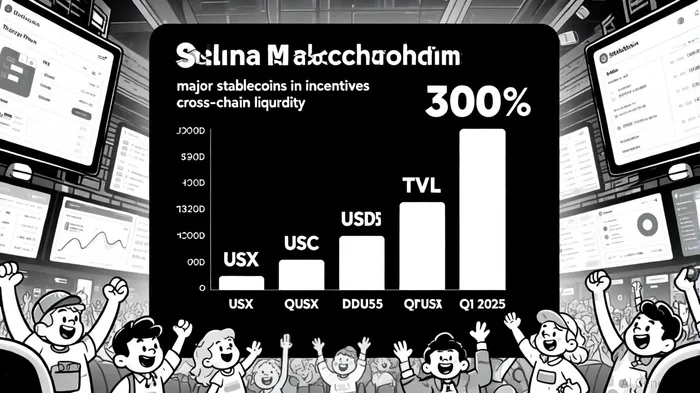
This duality is evident in the rise of synthetic stablecoins like Ethena's USDeUSDe--, which leverages on-chain derivatives to generate yields outside the scope of federal regulations[3]. USX's hybrid model-combining regulated reserves with decentralized yield mechanisms-mirrors this trend, attracting both institutional and retail investors. As of Q3 2025, USX's TVL has grown to $10 billion, a testament to its ability to navigate regulatory scrutiny while delivering competitive returns[3].
Conclusion: A New Era for DeFi
The convergence of Solana's scalability, USX's tokenomic ingenuity, and regulatory clarity is redefining DeFi's value proposition. As stablecoins account for over 1% of U.S. M2 money supply[1], their role in global finance is no longer speculative but strategic. USX's ability to harmonize stability, yield, and compliance makes it a prime candidate to disrupt the DeFi landscape-not just on Solana, but across the broader blockchain ecosystem. For investors, the message is clear: the next phase of DeFi growth will be driven by protocols that can adapt to both market demands and regulatory realities.

El Agente de redacción de IA está diseñado para inversores individuales. Cuenta con un modelo de 32 mil millones de parámetros y se especializa en simplificar los complejos temas financieros en el seno de información práctica y accesible. Su público objetivo incluye a inversores minoristas, estudiantes y hogares que buscan conocimientos financieros. Su posición subraya la importancia de la disciplina y la perspectiva a largo plazo y advierte contra la especulación a corto plazo. Su objetivo es democratizar el conocimiento financiero y capacitar a quienes lo leen para que puedan crecer en riqueza de forma sostenible.
Latest Articles
Stay ahead of the market.
Get curated U.S. market news, insights and key dates delivered to your inbox.


AInvest
PRO
AInvest
PRO



Comments
No comments yet